

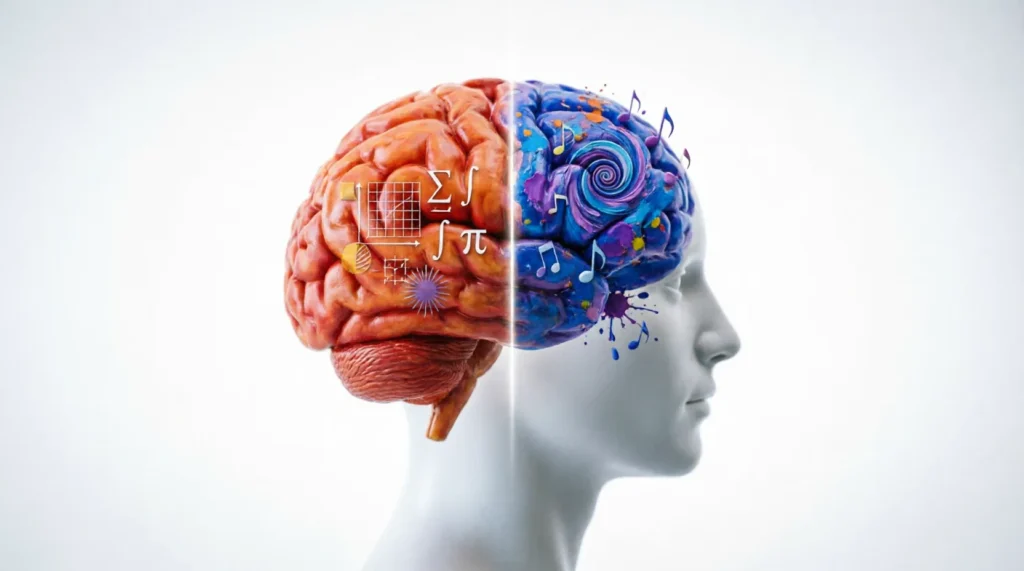
Quick answer: There is no scientifically valid “right or left brain test” that determines your personality, creativity, or logical ability. The idea that people are strictly “left-brained” (logical) or “right-brained” (creative) is a persistent neuromyth. While different brain hemispheres do specialize in certain functions, they work together constantly through a thick bundle of nerve fibers called the corpus callosum.
You have likely seen quizzes online promising to reveal whether you are a “left-brain thinker” or a “right-brain thinker.” These tests often ask you to choose between images, solve puzzles, or answer preference questions, then assign you a label. It is a compelling narrative: one side handles math and logic, while the other handles art and emotion. However, this binary classification is a significant oversimplification of how the human brain actually works. Understanding why this myth persists—and what neuroscience actually says—can help you stop worrying about which side “dominates” your thinking and start leveraging your whole brain’s potential.
| Term | Meaning / When to use | Example sentence |
|---|---|---|
| Left-Brained | A popular but inaccurate label for someone who is perceived as logical, analytical, and detail-oriented. | “He considers himself left-brained because he enjoys coding and data analysis.” |
| Right-Brained | A popular but inaccurate label for someone who is perceived as creative, intuitive, and artistic. | “She identifies as right-brained due to her passion for painting and improvisation.” |
| Hemispheric Specialization | The scientific term for the fact that certain cognitive processes are more active in one hemisphere than the other. | “Language processing often shows hemispheric specialization, with Broca’s area typically located in the left hemisphere.” |
| Corpus Callosum | The thick band of nerve fibers that connects the two cerebral hemispheres, allowing them to communicate. | “The corpus callosum ensures that visual information processed in the right hemisphere can be verbalized by the left.” |
When to use “Left-Brained”
In casual conversation, job interviews, or self-descriptions, people often use the term “left-brained” to describe a preference for structure, order, and linear reasoning. If you find yourself naturally drawn to spreadsheets, coding languages, or step-by-step instructions, you might describe yourself this way. It is a shorthand for saying, “I prefer logic over ambiguity.”
However, it is crucial to recognize that this is a metaphorical description of your preferences, not a biological diagnosis. You are not literally using only the left side of your brain. Even when you are solving a complex equation, your right hemisphere is actively involved in spatial reasoning and pattern recognition.
Here are examples of how this term appears in real-world contexts, along with the scientific reality behind them:
- Resume Summary: “Detail-oriented analyst with a left-brained approach to problem-solving.”
- Reality: This tells the hiring manager you value precision. It does not mean your right hemisphere is inactive. Your brain is integrating logical rules (left) with holistic context (right) to solve the problem efficiently.
- Classroom Discussion: “I’m too left-brained for creative writing; I prefer history dates.”
- Reality: This expresses a lack of confidence or interest in creative tasks, not a neurological limitation. Neuroplasticity means you can improve your creative writing skills with practice, regardless of your natural inclinations.
- Team Meeting: “Let’s get the right-brained creatives to brainstorm, and the left-brained planners to execute.”
- Reality: This divides teams based on a false dichotomy. Effective execution requires creativity (to solve unexpected problems), and effective brainstorming requires logic (to filter feasible ideas). Both halves of every team member’s brain are engaged in both tasks.
When to use “Right-Brained”
Similarly, “right-brained” is used to describe individuals who prioritize intuition, big-picture thinking, and artistic expression. If you prefer open-ended projects, visual learning, or emotional resonance over rigid structures, you might identify with this label. It suggests a comfort with ambiguity and a strength in synthesizing disparate ideas into new concepts.
Again, this is a description of style, not biology. When you paint a picture, your left hemisphere is hard at work helping you plan the composition, mix colors logically, and perhaps even read the instructions on the tube of paint. Creativity is not the exclusive domain of one hemisphere; it is a whole-brain activity.
Consider these common usage scenarios:
- Personal Bio: “Free-spirited designer with a right-brained mindset.”
- Reality: This signals that you value innovation and aesthetic appeal. It does not mean you are incapable of logical thought. In fact, good design requires rigorous logical constraints regarding usability and accessibility.
- Conflict Resolution: “Stop being so right-brained and look at the facts!”
- Reality: This is a dismissive comment implying that emotional or intuitive perspectives are invalid. It ignores the fact that “facts” are often interpreted through an intuitive lens, and emotional intelligence is a critical component of logical decision-making in social contexts.
- Learning Style: “I’m right-brained, so I need diagrams, not text.”
- Reality: While you may have a visual learning preference, this is not determined by hemisphere dominance. Many “visual” learners still process information linguistically. The best learning strategies engage multiple sensory and cognitive pathways simultaneously.
How to remember the difference
Since the “right vs. left” brain test is a myth, the most important thing to remember is that your brain works as a unified whole. However, if you need to recall the popular stereotypes associated with each side (for cultural literacy or understanding others’ self-perceptions), here is a simple mnemonic:
Left = Logic, Language, Linear. Right = Rhythm, Relationships, Recognition (of faces/spatial patterns).
But here is the editor-level insight that most quizzes miss: The corpus callosum is the hero. This thick bundle of over 200 million axonal fibers connects the two hemispheres. It allows them to share information almost instantly. When you read a joke, your left hemisphere decodes the words and grammar, while your right hemisphere understands the tone, sarcasm, and social context. Without the corpus callosum bridging the gap, you wouldn’t get the punchline. You would only have half the picture.
So, instead of asking “Which side am I?”, ask “How well are my hemispheres collaborating?” A healthy brain is not one that favors a side, but one that integrates both efficiently.
Common mistakes and exceptions
The biggest mistake people make is treating the left/right brain theory as a fixed personality trait. This leads to several harmful misconceptions:
- “I can’t be creative because I’m left-brained.” This is a self-limiting belief. Creativity involves making novel connections, a process that requires both logical knowledge (left) and associative thinking (right). Engineers, mathematicians, and programmers are often highly creative in their problem-solving approaches.
- “I’m bad at math because I’m right-brained.” Mathematical ability is not solely a left-hemisphere function. Geometry, calculus, and higher-level mathematics rely heavily on spatial visualization and abstract pattern recognition, which involve the right hemisphere. Struggling with math is usually a result of teaching methods or anxiety, not hemisphere dominance.
- Ignoring Individual Variability. While language centers are typically in the left hemisphere for right-handed people, this is not universal. Some left-handed people have language centers in the right hemisphere, or distributed across both. Furthermore, brain injury can cause other parts of the brain to take over functions lost in a damaged area, demonstrating incredible flexibility.
It is also worth noting the origin of this myth. The concept gained popularity in the 1960s and 70s after Roger Sperry’s research on split-brain patients (those who had their corpus callosum severed to treat epilepsy). His work showed that the hemispheres could function independently when disconnected. However, media outlets and self-help gurus exaggerated these findings, applying them to healthy brains where the hemispheres are firmly connected. As noted in historical contexts, the idea of lateralization has roots going back centuries, but modern neuroscience has moved far beyond the simple binary model. For a broader historical perspective on directional terms and their implications, one might look at how language itself evolves, such as the etymological roots found in resources like Right, which touches on the linguistic associations of “right” with correctness and authority, further fueling the cultural bias toward left-brain traits in some societies.
Frequently Asked Questions
Is there any scientific basis for left-brain vs. right-brain personality types? No. Modern neuroimaging studies (fMRI) show that both hemispheres are active during almost all cognitive tasks. There is no evidence that individuals have a dominant hemisphere that dictates their personality or learning style.
Why do I feel more logical or more creative depending on the day? This fluctuation is due to factors like sleep, stress, interest, and practice, not hemisphere switching. When you are well-rested and engaged, your whole brain functions better. Fatigue or anxiety can impair specific cognitive functions, making you feel less “sharp” in either logic or creativity.
Can I train my “weak” side? Since you don’t have a weak side, you should instead focus on training specific skills. If you want to be more creative, practice brainstorming and divergent thinking. If you want to be more logical, practice critical thinking and data analysis. These are skills, not biological defaults, and they can be improved by anyone at any age.
What should I do if a career counselor says I’m “right-brained”? Take it as feedback on your current interests and strengths, not as a biological limit. Use it to explore fields that value creativity, but do not rule out roles that require logic. Most modern jobs require a blend of both. Ask for specific skill assessments rather than broad hemisphere labels to get more actionable advice.

Kimberly Sanchez holds a Bachelor’s degree in Linguistics from UCLA and has spent over a decade working as a language consultant and educator. Her journey in the world of words began with a curiosity about how language shapes our perception of the world. With a keen eye for detail and a knack for making complex concepts accessible, Kimberly specializes in the nuances of English word comparisons and their real-world implications. She joined WordCompareHub to share her insights on frequently confused words and to promote a deeper understanding of language accuracy. Kimberly writes content that is both enlightening and practical, aimed at readers who seek to enhance their communication skills. Outside of her professional pursuits, she is an avid reader and enjoys exploring multilingual environments to observe linguistic diversity in action.