

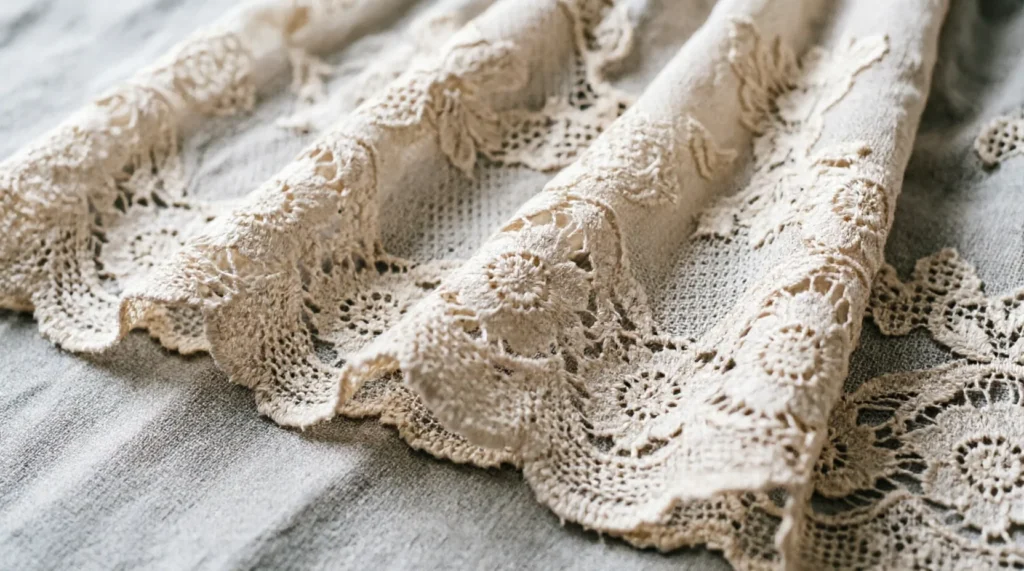
Quick answer: The correct spelling is lacy when describing delicate, lace-like fabric. “Lacey” is a proper name and should not be used to describe fabric texture.
If you’ve ever paused while writing about delicate textiles, wondering whether to type “lacy” or “lacey,” you’re not alone. This common spelling confusion trips up writers daily, from fashion bloggers to novelists describing a character’s wedding dress. The difference is straightforward once you understand the rule, but getting it wrong# Lacy or Lacey Fabric: The Correct Spelling for Delicate Textiles
Quick answer: Use lacy when describing fabric that resembles lace. Lacey is primarily a proper noun (a first name) and is incorrect when used as an adjective for textiles.
Writers frequently stumble over this pair because the sound is identical, and the visual similarity between “lacy” and “lacey” invites confusion. However, in professional editing and standard English usage, the distinction is rigid. If you are describing a curtain, a dress, or a trim that features the open, web-like pattern of lace, there is only one correct spelling. I have corrected thousands of manuscripts where authors mistakenly added an extra “e,” turning a descriptive adjective into what looks like a typo or a misplaced name. Understanding this difference ensures your writing looks polished and authoritative, whether you are drafting a fashion blog post or a product description for an e-commerce site.
| Term | Meaning / When to use | Example sentence |
|---|---|---|
| Lacy | Adjective describing something that resembles or is made of lace; used for fabrics, patterns, or delicate textures. | The bride chose a lacy veil to complement her vintage gown. |
| Lacey | Proper noun; almost exclusively used as a female first name. It is not standard as an adjective for fabric. | Lacey arrived at the fitting appointment ten minutes early. |
When to use lacy
The word lacy is the standard adjective derived from the noun “lace.” It describes anything that has the characteristics of lace: delicate, openwork, intricate, or semi-transparent. This term applies broadly beyond just fabric. You might describe a lacy frost pattern on a window, a lacy shadow cast by tree branches, or, most commonly, lacy fabric in clothing and home decor.
In the context of textiles, fabric refers to any flexible material consisting of a network of natural or artificial fibers. When those fibers are arranged in an open, decorative pattern reminiscent of traditional lacework, the correct descriptor is “lacy.” This spelling follows the standard English rule for forming adjectives from nouns ending in “e”: you typically drop the “e” and add “y.” Think of “ice” becoming “icy” or “noise” becoming “noisy.” The same logic applies here: “lace” becomes “lacy.”
Here are three concrete examples of how to use “lacy” correctly in professional and casual contexts:
- Product Description: “This summer blouse features lacy sleeves that provide breathability without sacrificing elegance.”
- Creative Writing: “The morning mist hung over the lake, creating a lacy veil that obscured the distant shore.”
- Interior Design Note: “We should replace the heavy drapes with lacy sheers to let more natural light into the living room.”
Using “lacy” signals to your reader that you understand the nuances of descriptive language. It is the go-to term for fashion editors, interior designers, and novelists who need to convey texture and delicacy. If you are writing about a garment that has cutouts, mesh details, or embroidered openwork, “lacy” is the precise word that captures that aesthetic.
When to use Lacey
The spelling Lacey is almost exclusively reserved for use as a proper noun. It is a common given name, particularly for women, though it can occasionally be found as a surname. You will see this spelling in bylines, character lists, social media handles, and personal introductions. It is not recognized by major style guides or dictionaries as a valid alternative spelling for the adjective describing lace-like textures.
If you encounter “Lacey” in a text, it should refer to a person. For instance, you might read about Lacey Chabert, an actress, or Lacey Sturm, a musician. In these cases, capitalizing the “L” is mandatory because it is a name. Using “Lacey” to describe a piece of cloth is a grammatical error that can distract readers and undermine the credibility of your writing. It looks like you have accidentally inserted a name into a sentence where an adjective belongs.
Consider these examples where “Lacey” is used correctly as a name:
- Email Signature: “Best regards, Lacey Thompson, Senior Editor.”
- Narrative Context: “Lacey insisted that the wedding invitations be sent out by Friday.”
- Social Media Caption: “Happy birthday to my best friend, Lacey! Here’s to another year of adventures.”
Note that even when referring to the name, consistency matters. Some individuals may spell their name “Laci,” “Lacie,” or “Lacy,” but “Lacey” is a distinct and common variation. Always respect the individual’s preferred spelling when referring to a specific person. However, never transfer this proper noun spelling to the general adjective. The moment you step away from referring to a specific human being named Lacey, you must revert to “lacy” for any descriptive purpose.
How to remember the difference
The most effective way to keep these two straight is to rely on a simple structural rule regarding English suffixes. When you turn a noun ending in a silent “e” into an adjective by adding “y,” you almost always drop the “e.”
- Ice + y = Icy (not Icey)
- Noise + y = Noisy (not Noisey)
- Lace + y = Lacy (not Lacey)
I tell my junior editors to think of the “e” as excess baggage. When you are describing a quality (the adjective form), you don’t need the extra letter. The “e” stays only when you are naming a person. Another helpful mnemonic is to associate the “e” in Lacey with “Entity” or “Everyone.” A name refers to a specific entity or person. If you are talking about a thing, a fabric, or a pattern, drop the “e.”
Additionally, consider the visual shape of the words. “Lacy” is shorter and lighter, much like the delicate fabric it describes. “Lacey” is heavier and longer, suitable for anchoring a name. If you are unsure, try substituting the word with “icy.” You would never write “icey snow,” so you should not write “lacey fabric.” This parallel structure is a reliable checkpoint for quick verification during proofreading.
Common mistakes and exceptions
The most frequent mistake I see is the hypercorrection of adding an “e” because the writer knows the root word is “lace.” They fear that dropping the “e” changes the pronunciation or loses the connection to the root. However, English orthography is consistent here. The pronunciation remains the same (/ˈleɪ.si/), but the spelling changes to adhere to adjectival conventions.
Another common error occurs in digital communication where autocorrect may interfere. Some predictive text algorithms might suggest “Lacey” if you have previously typed the name of a contact named Lacey. Always double-check your final draft. If you are describing a textile, ensure the suggestion hasn’t swapped your intended adjective for a proper noun.
There are no significant regional differences between US and UK English for this specific word. Both American and British standards prefer “lacy” for the adjective. You will not find “lacey” listed as an acceptable variant in Oxford English Dictionary or Merriam-Webster for the adjectival form. This uniformity makes it easier for global writers: the rule is absolute regardless of your audience’s location.
One edge case involves brand names. A company might choose to spell its brand name “Lacey Fabrics” for stylistic or trademark reasons. In such cases, you must respect the brand’s official styling. However, this is a proper noun exception, not a grammatical one. In your own prose, unless you are quoting the brand name directly, you should still use “lacy” to describe the products they sell. For example: “I bought a scarf from Lacey Fabrics, and the material was beautifully lacy.”
It is also worth noting that Lacey is a place name, such as Lacey, Washington. When referring to the city, you must use the capitalized “Lacey.” Confusing the city with the fabric adjective is rare but possible in poorly edited local news snippets. Always capitalize proper nouns and lowercase adjectives to maintain clarity.
Frequently Asked Questions
Is “lacey” ever correct when describing fabric? No, “lacey” is not a standard spelling for the adjective describing lace-like fabric. Use “lacy” for all descriptive purposes involving textiles, patterns, or textures.
Why do I see “lacey” used in some online stores? If you see “lacey” used as an adjective on a website, it is likely a typographical error or a result of poor editing. Occasionally, it may be part of a brand name or a specific product title chosen for stylistic reasons, but it is not grammatically correct in standard English.
Does the rule change if I am writing for a UK audience? No, the rule is the same in both US and UK English. “Lacy” is the correct adjective form in all major varieties of English, including Australian and Canadian English.
How do I know if I should capitalize “lacy”? Only capitalize “Lacy” if it is the first word of a sentence or part of a proper noun, such as a person’s name (e.g., Lacey Smith) or a place name (e.g., Lacey, Washington). When used as an adjective for fabric, it should always be lowercase unless it starts a sentence.

Nathan Williams is a seasoned editor and writer with a passion for the subtleties of the English language. With a degree in English from NYU and more than 12 years of editorial experience, he has honed his expertise in spelling accuracy and the comparison of often-misused words. Nathan’s foray into language analysis was sparked by his desire to help others communicate more effectively and avoid common pitfalls in writing. At WordCompareHub, he crafts comprehensive guides and articles that discuss word usage distinctions and provide effective spelling strategies. Nathan is driven by the belief that clarity in language is key to effective communication. In his leisure time, he enjoys crosswords and participates in local word games, continually expanding his lexicon and sharpening his linguistic skills.