

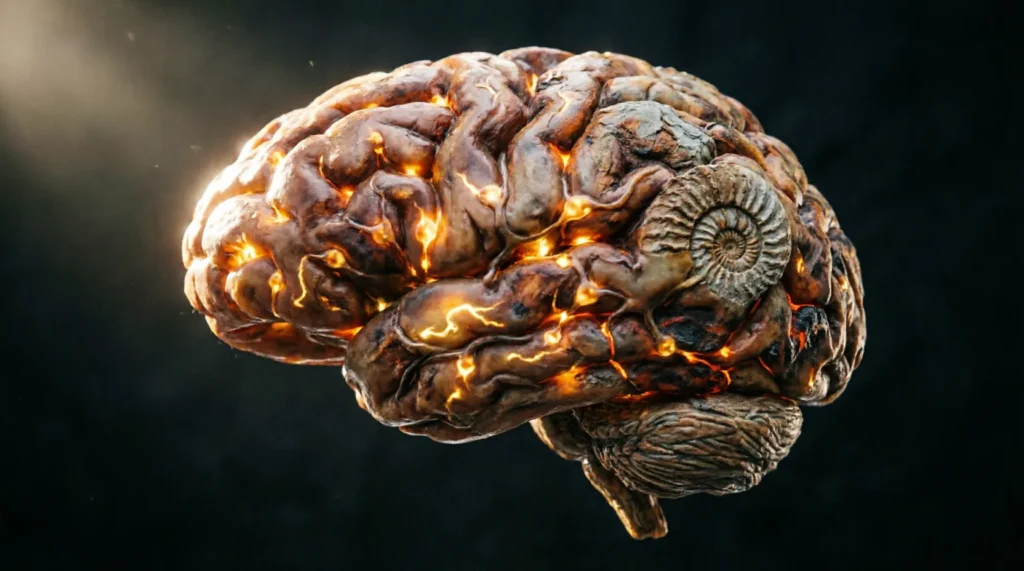
Quick answer: “Instinctual” is the correct adjective to describe behavior driven by innate, biological impulses. “Dinosaur brain” is not a standard grammatical term but a colloquial metaphor referencing the reptilian complex; it should never be used as a direct synonym for “instinctual” in formal writing.
Writers and speakers often confuse these terms because both relate to primal, automatic human responses. However, one is a precise linguistic descriptor found in dictionaries, while the other is a pop-psychology metaphor that lacks grammatical utility. Understanding this distinction prevents awkward phrasing in professional emails, academic papers, and editorial content.
| Term | Meaning / When to use | Example sentence |
|---|---|---|
| Instinctual | Use this adjective when describing actions, feelings, or reactions that are innate, automatic, and not learned. | Her instinctual reaction was to pull her hand back from the hot stove. |
| Dinosaur brain | Use this noun phrase only in informal contexts to metaphorically describe primitive, survival-based thinking (fight-or-flight). Do not use as an adjective. | He let his dinosaur brain take over during the argument, leading to an aggressive outburst. |
When to use instinctual
“Instinctual” is a standard English adjective derived from the noun “instinct.” It describes behaviors, responses, or knowledge that are inherent rather than acquired through experience or education. As noted in definitions regarding Instinctual behavior, these actions are biologically hardwired into an organism.
You should use “instinctual” when you need to modify a noun to indicate that the subject acted without conscious thought. It is the preferred term in psychology, biology, and formal literary analysis. Unlike “intuitive,” which implies a gut feeling based on subconscious pattern recognition, “instinctual” implies a deeper, evolutionary drive.
Here are three concrete examples of how to use this word correctly in professional and personal contexts:
- In a performance review: “The candidate demonstrated an instinctual understanding of client needs, anticipating problems before they were voiced.”
- In a creative writing piece: “The wolf’s instinctual fear of fire kept it at the edge of the campsite, despite its hunger.”
- In a medical report: “The infant displayed instinctual rooting reflexes immediately after birth, seeking nourishment without prior learning.”
Notice that in every case, “instinctual” functions as an adjective. It answers the question, “What kind of reaction/understanding/fear was it?” If you can replace the word with “innate” or “automatic,” then “instinctual” is the correct choice.
When to use dinosaur brain
The term “dinosaur brain” is not a scientific classification nor a standard grammatical unit. It is a colloquial metaphor often used in self-help literature and casual conversation to refer to the “reptilian complex” or the basal ganglia and brainstem. These areas of the brain control basic survival functions like breathing, heart rate, and the fight-or-flight response. While popular culture sometimes links this concept to actual Dinosaur anatomy, the phrase is purely metaphorical when applied to humans.
You should only use “dinosaur brain” in informal settings where a metaphorical tone is appropriate. It is never used as an adjective. You cannot say someone is “dinosaur brain.” You must use it as a noun phrase, usually preceded by a possessive pronoun (my, your, his, her) or an article (the).
This term is useful when you want to vividly describe a loss of emotional control or a regression to primitive survival tactics. However, it carries a slightly derogatory or humorous connotation, implying that the person is acting irrationally or aggressively.
Here are three examples of appropriate usage:
- In a casual text message to a friend: “Sorry I snapped at you earlier. My dinosaur brain thought you were criticizing me, so I got defensive.”
- In a blog post about stress management: “When we are sleep-deprived, our dinosaur brain becomes more active, making us prone to irritability and poor decision-making.”
- In a team retrospective meeting (informal): “We let our dinosaur brain run the meeting today, focusing on blame instead of solutions. Let’s try again tomorrow.”
Note that you would never write “a dinosaur brain reaction.” Instead, you would write “a reaction driven by the dinosaur brain.” The grammatical structure is fundamentally different from “instinctual.”
How to remember the difference
The confusion between these two terms often stems from their thematic overlap: both deal with primitive, non-conscious human behavior. However, their grammatical roles are distinct. To keep them straight, use this simple editor’s trick:
Look at the suffix.
- Instinctual ends in -ual. This is a common adjective ending in English (like actual, visual, sexual). If you can put the word before a noun (e.g., instinctual fear), it is an adjective.
- Dinosaur brain ends in a noun (brain). It is a thing, not a descriptor. You cannot put a noun directly before another noun to create an adjective in this specific context without hyphenation, and even then, “dinosaur-brain reaction” is clunky and informal.
Another helpful mnemonic is the “Formal vs. Informal” test. Imagine you are writing a cover letter for a job at a law firm. Would you write, “I have a strong dinosaur brain for detail”? No, that sounds absurd. Would you write, “I have an instinctual eye for detail”? Yes, that sounds professional and precise. If the context is formal, always choose “instinctual.” If you are joking with a friend about why you ate a whole pizza, you might blame your “dinosaur brain.”
Additionally, consider the source of the behavior. “Instinctual” applies to all innate behaviors, including nurturing, mating, and exploration. “Dinosaur brain” specifically refers to survival mechanisms—fear, anger, and territoriality. If the behavior is positive or neutral (like a mother protecting her child), “instinctual” is the better fit. “Dinosaur brain” almost always implies a negative, reactive state.
Common mistakes and exceptions
Even experienced writers stumble when trying to describe primal human nature. Here are the most frequent errors I see in manuscripts and how to fix them.
Mistake 1: Using “dinosaur brain” as an adjective
- Incorrect: “He had a dinosaur brain response to the news.”
- Correct: “He had an instinctual response to the news.”
- Why: “Dinosaur brain” is a noun phrase. It cannot modify “response” directly. If you want to keep the metaphor, you must rephrase: “His response was driven by his dinosaur brain.”
Mistake 2: Confusing “instinctual” with “intuitive”
- Incorrect: “She made an instinctual guess about the stock market.”
- Correct: “She made an intuitive guess about the stock market.”
- Why: Stock market trends are not biologically hardwired. “Instinctual” refers to evolutionary biology. “Intuitive” refers to subconscious processing of learned information. Use “instinctual” for survival/biological acts; use “intuitive” for skilled guesses.
Mistake 3: Overusing the metaphor in professional settings
- Incorrect: “Our team needs to stop using their dinosaur brains and start thinking logically.”
- Correct: “Our team needs to move past instinctual defensive reactions and engage in logical analysis.”
- Why: Calling colleagues’ brains “dinosaur” is unprofessional and potentially insulting. “Instinctual defensive reactions” is objective, clinical, and respectful.
US vs. UK Differences
There is no significant difference in the usage of “instinctual” between American and British English. Both variants accept it as the standard adjective form of “instinct.” Similarly, “dinosaur brain” is a cultural metaphor used globally in English-speaking regions, though it is more common in pop-psychology books than in academic texts in either region.
One minor exception: In some very old texts, you might see “instinctive” used where modern editors prefer “instinctual.” While “instinctive” is still correct and widely used, “instinctual” has gained preference in scientific contexts to distinguish innate biological drives from learned habits. For general writing, both are acceptable, but “instinctual” feels more precise when discussing deep-seated biological imperatives.
Frequently Asked Questions
Is “instinctual” a real word? Yes, “instinctual” is a standard English adjective recognized by all major dictionaries, including Oxford and Merriam-Webster. It is the adjectival form of the noun “instinct.”
Can I use “reptilian brain” instead of “dinosaur brain”? Yes, “reptilian brain” is a more scientifically grounded metaphor, referring to the triune brain theory. However, like “dinosaur brain,” it is a noun phrase, not an adjective. It is slightly more formal than “dinosaur brain” but still inappropriate for rigorous academic writing.
What is the difference between “instinct” and “instinctual”? “Instinct” is a noun (e.g., “He followed his instinct”). “Instinctual” is an adjective (e.g., “It was an instinctual reaction”). You use the noun when naming the drive itself, and the adjective when describing a behavior caused by that drive.
Is it ever correct to say “dinosaur instinct”? “Dinosaur instinct” is grammatically possible as a compound noun, but it is semantically confusing unless you are literally writing about dinosaurs. For humans, it is better to say “primal instinct” or “instinctual behavior.” Avoid mixing the metaphor (“dinosaur”) with the scientific term (“instinct”) unless you are being deliberately playful.

Kimberly Sanchez holds a Bachelor’s degree in Linguistics from UCLA and has spent over a decade working as a language consultant and educator. Her journey in the world of words began with a curiosity about how language shapes our perception of the world. With a keen eye for detail and a knack for making complex concepts accessible, Kimberly specializes in the nuances of English word comparisons and their real-world implications. She joined WordCompareHub to share her insights on frequently confused words and to promote a deeper understanding of language accuracy. Kimberly writes content that is both enlightening and practical, aimed at readers who seek to enhance their communication skills. Outside of her professional pursuits, she is an avid reader and enjoys exploring multilingual environments to observe linguistic diversity in action.