

Quick answer: Use ingrained (one word) when describing deep-seated habits, beliefs, or stains that are firmly fixed. The phrase in granite is not a standard English idiom for permanence; if you mean something is unchangeable, use “set in stone” or “written in stone.” “Ingrained” is the correct adjective for deeply embedded traits.
Writers frequently stumble over the phrase “ingrained or in granite” because they mishear the common idiom “set in stone” or confuse the etymology of ingrained with the hardness of granite rock. I have corrected this specific error in countless manuscripts, from corporate mission statements to personal essays. The confusion usually stems from a desire to express that something is permanent, unchangeable, or deeply rooted. However, English has precise tools for these concepts, and mixing them up creates awkward, incorrect phrasing that undermines your credibility. Understanding the distinct roles of ingrained and the literal material granite will sharpen your writing and ensure you convey exactly what you mean.
| Term | Meaning / When to use | Example sentence |
|---|---|---|
| Ingrained | Adjective. Describes habits, beliefs, dirt, or attitudes that are deeply fixed and difficult to change. | His fear of public speaking was so ingrained that he avoided all team meetings. |
| In granite | Prepositional phrase. Literally means inside or made of the igneous rock granite. Not an idiom for permanence. | The statue was carved in granite to withstand the harsh coastal weather. |
| Set in stone | Idiom. Means final, unchangeable, or permanent. Use this instead of “in granite” for figurative permanence. | The wedding date is set in stone, so we cannot move the venue now. |
When to use ingrained
Ingrained is an adjective that describes something that has become a permanent part of something else, usually through long-standing repetition or deep penetration. It comes from the idea of grain, such as the grain of wood or fabric, where dirt or dye penetrates deeply into the fibers. You should use ingrained when discussing psychology, sociology, hygiene, or materials science where depth and fixation are key.
In my experience editing professional bios and academic papers, ingrained is most often applied to human behavior and societal norms. It implies that the trait is not superficial; it is woven into the very structure of the person or system. It is rarely used for physical objects unless you are talking about dirt or stains that have penetrated a surface.
Here are three concrete examples of how to use ingrained correctly in different contexts:
- Resume/Cover Letter: “My commitment to ethical sourcing is ingrained in my professional philosophy, guiding every vendor selection I make.” (This shows a deep-seated value, not just a temporary preference.)
- Email to a Team: “We need to address the ingrained skepticism our clients feel toward new software updates.” (This acknowledges a deep, historical attitude that won’t change with a single announcement.)
- Creative Writing: “The smell of rain on hot asphalt was ingrained in her memory, triggering nostalgia every summer.” (This describes a sensory detail deeply fixed in the mind.)
Note that ingrained can also be spelled engrained. Both are acceptable, but ingrained is significantly more common in modern American and British English. I recommend sticking to ingrained for consistency unless you are following a specific style guide that prefers the en- prefix. The meaning remains identical: deeply fixed, firm, or inveterate.
When to use in granite
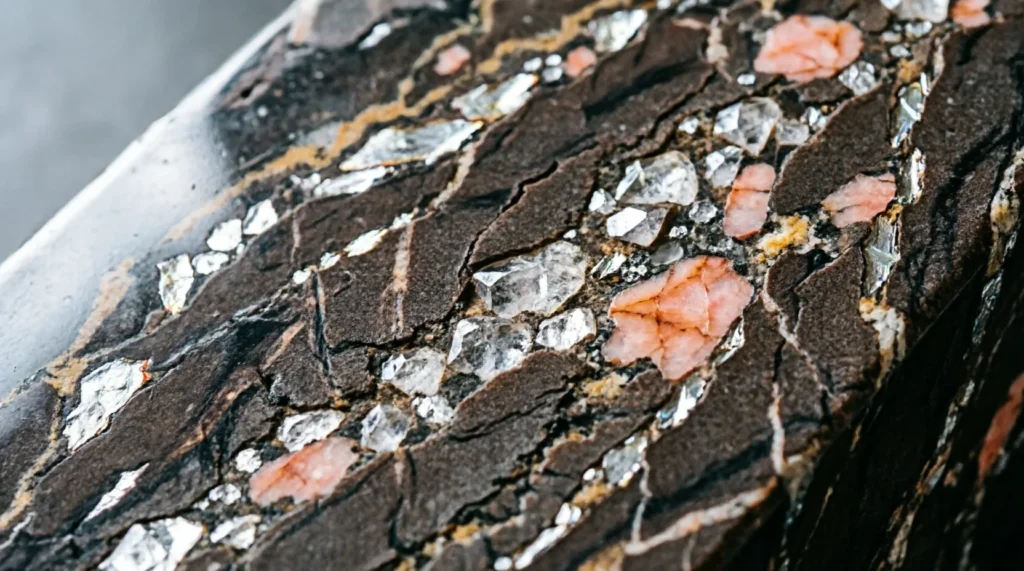
The phrase in granite is literal. It refers to the igneous rock known for its durability and coarse-grained texture. According to Granite, this rock is composed mainly of quartz, feldspar, and mica, making it one of the hardest natural materials available. You use in granite only when you are physically describing an object made of this rock or located within it.
You should never use in granite as a metaphor for something being unchangeable or permanent. This is a common malapropism where writers mix up “set in stone” with the specific type of stone, granite. While granite is indeed durable, the English idiom is “set in stone,” not “set in granite.” Using “in granite” figuratively sounds awkward and incorrect to native speakers and editors.
Here are three examples of correct literal usage versus incorrect figurative usage:
- Correct (Literal): “The memorial plaque was cast in granite to ensure it lasted for centuries.” (This is a physical description of material.)
- Incorrect (Figurative): “Our company values are written in granite.” (This is wrong. Values are abstract; they cannot be physically written in rock. Use “set in stone” if you mean they are unchangeable, though even then, implying values never evolve is often poor business writing.)
- Correct (Literal): “The sculptor worked in granite, chipping away at the massive block with pneumatic tools.” (This describes the medium of art.)
If you are tempted to write “ingrained in granite,” you are likely conflating two ideas: that a habit is deeply fixed (ingrained) and that something is permanent (stone). These are separate concepts. A habit can be ingrained without being permanent (it can be unlearned), and something can be set in stone without being ingrained (a rule can be rigid but not deeply internalized). Keep them distinct.
How to remember the difference
The easiest way to remember the difference is to focus on the root word grain.
- Ingrained has grain in it. Think of wood grain or fabric grain. Dirt gets into the grain. Habits get into the mental grain. If it’s deep inside the structure, it’s ingrained.
- Granite is a rock. It’s hard, cold, and external. You carve in granite, but you don’t have personality traits in granite.
A simple mnemonic I use with junior editors is: “Habits have grain; rocks are granite.”
Another trick is to look at the prefix. In- means “into.” Grained refers to the texture. So ingrained means “put into the texture.” This works for dirt in carpet, bias in hiring, or fear in a child’s mind. It does not work for rock. If you can’t touch it, it’s probably ingrained (if it’s a trait) or set in stone (if it’s a rule). It is never in granite unless you are holding a hammer and chisel. For more, see Ingrailed clay.
Common mistakes and exceptions
One of the most frequent errors I see is the hybrid phrase “ingrained in stone” or “ingrained in granite.” This is redundant and mixed metaphors. Ingrained already implies depth within a substance. Stone implies external hardness. Pick one lane.
- Wrong: “His prejudice was ingrained in stone.”
- Right: “His prejudice was ingrained.” (It’s deep inside him.)
- Right: “The law is set in stone.” (It’s unchangeable externally.)
Another common mistake is confusing ingrained with embedded. While similar, embedded suggests something placed into a surrounding mass, often intentionally (like a journalist embedded with troops). Ingrained suggests something that has grown or worked its way in over time, often unintentionally or naturally. A stain is ingrained; a microchip is embedded.
There are no significant US vs. UK spelling differences for ingrained itself, but there is a slight preference in British English for engrained. However, major dictionaries like Oxford and Merriam-Webster list ingrained as the primary form. For global audiences, ingrained is the safer bet.
Additionally, do not confuse ingrained with grained. Grained simply means having a visible grain (e.g., “wood-grained paper”). Ingrained means the grain has been penetrated. A table can be grained (have a pattern) without being ingrained (dirty deep inside).
Frequently Asked Questions
Is “engrained” a wrong spelling? No, engrained is an accepted variant spelling of ingrained, but ingrained is far more common in modern usage. I recommend using ingrained to avoid looking outdated or overly formal.
Can I say “set in granite” instead of “set in stone”? You can, but it sounds unusual and overly specific. The idiom is “set in stone.” Using “granite” draws attention to the specific rock type, which is unnecessary for the metaphor. Stick to “set in stone” for clarity and natural flow.
What is the opposite of ingrained? The opposite of ingrained is superficial, fleeting, or shallow. If a habit is not ingrained, it is easily changed or barely present. For example, “His interest in jazz was superficial, not ingrained.”
Is “ingrained” always negative? No. While often used for negative traits like bias or fear, ingrained can describe positive qualities too. For example, “Her ingrained sense of integrity helped her resist the bribe.” It simply means deep-seated, regardless of moral value.

Brian Garcia has always been fascinated by the intricacies of the English language. With a Master’s degree in English Literature from the University of Chicago and over 15 years of experience in the field, Brian has dedicated his career to unraveling the complexities of word usage, comparisons, and spelling. His expertise lies in breaking down commonly confused words, helping readers gain clarity and confidence in their language skills. What drew Brian to this field was his passion for storytelling and his love for the art of communication. As a content creator for WordCompareHub, he focuses on engaging readers with insightful articles that demystify tricky word pairs and offer practical spelling tips. In his free time, Brian enjoys delving into etymology and exploring the evolution of words through history.