

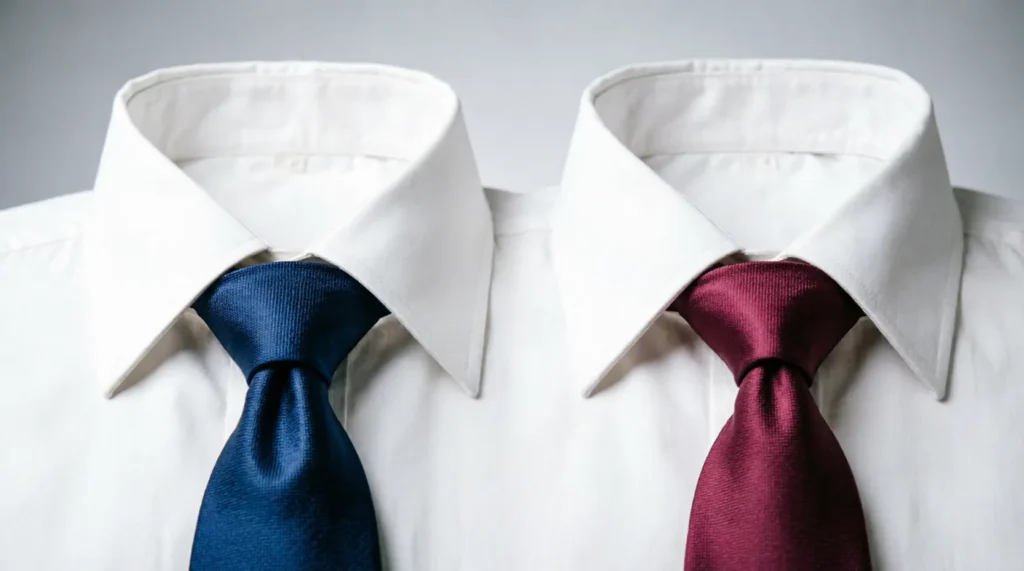
Quick answer: Neither is “wrong,” but they serve different purposes. Use the Half Windsor for everyday business and slim collars; use the Full Windsor for formal events, wide-spread collars, and when you need a symmetrical, triangular knot that commands attention.
The confusion between the Half Windsor and the Full Windsor isn’t about grammar or spelling—it’s about geometry, proportion, and social signaling. As a copy editor who has spent decades polishing executive bios and reviewing professional headshots, I see this mistake constantly. It’s not a typo, but it is a visual error. A man in a sharp suit with a tiny, lopsided knot looks as out of place as a sentence with a dangling modifier.
While the Windsor name evokes royal heritage and traditional British tailoring, the practical application of these knots comes down to your collar spread and the occasion. Understanding the difference ensures your non-verbal communication matches the quality of your written words.
| Term | Meaning / When to use | Example sentence |
|---|---|---|
| Half Windsor | A medium-sized, slightly asymmetrical knot best for standard point collars and daily office wear. | “I tied a Half Windsor for my morning client meeting because it looked neat without being overly stiff.” |
| Full Windsor | A large, symmetrical, triangular knot ideal for wide-spread collars, formal events, and taller individuals. | “For the black-tie gala, he chose a Full Windsor to fill the space of his cutaway collar perfectly.” |
When to use Half Windsor
The Half Windsor is the workhorse of the tie world. It is not “half” of a Full Windsor in terms of steps, but it results in a knot that is roughly half the bulk. I recommend this knot for 80% of your professional life. It is sophisticated enough for boardrooms but relaxed enough for after-work drinks.
The primary rule for the Half Windsor is proportion. If you have a standard point collar (where the collar points are closer together) or a button-down collar, the Full Windsor will often look too bulky, pushing the collar points outward unnaturally. The Half Windsor sits neatly between the collar leaves without distorting the fabric.
Here are three real-world scenarios where I advise clients to choose the Half Windsor:
- The Daily Commute Office Job: You need a knot that stays tidy through an eight-hour day but doesn’t feel like a chokehold. The Half Windsor uses less fabric, meaning there is less bulk around your neck, which increases comfort during long periods of sitting.
- Slimmer Ties and Modern Suits: Modern fashion trends have moved toward slimmer tie blades (2.5 to 3 inches wide). A Full Windsor on a slim tie can look top-heavy and unbalanced. The Half Windsor maintains the sleek silhouette of contemporary tailoring.
- The “Approachable Authority” Look: In sales or customer-facing roles, you want to look professional but not intimidating. The slightly asymmetrical nature of the Half Windsor (it leans slightly to one side) feels more organic and less rigid than the perfect symmetry of the Full Windsor.
Consider this email signature scenario. You are sending a follow-up proposal. Your headshot shows you in a navy suit with a crisp white shirt. If the tie knot is small and centered, it suggests precision and attention to detail. If it were a massive, bulky knot, it might distract from your face. The Half Windsor frames the face without dominating it.
When to use Full Windsor
The Full Windsor, often called the “Double Windsor,” is the statement piece. It is large, symmetrical, and distinctly triangular. This knot was popularized by the Duke of Windsor, who preferred a wide, substantial knot to fill the wide gap of his spread collars. According to historical accounts linked to the Windsor legacy, the Duke was known for his distinctive style, which often involved unconventional choices for the era, including the volume of his tie knots.
Use the Full Windsor when you need to project maximum confidence, authority, or formality. It requires a wider collar spread to look correct. If you attempt a Full Windsor with a standard point collar, the knot will push the collar points up and out, creating a “winged” look that appears sloppy rather than stylish.
Here are three specific instances where the Full Windsor is the only correct choice:
- Formal Events and Weddings: When wearing a tuxedo or a formal dark suit, the Full Windsor provides the gravitas required for the occasion. It fills the V-shape of the vest or waistcoat perfectly, ensuring no shirt fabric is visible below the knot.
- Wide-Spread or Cutaway Collars: These shirts are designed with a wide gap between the collar points. A small knot would look lost in this space, like a period at the end of a very long sentence. The Full Windsor fills this void, creating a balanced, harmonious look.
- Tall or Broad-Shouldered Individuals: Proportion matters. If you have a larger frame, a small knot can look diminutive. The Full Windsor scales better with a broader chest and longer neck, maintaining visual balance.
Imagine you are giving a keynote speech. You are standing on stage, under bright lights. The audience is looking at your face and upper body. A Full Windsor creates a strong, triangular anchor point that draws the eye upward to your face. It signals that you have prepared, that you respect the occasion, and that you are in command. In my experience editing speaker bios, the visual confidence of a well-tied Full Windsor often mirrors the authoritative tone of the text itself.
How to remember the difference
The biggest hurdle for most people is remembering which knot does what. I use a simple mnemonic based on the shape and the name.
“Half is for Habit, Full is for Formal.”
- Habit: You wear the Half Windsor out of habit. It’s your daily driver. It’s easy, quick, and works for most situations.
- Formal: You wear the Full Windsor for Formal events. It takes more time, uses more fabric, and makes a bigger impression.
Another trick is to look at the collar.
- If the collar points are close (like a standard shirt), go Half.
- If the collar points are far (like a spread shirt), go Full.
Think of it like punctuation. The Half Windsor is a comma—it keeps things moving smoothly. The Full Windsor is a colon—it introduces something important and demands attention.
A common editor-level insight: Check the dimple. Both knots should have a dimple (the small indentation just below the knot). However, the Full Windsor holds its dimple better due to its bulk. If you can’t maintain a dimple in a Half Windsor, your tie might be too thin or too thick for the knot. Adjusting the tension is key, but the knot choice itself sets the foundation.
Common mistakes and exceptions
Even with the right knot selected, execution errors can ruin the look. Here are the most frequent mistakes I see, along with how to fix them.
1. The “Skinny Tie” Trap Many young professionals buy ultra-skinny ties (under 2 inches). A Full Windsor on a skinny tie looks like a lollipop on a stick. It is top-heavy and unstable. Fix: Stick to the Half Windsor or even a Four-in-Hand knot for skinny ties. Save the Full Windsor for standard width ties (3–3.5 inches).
2. The Collar Crush Using a Full Windsor on a soft, unstructured collar. The weight of the large knot will pull the collar down, making you look slovenly. Fix: Ensure your shirt has fused or stiffened collars if you plan to wear a Full Windsor regularly. The collar must have the structural integrity to support the knot.
3. The Length Issue The Full Windsor consumes more tie length. If you are tall, you might find the tie ends too short. Conversely, if you are shorter, the tie might hang too low. Fix: Always start with the wide end of the tie lower than the narrow end. For a Full Windsor, start the wide end about 12 inches lower than the narrow end. For a Half Windsor, 8–10 inches is sufficient. Adjust based on your height and the tie’s total length.
4. US vs. UK Spelling Confusion While not directly related to the knot, it is worth noting that the term “Windsor” is consistent globally. However, in broader fashion writing, you may encounter differences in terminology. For instance, the Half concept applies to many binary choices in English, but in tie knots, the naming is standardized. Do not confuse “Windsor” with “Windsor knot” as separate entities; they are the same. The distinction is strictly between Half and Full.
5. The Symmetry Myth People often think the Half Windsor is “crooked.” It is not crooked; it is slightly asymmetrical by design. The Full Windsor is perfectly symmetrical. If your Half Windsor looks wildly lopsided, you are likely pulling the ends unevenly during the tightening phase. Practice pulling the narrow end while holding the knot to center it.
Frequently Asked Questions
Is the Half Windsor appropriate for a job interview? Yes, absolutely. The Half Windsor is professional, neat, and conservative. It is an excellent choice for interviews, especially if you are wearing a standard point-collar shirt. It shows you care about your appearance without trying too hard.
Can I use a Full Windsor with a button-down collar? No. Button-down collars are casual and have soft, close-set points. A Full Windsor is too large and formal for this style. It will bulge awkwardly between the buttons. Stick to a Four-in-Hand or a Half Windsor for button-downs.
Which knot is easier to tie? The Half Windsor is generally easier for beginners. It involves fewer steps and is less prone to becoming loose or uneven. The Full Windsor requires more precise folding and tightening to maintain its symmetrical shape.
Does the type of tie fabric matter? Yes. Thick fabrics like wool or knit ties do not handle the multiple folds of a Full Windsor well; they become too bulky. Silk and polyester blends are ideal for Full Windsors. For thick fabrics, stick to the Half Windsor or simpler knots to avoid a chunky, unrefined look.

Brian Garcia has always been fascinated by the intricacies of the English language. With a Master’s degree in English Literature from the University of Chicago and over 15 years of experience in the field, Brian has dedicated his career to unraveling the complexities of word usage, comparisons, and spelling. His expertise lies in breaking down commonly confused words, helping readers gain clarity and confidence in their language skills. What drew Brian to this field was his passion for storytelling and his love for the art of communication. As a content creator for WordCompareHub, he focuses on engaging readers with insightful articles that demystify tricky word pairs and offer practical spelling tips. In his free time, Brian enjoys delving into etymology and exploring the evolution of words through history.