

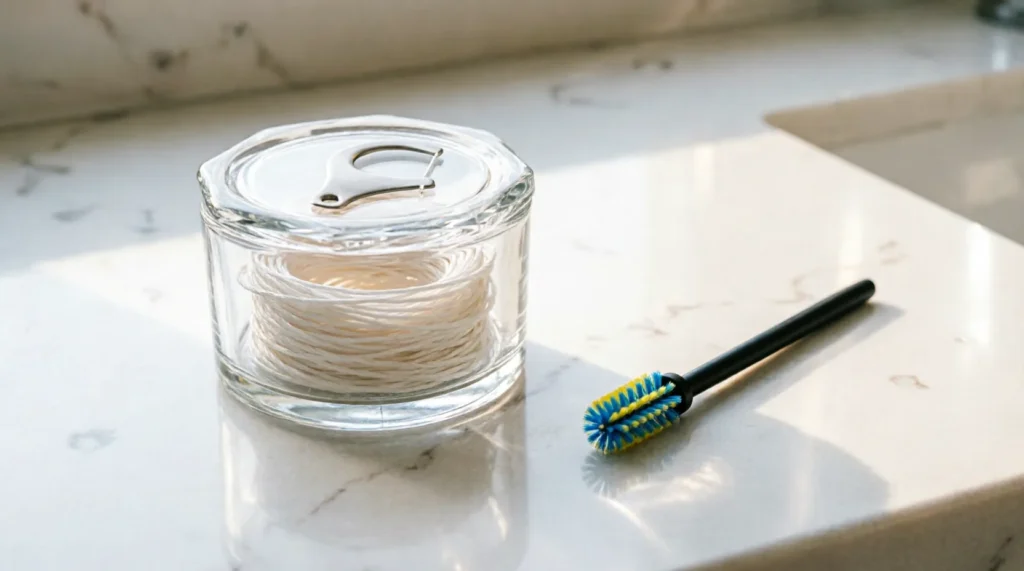
Quick answer: Use dental floss for tight contacts where teeth touch, and use an interdental brush for open spaces, gum recession, or braces. Both remove plaque, but they physically fit different gap sizes.
I see this confusion constantly when reviewing health content and reading patient emails. People use the terms interchangeably, assuming floss and an interdental brush are just two names for the same string-cleaning tool. They are not. One is a thin thread for tight spaces, and the other is a tiny bristle brush for wider gaps, and using the wrong one leaves plaque behind. As a veteran editor who has corrected countless health manuscripts and patient guides, I can tell you that this specific mix-up leads to real clinical failures. When patients use the wrong tool, they miss up to forty percent of the tooth surface, leading to cavities and gum disease.
| Term | Meaning / When to use | Example sentence |
|---|---|---|
| Floss | A thin string used for tight tooth contacts where teeth touch firmly. | “I need to use floss because my front teeth have no gap between them.” |
| Interdental brush | A tiny bristle brush on a wire used for open gaps, receding gums, or braces. | “My hygienist told me to switch to an interdental brush for the spaces near my molars.” |
When to use floss
Dental floss is your primary weapon for tight contacts. A tight contact is exactly what it sounds like: the physical point where two adjacent teeth touch each other. In a healthy mouth with no gum recession, the triangular space between the teeth (the embrasure) is completely filled by the gingival papilla, the pink gum tissue. Because the teeth are touching and the gum is filling the space below, there is no physical room for a brush to pass through.
According to Floss, dental floss is specifically designed as a soft plastic thread to remove food and plaque from between teeth and under the gumline. It slides through the tight contact point, wraps around the side of the tooth in a C-shape, and scrapes the biofilm off the enamel. If you try to force an interdental brush into this space, you will crush the gum papilla, cause bleeding, and fail to clean the tooth. The string is thin enough to pass through the contact without tearing the tissue, allowing you to hug the convex surface of the tooth.
Proper technique matters just as much as the tool itself. You must curve the floss into a C-shape against the side of the tooth, slide it slightly under the gumline until you feel resistance, and scrape upward. Simply popping the floss through the contact and pulling it straight out does nothing to remove the plaque hiding on the tooth surface.
I see this error constantly in written communication. Here are three real examples of how this confusion shows up in the wild, and how I correct it:
- Email to a periodontist: A patient wrote, “Dear Dr. Aris, I’ve been using my interdental brush on my tight front teeth but it hurts and my gums bleed every time.” The fix: I replied that she was using the wrong tool. Tight front teeth require floss. The brush was traumatizing her papilla because it physically could not pass through the contact point without tearing the tissue.
- Text message to a partner: A quick text read, “Can you buy more interdental brushes? I ran out and my teeth feel fuzzy.” The fix: If your teeth feel fuzzy because of tight contacts, buying more brushes won’t help. You need floss. I corrected the text to, “Can you buy more floss? My contacts are too tight for the brushes.”
- LinkedIn bio for a dental hygienist: A professional wrote, “Educated patients on using an interdental brush for all tight posterior contacts.” The fix: Tight posterior contacts require floss. An interdental brush will not fit. I changed the line to, “Educated patients on using floss for tight contacts and interdental brushes for open embrasures.”
When to use interdental brush
The interdental brush takes over when the anatomy changes. As we age, or if we have a history of periodontal disease, the gum papilla shrinks and recedes. This creates an open space—a “black triangle”—between the teeth. In this open embrasure, floss is practically useless. It just snaps through the wide gap, cleaning a microscopic strip of the tooth while leaving the concave root surfaces covered in plaque.
The Interdental wiki entry notes that these spaces require specialized tools to clean the concave root surfaces effectively, which is where the interdental brush excels. The tiny bristles physically fill the open gap, sweeping the concave sides of the adjacent teeth and the floor of the embrasure. You must insert the brush straight in, following the natural path of the space, and pull it back and forth a few times to dislodge the biofilm. Never bend the wire at a sharp angle, or the wire will snap inside the gum tissue.
It is also crucial to choose the right handle. Some interdental brushes come with a straight, rigid handle, while others feature an angled neck. The angled neck is generally superior for reaching the back molars without your hand getting in the way. Regardless of the handle style, the wire core must be coated in soft plastic to prevent scratching the enamel.
You must use an interdental brush in the following scenarios:
- Gum recession: When the papilla has shrunk, leaving an open triangular gap.
- Braces: The orthodontic wires and brackets create massive food traps. Floss cannot navigate around the hardware, but a brush can sweep under the wire.
- Dental bridges and implants: A bridge spans a missing tooth, creating a wide open space underneath the pontic (the fake tooth). You must use an interdental brush to clean under the bridge. Floss cannot clean the wide concave surface of an implant either.
How to remember the difference
The easiest way to remember which tool to use is a simple physical analogy. Think of cleaning a tiled floor. You would not use a wide push broom to clean a hairline crack in the tile, and you would not use a single piece of string to sweep a wide open doorway. Match the tool to the physical dimension of the space.
For a quick mnemonic, use this phrase: Thread for the crack, bristles for the gap.
If the teeth touch and the gum fills the space (the crack), use the thread (floss). If the gum has receded and there is a visible hole (the gap), use the bristles (interdental brush). As an editor, I always tell writers to look at the physical reality of the object they are describing. Floss is a string; it belongs in a string-sized space. A brush has bristles; it belongs in a space wide enough to accommodate those bristles without crushing the gum.
Common mistakes and exceptions
The most common mistake I see is the “one size fits all” approach. Patients buy one size of interdental brush and try to use it everywhere in their mouth. The mesial (front) spaces between teeth are usually smaller than the distal (back) spaces. You often need a smaller brush for the front teeth and a larger brush for the molars. Forcing a large brush into a small space causes gum recession.
Another massive exception involves bleeding. People often assume that if their gums bleed, they should stop cleaning between their teeth. This is backwards. Bleeding is a sign of inflammation caused by plaque biofilm. If you use the correct tool and technique, the bleeding will stop after a week or two. The exception is if you are physically tearing the gum by forcing a brush into a tight contact. In that case, stop immediately, switch to floss, and let the tissue heal.
There are also regional terminology differences. In the United States, interdental brushes are frequently called “proxy brushes” or “gum brushes” in casual conversation, though the clinical term remains interdental brush. In the UK and Australia, “interdental brush” is the standard consumer term. Floss is universally called floss, though the US market has a heavy sub-debate over waxed versus unwaxed floss, which is a separate issue entirely.
A final critical mistake is poor hygiene with the brushes themselves. Unlike floss, which you throw away after one use, an interdental brush is reused. You must rinse it thoroughly after every use and let it air dry. If the bristles become frayed or bent out of shape, the brush is no longer effective and must be replaced. Sharing an interdental brush between family members is a severe hygiene violation that transfers blood and bacteria directly from one mouth to another.
Finally, many people neglect the space behind their very last molars. This area is highly prone to plaque accumulation because it is difficult to see and reach. An angled interdental brush is often the only tool that can effectively clean the distal surface of the last tooth in the arch, as floss requires two hands and complex wrapping techniques to reach that far back.
Frequently Asked Questions
Can I use both floss and an interdental brush on the same day? Yes, and you often should. Use floss for the tight contacts at the front of your mouth, and use the interdental brush for the open spaces at the back. They clean different anatomical spaces and complement each other perfectly.
Which one is better for removing plaque? Studies show that interdental brushes remove significantly more plaque than floss, but only in open embrasures. If your teeth have tight contacts with no gum recession, floss is the only tool that will physically fit into the space to remove the plaque.
Do I still need floss if I use an interdental brush? If you have open spaces everywhere due to severe gum recession, an interdental brush might be all you need. However, most people have a mix of tight contacts and open spaces, meaning you need floss for the tight areas to prevent cavities from forming where the teeth touch.
What size interdental brush should I buy? You should buy a variety pack that includes multiple sizes, typically ranging from 0.6mm to 1.2mm. The brush should pass through the gap with slight resistance; if it slides through with zero resistance, it is too small, and if you have to force it, it is too large.

Kimberly Sanchez holds a Bachelor’s degree in Linguistics from UCLA and has spent over a decade working as a language consultant and educator. Her journey in the world of words began with a curiosity about how language shapes our perception of the world. With a keen eye for detail and a knack for making complex concepts accessible, Kimberly specializes in the nuances of English word comparisons and their real-world implications. She joined WordCompareHub to share her insights on frequently confused words and to promote a deeper understanding of language accuracy. Kimberly writes content that is both enlightening and practical, aimed at readers who seek to enhance their communication skills. Outside of her professional pursuits, she is an avid reader and enjoys exploring multilingual environments to observe linguistic diversity in action.