

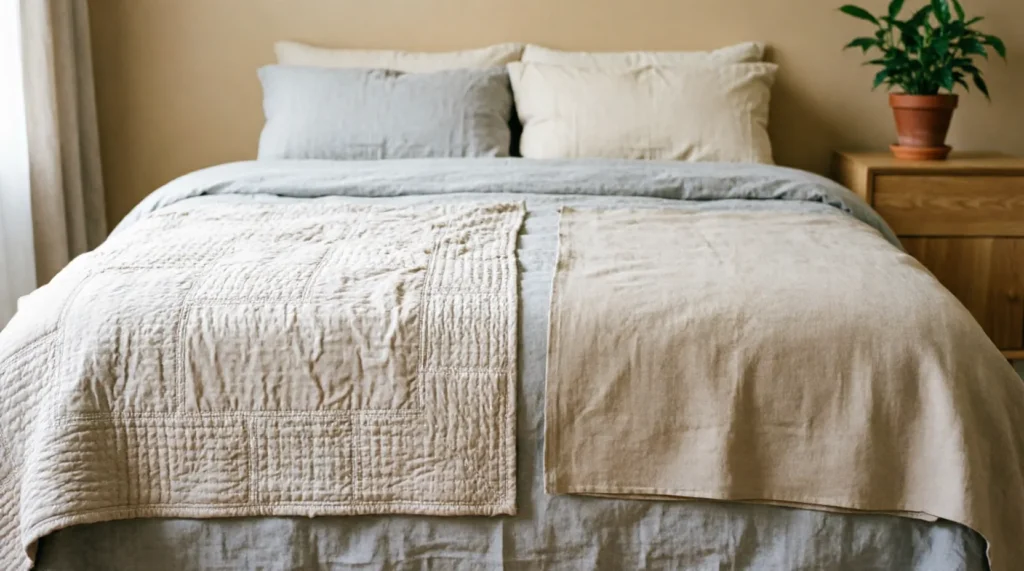
Quick answer: A quilt is a three-layer textile composed of a decorative top, insulating batting, and a backing stitched together, while a coverlet is a lightweight, single-layer or thinly woven bedspread that drapes over the mattress without reaching the floor.
Shoppers and writers frequently confuse these terms because both serve as decorative bed toppers, yet they function entirely differently in bedding layering systems. In my years editing home goods copy and interior design manuscripts, I have corrected countless product descriptions that mislabeled heavy quilts as coverlets or described thin matelassé spreads as quilts; getting this distinction wrong leads to customer returns and muddled prose. Understanding the structural difference ensures you select the right warmth level for your climate and use the precise terminology in your writing.
| Term | Meaning / When to use | Example sentence |
|---|---|---|
| Quilt | A three-layer bed covering with stitched-through insulation; use when describing warmth, craftsmanship, or traditional bedding. | She inherited a hand-stitched quilt that kept her warm through New England winters. |
| Coverlet | A lightweight, non-insulated bedspread that sits atop other layers; use when describing decorative styling or summer bedding. | The designer chose a linen coverlet to add texture without overheating the guest room. |
When to Use Quilt
Use the word quilt when you are referring to a specific construction method involving three distinct layers secured by stitching. According to Difference, distinguishing between similar terms requires identifying the unique structural attributes that separate one category from another, and for quilts, that attribute is the sandwich of top, batting, and back held together by quilting stitches. This term implies weight, warmth, and often artisanal labor. If the item has visible loft, puffy sections created by batting, or intricate stitch patterns that penetrate all layers, it is a quilt.
In professional editing and e-commerce copywriting, precision here prevents misleading customers about thermal performance. I once audited a luxury bedding catalog where the copywriter described a “summer quilt” made of two layers of cotton voile with no filling; this was technically a coverlet or a light blanket, and calling it a quilt set false expectations for warmth. Correct usage signals to the reader that the item provides genuine insulation.
- Product Description Fix: Original: “This breathable coverlet features diamond stitching and polyester fill for cozy nights.” Correction: “This lightweight quilt features diamond stitching and polyester fill for cozy nights.” (The presence of fill and stitching through layers makes it a quilt, regardless of the “breathable” marketing claim.)
- Interior Design Blog: “To achieve the farmhouse look, layer a vintage quilt at the foot of the bed over your duvet for added warmth and visual interest.” (Correct because the vintage piece provides both decorative texture and functional insulation.)
- Customer Service Email: “I apologize for the confusion; the item you received is indeed a quilt, not a coverlet, which explains why it feels heavier and warmer than the photos suggested.” (Acknowledges the structural reality that defines the user’s sensory experience.)
When to Use Coverlet
Use coverlet when describing a lightweight, decorative bed covering that lacks substantial internal insulation. As defined by Coverlet, this textile is typically woven as a single piece or with minimal layering, designed primarily to cover the mattress and box spring while leaving the bed frame legs exposed or barely grazing the floor. Coverlets do not have batting; their thickness comes solely from the weave structure, such as matelassé, jacquard, or waffle knit. They are styling tools first and warming tools second.
This term is appropriate for summer bedding, layered looks where the duvet provides the warmth, or minimalist aesthetics where bulk is undesirable. In manuscript editing, I flag “quilt” as an error whenever the described item is flat, un-padded, and intended solely as a surface accent. Using “coverlet” correctly tells the buyer or reader that this piece will not replace a duvet or blanket in cold weather.
- Real Estate Listing: “The primary suite features custom built-ins and is staged with a neutral linen coverlet to showcase the platform bed’s clean lines.” (Correct because the goal is visual staging without adding visual or physical bulk.)
- Hospitality Procurement Spec: “Standardize guest rooms with white matelassé coverlets that can be laundered industrially without degrading fill integrity.” (Correct because matelassé is a woven structure without separate batting, making it durable for commercial laundry.)
- Lifestyle Article Correction: Original: “Swap out your heavy winter quilt for a breezy cotton quilt in July.” Correction: “Swap out your heavy winter quilt for a breezy cotton coverlet in July.” (A cotton piece meant for July heat should lack insulation; calling it a quilt contradicts the seasonal advice.)
How to Remember the Difference
As a copy editor, I rely on tactile and etymological cues rather than abstract definitions to catch errors during fast read-throughs. The most reliable mnemonic I use is “Quilts Have Guts, Coverlets Are Just Skin.” A quilt always has “guts”—the middle layer of batting that gives it body, loft, and warmth. If you pinch the fabric and feel air or padding between two layers of cloth, it has guts; it is a quilt. A coverlet is just “skin”—a single woven surface or two fabrics fused without intervening fluff. It lies flat against itself.
Another editor-level insight involves checking the edge finishing. Quilts almost always have binding—a strip of fabric wrapped around the raw edges to enclose the three layers. Coverlets frequently have hemmed edges, fringe, or selvage finishes because there are no raw internal layers to contain. When reviewing product photography or physical samples, I look at the perimeter first; visible binding is a near-guarantee of quilt construction, while a simple turned hem suggests a coverlet. This visual check catches mislabeling faster than reading the spec sheet, especially when suppliers use ambiguous terms like “bedspread” or “blanket” in their data feeds.
You can also test by drape behavior. Hold the item up by two corners. A quilt will hold its shape somewhat stiffly due to the batting acting as a stabilizer; it resists folding into sharp creases. A coverlet will collapse into fluid folds immediately, behaving more like a large towel or tablecloth. This physical test resolves ambiguity when product descriptions are vague or translated poorly from overseas manufacturers.
Common Mistakes and Exceptions
The most pervasive error I encounter is using “quilt” as a generic synonym for any bed covering. This is incorrect. A duvet cover is not a quilt. A comforter is not a quilt. A blanket is not a quilt. Only items with the specific three-layer stitched construction qualify. In British English, the term “quilt” sometimes refers to what Americans call a “duvet” or “continental quilt,” but in American publishing and retail standards, maintaining the strict definition prevents consumer confusion. If you are writing for a UK audience, clarify “patchwork quilt” versus “duvet” to avoid ambiguity; for US audiences, adhere strictly to the three-layer rule.
Another frequent mistake is conflating “coverlet” with “bedspread.” While related, they differ in length and coverage. A bedspread traditionally reaches all the way to the floor, concealing the entire bed frame and any under-bed storage. A coverlet stops at or just below the mattress apron, intentionally exposing the bed legs. I see this error constantly in hotel marketing materials where properties advertise “luxury bedspreads” but show images of coverlets; this matters for accessibility compliance and cleaning protocols, as floor-length textiles require different maintenance. Always verify the drop length before choosing the term.
Matelassé presents a tricky exception. This French weaving technique creates a puckered, quilted appearance through loom mechanics rather than actual stitching through batting. Many consumers and even some retailers call matelassé pieces “quilts” because they look padded. However, true matelassé coverlets have no fill; the puffiness is structural illusion. Unless the product specifications confirm added batting, classify matelassé items as coverlets. I maintain a personal checklist for this: if the care label says “100% cotton” with no mention of polyester fill or down alternative, and the texture is uniform across the entire surface without distinct batted channels, it is a coverlet regardless of how puffy it appears in photos.
Regional dialect and historical usage also create edge cases. In some American South traditions, “counterpane” was used interchangeably with coverlet, though this term is now archaic. Vintage textile collectors may use “coverlet” specifically for 19th-century Jacquard-woven figured textiles, distinguishing them from later machine-made versions. When writing about antiques or regional heritage, acknowledge this specificity; when writing modern e-commerce or lifestyle content, stick to contemporary industry standards to ensure searchability and customer comprehension.
Frequently Asked Questions
Can a coverlet be used as a quilt in summer? No, because a coverlet lacks insulating batting; it provides only the weight and warmth of its woven fabric, making it suitable as a standalone summer layer but structurally distinct from a quilt even in hot weather.
Is a duvet cover the same thing as a coverlet? Absolutely not; a duvet cover is a removable envelope that encases a fluffy insert, while a coverlet is a finished, standalone decorative top layer with no opening or insert capability.
Why do some stores label lightweight quilts as coverlets? Retailers often prioritize aesthetic categorization over technical accuracy for SEO and navigation; always check the product specifications for batting content and layer count to determine the true classification regardless of the menu label.
Does the stitching pattern determine if something is a quilt? Stitching alone does not make a quilt; decorative embroidery or tack stitching on a single layer of fabric remains a coverlet or embroidered spread, whereas true quilting must penetrate through top, batting, and backing simultaneously to secure the three-layer structure.

Brian Garcia has always been fascinated by the intricacies of the English language. With a Master’s degree in English Literature from the University of Chicago and over 15 years of experience in the field, Brian has dedicated his career to unraveling the complexities of word usage, comparisons, and spelling. His expertise lies in breaking down commonly confused words, helping readers gain clarity and confidence in their language skills. What drew Brian to this field was his passion for storytelling and his love for the art of communication. As a content creator for WordCompareHub, he focuses on engaging readers with insightful articles that demystify tricky word pairs and offer practical spelling tips. In his free time, Brian enjoys delving into etymology and exploring the evolution of words through history.