

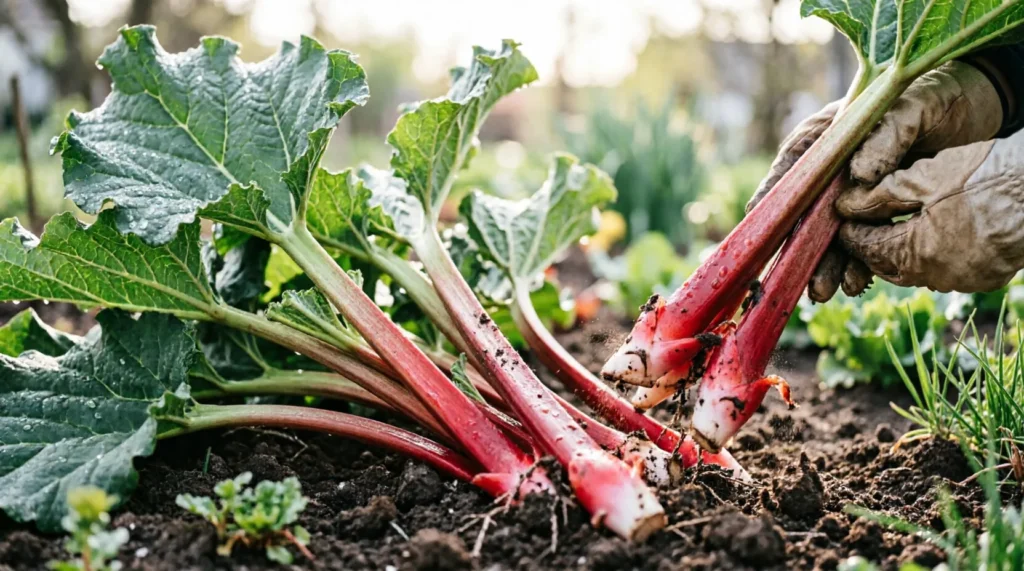
Quick answer: You should pull rhubarb stalks rather than cut them. Pulling the stalk from the base removes the entire stem cleanly and prevents rot, whereas cutting leaves a stub that can decay and invite disease into the crown.
Gardeners often debate whether to use a sharp knife or their bare hands when harvesting rhubarb. This confusion usually stems from a desire to be gentle with the plant or a misunderstanding of how rhubarb grows. However, the method you choose has significant implications for the long-term health of your perennial crop. While cutting might seem cleaner, it is technically inferior for this specific vegetable. Understanding the biological reason behind pulling ensures your rhubarb patch remains productive for years.
| Term | Meaning / When to use | Example sentence |
|---|---|---|
| Pull | Grasp the stalk near the base and twist/pull upward to detach it from the crown; the recommended method for harvesting. | “I always pull my rhubarb stalks in early spring to keep the crown healthy.” |
| Cut | Use a knife or shears to sever the stalk above the soil line; generally discouraged as it leaves rotting stumps. | “Avoid cutting rhubarb unless the stalk is too brittle to pull without breaking.” |
When to use Pull
Pulling is the gold standard for harvesting rhubarb. This method involves grasping the stalk firmly near its base, close to the soil level, and giving it a gentle but firm twist and pull. The goal is to detach the stalk from the main crown underground.
The primary reason for pulling is hygiene and plant health. Rhubarb crowns are susceptible to rot if organic matter is left to decompose on them. When you cut a stalk, you leave a hollow stump protruding from the crown. This stump collects water and becomes an entry point for bacteria and fungi. Over time, these rotting stumps can compromise the integrity of the crown, leading to reduced yields or even plant death.
According to general horticultural practices documented in resources like Rhubarb, proper harvesting techniques are crucial for maintaining the vigor of perennial plants. Pulling ensures that the entire petiole (leaf stalk) is removed, leaving no debris behind to harbor pests or disease.
Here are three real-world examples where pulling is the correct action:
- The Spring Harvest: In April, when the stalks are thick and juicy, I grasp the base of a large red stalk, twist it slightly to break the fibers, and pull it away from the center. It comes away cleanly with a satisfying pop.
- The Thinning Process: If my rhubarb patch becomes too crowded, I pull the smaller, thinner stalks from the interior to improve air circulation. This selective pulling helps the remaining stalks grow larger.
- The End-of-Season Cleanup: In late June, before the heat makes the stalks tough, I pull the remaining harvestable stalks. This allows the plant to focus its energy on root storage for the next winter rather than supporting excessive foliage.
When to use Cut
While pulling is the preferred method, there are rare exceptions where cutting might be necessary. It is important to note that “cutting” here refers to a fallback strategy, not a best practice. You should only consider cutting if the stalk is extremely brittle or if pulling risks damaging the crown due to poor leverage.
Sometimes, older stalks become woody or dry. If you attempt to pull a brittle stalk, it may snap off halfway, leaving the same problematic stump you were trying to avoid. In this specific scenario, using a sharp, sterilized knife to cut the stalk as close to the base as possible is better than leaving a jagged, broken remnant. However, you must be diligent about removing any remaining stub manually if it does not come away easily.
Another instance where cutting is discussed is in commercial farming contexts where speed is prioritized over individual plant longevity, but for home gardeners, the health of the plant is paramount. The concept of force application differs here; while Pull implies a tensile force that separates the structure at its natural junction, cutting relies on shear force which can damage surrounding tissues if not done precisely.
Here are examples where cutting might be considered, though often with caveats:
- The Brittle Stalk: Last year, during a drought, my rhubarb stalks became fibrous. One snapped when I tried to pull it. I used a knife to trim the remaining stub flush with the crown to prevent rot.
- The Crowded Patch: In a densely planted bed where I couldn’t get my hand around the base of a central stalk, I used long-handled shears to cut it. I then carefully dug out the small remaining piece with a trowel.
- The Damaged Crown: If a plant has existing damage or disease, minimizing physical stress on the crown might suggest cutting. However, most experts argue that careful pulling is still less invasive than introducing a tool near the sensitive growth points.
How to remember the difference
Remembering whether to cut or pull rhubarb can be simplified with a single mnemonic: “Pull to Protect.”
Think of the rhubarb crown as a vulnerable head. Cutting leaves a “scab” or open wound (the stump) that can get infected. Pulling removes the limb cleanly at the joint, like pulling a loose tooth, leaving the gum (crown) smooth and intact.
Another way to visualize it is to think of celery. You rarely cut celery stalks off the bunch when preparing them; you snap or pull them apart to maintain freshness. Rhubarb operates on a similar principle, though it is attached to a perennial root system rather than a basal plate.
I often tell my gardening clients to imagine they are removing a sticker. If you peel it off (pull), it’s gone. If you tear it (cut/snap), bits remain stuck and annoy you later. The “bits” in this case are rotting plant matter that will annoy your rhubarb plant by inviting disease.
Common mistakes and exceptions
Even experienced gardeners can fall into traps when harvesting rhubarb. Here are the most common errors and how to avoid them.
Mistake 1: Cutting too high. If you decide to cut because the stalk is brittle, do not leave a tall stump. A common error is cutting the stalk 2-3 inches above the ground. This creates a hollow tube that fills with rainwater, accelerating rot. Always cut as close to the base as physically possible.
Mistake 2: Pulling too early in the first year. If you have just planted a new rhubarb crown, do not harvest any stalks in the first year. Pulling or cutting stalks stresses the plant when it needs to establish its root system. Wait until the second year to harvest lightly, and full harvests only from the third year onward.
Mistake 3: Removing all the leaves. Rhubarb needs its leaves to photosynthesize and store energy in the roots for next year’s growth. Never pull or cut more than half to two-thirds of the stalks at one time. Leave at least 4-5 strong stalks per plant to ensure it survives the winter.
US vs UK Differences: There is no significant regional difference in the method of harvesting between the US and the UK; both recommend pulling. However, terminology can vary. In some older British texts, you might see references to “lifting” rhubarb, which refers to forcing rhubarb in darkness (a process called “forcing”) rather than the harvesting technique itself. Do not confuse “forcing” with “pulling.” Forcing is a cultivation method; pulling is the harvest action.
Exception: Ornamental Rhubarb. Some varieties of rhubarb are grown primarily for their ornamental value rather than culinary use. While the harvesting rule remains the same if you do choose to take stalks, many gardeners never harvest ornamental varieties. If you do, pull them to maintain the aesthetic clump shape without unsightly cut ends.
Frequently Asked Questions
Can I use scissors to harvest rhubarb? You can, but it is not recommended. Scissors often crush the stem rather than cutting it cleanly, and they struggle to reach the base without damaging surrounding stalks. If you must use a tool, use a sharp knife.
What happens if I accidentally cut my rhubarb instead of pulling it? Don’t panic. If you leave a short, clean cut, the plant will likely survive. However, monitor the stump for signs of rot (mushiness or foul smell). If it begins to rot, gently dig it out with a small tool to prevent the decay from spreading to the crown.
Is it okay to pull rhubarb in the summer? It is best to stop harvesting by mid-summer (late June or early July). Pulling stalks late in the season weakens the plant before it can store enough energy for winter. Let the plant grow undisturbed for the rest of the summer to build up its root reserves.
Why do some grocery stores sell cut rhubarb? Commercial growers often cut rhubarb for efficiency and uniformity in packaging. They manage disease risk through chemical treatments and rapid turnover. Home gardeners do not have these industrial safeguards, so manual pulling is the safer, more sustainable choice for a perennial patch.

Kimberly Sanchez holds a Bachelor’s degree in Linguistics from UCLA and has spent over a decade working as a language consultant and educator. Her journey in the world of words began with a curiosity about how language shapes our perception of the world. With a keen eye for detail and a knack for making complex concepts accessible, Kimberly specializes in the nuances of English word comparisons and their real-world implications. She joined WordCompareHub to share her insights on frequently confused words and to promote a deeper understanding of language accuracy. Kimberly writes content that is both enlightening and practical, aimed at readers who seek to enhance their communication skills. Outside of her professional pursuits, she is an avid reader and enjoys exploring multilingual environments to observe linguistic diversity in action.