

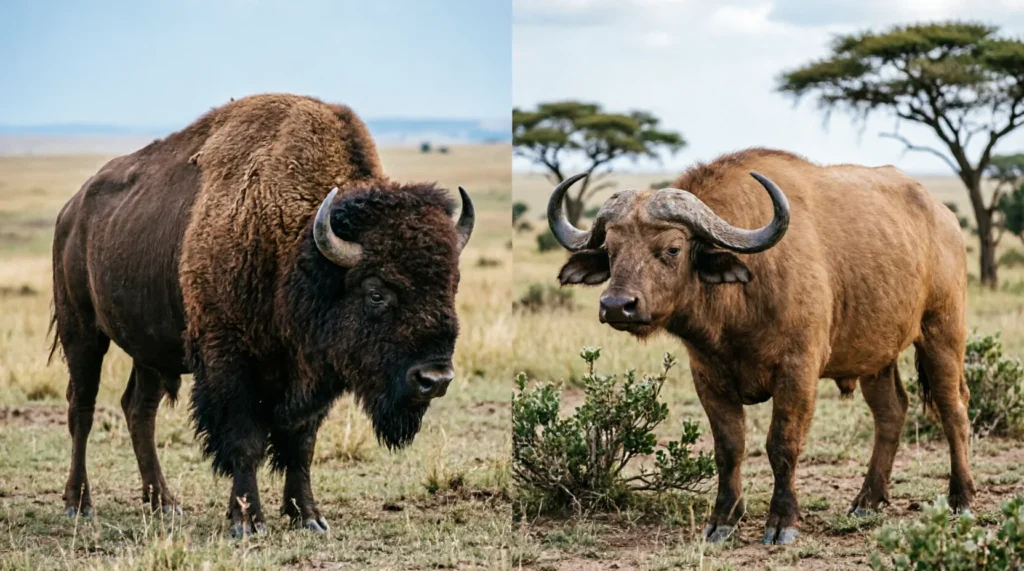
Quick answer: In North America, the large, shaggy herbivore roaming the Great Plains is a bison, not a buffalo. “Buffalo” correctly refers to distinct species in Africa (Cape buffalo) and Asia (water buffalo). While “buffalo” is colloquially accepted for American bison, bison is the scientifically accurate term.
You have likely heard the phrase “herd of buffalo” used to describe the iconic animals of the American West. It is a mistake so pervasive that even state license plates and popular media perpetuate it. As an editor who has spent decades correcting manuscripts, I see this confusion constantly. The mix-up isn’t just a trivial semantic error; it reflects a fundamental misunderstanding of zoological classification and geographic history. Knowing the bison or buffalo difference ensures your writing is precise, authoritative, and factually correct.
| Term | Meaning / When to use | Example sentence |
|---|---|---|
| Bison | Use for the large, humped bovids native to North America (Bison bison) and Europe (Bison bonasus). | The national park rangers monitored the bison herd migrating through Yellowstone. |
| Buffalo | Use for the African Cape buffalo (Syncerus caffer) or Asian water buffalo (Bubalus bubalis). Never use for American bison in formal or scientific contexts. | Tourists on safari were warned to keep their distance from the aggressive Cape buffalo. |
When to use Bison
Use bison whenever you are referring to the large, shaggy mammals with prominent shoulder humps that are native to North America and Europe. This is the only correct term in scientific, academic, and precise journalistic writing when discussing the animal that once roamed the Great Plains in numbers estimated at 30 to 60 million.
The American bison (Bison bison) is distinct from true buffaloes in several key anatomical ways. Most notably, bison have a large, muscular hump over their shoulders, which is composed of muscle supported by long vertebrae. They also have shorter, curved horns and a beard on their chin. In contrast, true buffaloes lack this shoulder hump and have different horn structures.
Here are three examples of how I correct this usage in real-world editing scenarios:
- Resume/CV Error: A wildlife biologist listed “Managed buffalo conservation projects” on their resume.
- Correction: “Managed bison conservation projects.” Using the correct terminology demonstrates professional expertise and attention to detail.
- Travel Blog Draft: A writer described their trip to South Dakota: “We watched the buffalo graze near Mount Rushmore.”
- Correction: “We watched the bison graze near Mount Rushmore.” Precision enhances the credibility of travel writing, especially when discussing local fauna.
- Academic Paper: A student’s history thesis stated, “The slaughter of the buffalo changed the ecosystem.”
- Correction: “The slaughter of the bison changed the ecosystem.” Academic rigor requires precise taxonomic language.
According to Difference, distinguishing between similar terms is crucial for clear communication, and this applies heavily to zoological nomenclature where common names often obscure scientific reality.
When to use Buffalo
Use buffalo only when referring to specific species outside of North America and Europe. There are two primary animals that hold this title: the African buffalo (also known as the Cape buffalo) and the Asian water buffalo.
The African buffalo (Syncerus caffer) is found in sub-Saharan Africa. It is known for its aggressive nature and is considered one of the most dangerous animals to hunters. It lacks the shoulder hump of the bison and has horns that fuse at the base to form a “boss.”
The Asian water buffalo (Bubalus bubalis) is domesticated and widely used in agriculture across Asia. It is adapted to wetland environments and has large, curved horns. Neither of these animals is related closely to the American bison.
Here is how I apply this rule in editing:
- News Article: A report on agriculture in Vietnam mentioned, “Local farmers rely on buffalo for plowing rice fields.”
- Verdict: Correct. This refers to the Asian water buffalo.
- Safari Guidebook: A section warning tourists about dangerous game listed, “Avoid close encounters with the buffalo.”
- Verdict: Correct, assuming the context is an African safari referring to the Cape buffalo.
- Children’s Book Manuscript: A story set in Wyoming featured a character riding a “wild buffalo.”
- Correction: Change to “wild bison.” Even in fiction, maintaining factual accuracy regarding local wildlife respects the setting and educates young readers.
It is worth noting that the word “buffalo” itself has a complex etymological history, often traced back to indigenous languages and early European explorers who misidentified the animals they encountered. For more on the linguistic background, you can refer to the entry on Buffalo, which details how the name became entrenched in common parlance despite its inaccuracy for the North American species.
How to remember the difference
Remembering the bison or buffalo difference is easier if you focus on geography and anatomy. Here is my favorite mnemonic trick that I teach to junior editors:
“Bison have a Bump; Buffalo are Far Off.”
- Bison have a Bump: The most visible feature of the American bison is the massive muscle hump on its shoulders. If it has a bump, it’s a bison.
- Buffalo are Far Off: True buffaloes are not native to North America. They are “far off” in Africa and Asia. If you are in the United States or Canada, you are looking at a bison.
Another helpful tip is to think of the word Bison starting with B for Big Hump. Conversely, Buffalo starts with B but can be associated with Beyond North America.
I also recommend visualizing the horns. Bison horns are short and pointy, curving upward. Buffalo horns (especially the Cape buffalo) are long, heavy, and curve downward or outward, often meeting in the middle. If the horns look like a heavy helmet, it’s likely a buffalo. If they look like short daggers, it’s a bison.
Common mistakes and exceptions
While the rule is strict in science, language is fluid, and there are exceptions in common usage. However, knowing when you can bend the rule and when you must stand firm is key to professional writing.
1. The Colloquial Exception In casual conversation among Americans, calling a bison a “buffalo” is widely understood and socially acceptable. You will hear it in everyday speech, see it on souvenir shops, and even find it in some historical texts. However, this does not make it correct. In any formal writing—business reports, academic papers, journalism, or educational materials—you must use bison. Using “buffalo” in these contexts signals a lack of precision.
2. The City of Buffalo Do not confuse the animal with the city. Buffalo, New York, is named after the creek, which may have been named after the animal (incorrectly) or after the French word beau fleuve (beautiful river). Regardless of the city’s name, the animals in nearby parks are still bison.
3. US vs. UK English There is no significant difference between US and UK English regarding this specific term. Both varieties distinguish between bison and buffalo in scientific contexts. However, British writers may be less familiar with the American bison, leading to occasional misuse in international publications. Always default to bison for the North American animal, regardless of your audience’s location.
4. The “Wood Buffalo” There is a subspecies called the Wood Bison (Bison bison athabascae), which is larger and lives in forested areas of Canada and Alaska. Note that it is still a bison, not a buffalo. The name “Wood Buffalo” is sometimes used colloquially, but the scientific community strictly classifies it as a bison.
5. Historical Texts When quoting historical documents from the 19th century, you may encounter the word “buffalo” used to describe American bison. In this case, retain the original wording in quotes to preserve historical accuracy, but clarify in your own text that these were bison. For example: “As Lewis and Clark noted, ‘the buffalo were numerous,’ though we now know they were observing bison.”
Frequently Asked Questions
Is it wrong to call American bison “buffalo”? In casual conversation, it is common and generally understood, but it is scientifically incorrect. In formal, academic, or professional writing, it is considered an error and should be avoided.
What is the main physical difference between a bison and a buffalo? The most obvious difference is the shoulder hump. Bison have a large, muscular hump on their shoulders, while true buffaloes (African and Asian) do not. Additionally, bison have shorter, curved horns, whereas buffaloes have longer, heavier horns.
Are bison and buffalo related? They are both members of the Bovidae family, which includes cattle, goats, and sheep, but they belong to different genera. American bison are in the genus Bison, while African buffaloes are in Syncerus and Asian water buffaloes are in Bubalus. They are distant cousins, not direct relatives.
Why do people call bison “buffalo” if it’s wrong? The term originated with early French trappers who called the bison boeufs (oxen), which English speakers may have anglicized to “buffalo.” The name stuck in popular culture despite being zoologically inaccurate, leading to the widespread confusion we see today.

Nathan Williams is a seasoned editor and writer with a passion for the subtleties of the English language. With a degree in English from NYU and more than 12 years of editorial experience, he has honed his expertise in spelling accuracy and the comparison of often-misused words. Nathan’s foray into language analysis was sparked by his desire to help others communicate more effectively and avoid common pitfalls in writing. At WordCompareHub, he crafts comprehensive guides and articles that discuss word usage distinctions and provide effective spelling strategies. Nathan is driven by the belief that clarity in language is key to effective communication. In his leisure time, he enjoys crosswords and participates in local word games, continually expanding his lexicon and sharpening his linguistic skills.