

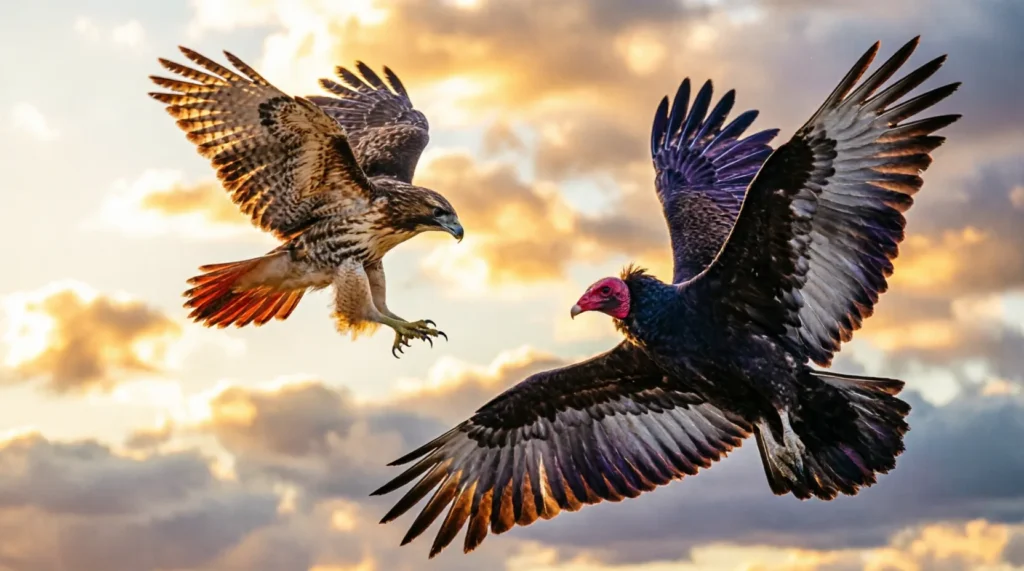
Quick answer: “Hawk” and “turkey vulture” refer to two completely different species of birds with distinct behaviors, diets, and physical traits. They are not synonyms, spelling variants, or interchangeable terms; using one to describe the other is factually incorrect in both ornithology and general writing.
Writers often confuse these two raptors because they both soar high in the sky and possess impressive wingspans. However, conflating a hawk with a turkey vulture is akin to calling a lion a hyena simply because both are predators. This error frequently appears in nature writing, student essays, and casual observation logs where the observer sees a large bird circling overhead and defaults to the more familiar term “hawk.” Understanding the precise distinction ensures your writing remains accurate and credible.
| Term | Meaning / When to use | Example sentence |
|---|---|---|
| Hawk | Use when referring to active hunters in the Accipitridae family that catch live prey with sharp talons. | The red-tailed hawk swooped down to catch a field mouse in the meadow. |
| Turkey Vulture | Use when referring to the specific scavenger Cathartes aura that feeds on carrion and has a bald, red head. | We spotted a turkey vulture circling the highway, likely attracted by roadkill. |
When to use Hawk
Use the term “hawk” when you are describing a bird of prey from the family Accipitridae (which includes true hawks, eagles, and kites) or Accipitriformes generally, specifically those that hunt live animals. Hawks are diurnal hunters, meaning they are active during the day, and they rely on keen eyesight and powerful talons to capture mammals, birds, and reptiles.
In professional editing, I see this term misapplied when writers describe any large bird with broad wings as a hawk. To be precise, a hawk is an active predator. If the bird is diving at speed, hovering over a field, or perching alertly on a telephone wire scanning for movement, it is likely a hawk. Common species include the Red-tailed Hawk, Cooper’s Hawk, and Sharp-shinned Hawk.
Here are three concrete examples of correct usage in different contexts:
- Nature Blog Post: “The Cooper’s hawk maneuvered through the dense pine branches with agility, pursuing a starling that had foolishly lingered too long in the open.”
- Wildlife Photography Caption: “Captured this stunning image of a Ferruginous hawk mid-dive, its talons extended to grasp a jackrabbit in the Utah desert.”
- Educational Material: “Unlike scavengers, the hawk relies on fresh meat obtained through direct hunting, playing a crucial role in controlling rodent populations.”
The key identifier for a hawk is its behavior: it is looking for something alive to kill. Its physical structure supports this; hawks have strong, curved beaks designed for tearing flesh from live prey and sharp, powerful talons for gripping struggling animals.
When to use Turkey Vulture
Use the term “turkey vulture” only when referring to the specific species Cathartes aura, a large scavenger native to the Americas. This bird is easily identified by its bald, red head, black plumage, and distinctive two-toned underwings that appear silver in flight. Unlike hawks, turkey vultures do not hunt live prey. They are obligate scavengers, feeding almost exclusively on carrion (dead animals).
According to Vulture, vultures play a critical ecological role by cleaning up dead matter, which helps prevent the spread of disease. The turkey vulture, specifically, has an exceptional sense of smell, which allows it to locate carcasses hidden under forest canopies—a trait rare among birds of prey.
Here are three concrete examples of correct usage:
- Field Journal Entry: “Observed a group of three turkey vultures descending toward the deer carcass near the creek bed; their bald heads were clearly visible even from a distance.”
- Travel Article: “Driving through the Southwest, we saw the silhouette of a turkey vulture riding the thermal currents, its wings held in a slight dihedral angle.”
- Environmental Report: “The presence of turkey vultures in the area indicates a healthy ecosystem capable of supporting scavenger populations, though local farmers sometimes mistake them for threats to livestock.”
It is crucial to note that while people often call any large soaring bird a “vulture,” the term “turkey vulture” is specific. Other vultures exist, such as the Black Vulture, but they have different physical traits (like black heads instead of red). Using “turkey vulture” correctly requires confirming the red head and the specific geographic location (the Americas).
How to remember the difference
The most effective way to distinguish between these two birds is to focus on their heads and their meals. I teach my junior editors a simple mnemonic: “Hawks Hunt, Vultures Visit.”
- Hawks Hunt: They are active killers. They have feathered heads because they dive into brush and struggle with live prey, so feathers protect their skin from scratches and blood.
- Vultures Visit: They visit meals that are already prepared (dead). They have bald heads because sticking their heads inside a rotting carcass would mat feathers with bacteria and gore. A bald head is easier to keep clean and sanitize in the sun.
Another visual trick involves their flight patterns. When you see a bird soaring:
- If it holds its wings flat or slightly raised in a shallow “V” (dihedral), it is likely a Turkey Vulture.
- If it holds its wings flat or slightly bowed down, it is likely a Hawk (or an eagle).
This physical distinction is reliable enough for casual observation and prevents the common error of labeling every soaring raptor as a hawk. For more, see Turkey.
Common mistakes and exceptions
One of the most frequent errors I encounter in manuscript reviews is the generic use of “hawk” for any raptor. This is particularly problematic in scientific or educational writing where precision is mandatory. For instance, calling a turkey vulture a “black hawk” is biologically inaccurate and misleading.
Another common mistake involves the term “buzzard.” In North America, people often colloquially refer to turkey vultures as buzzards. However, in Europe and ornithological terms, a buzzard is actually a type of hawk (specifically, the Buteo genus). This linguistic divergence causes confusion in international writing. If you are writing for a global audience, avoid using “buzzard” to mean turkey vulture. Stick to “turkey vulture” for clarity.
There are no regional spelling differences for these terms (unlike “color/colour”), but there are taxonomic nuances. For example, the Osprey is sometimes called a “fish hawk,” but it is not a true hawk. Similarly, the American Kestrel is a small falcon, not a hawk, though it is often grouped with them in casual conversation. Always verify the specific species if your writing demands scientific accuracy.
A notable exception in behavior occurs when hawks scavenge. While rare, some hawk species will eat carrion if live prey is scarce. However, this opportunistic behavior does not reclassify them as vultures. Their primary biological design and behavioral instinct remain predatory. Conversely, turkey vultures almost never kill live animals; their talons are weak and not designed for grasping struggling prey.
Frequently Asked Questions
Can a turkey vulture kill a hawk? No, turkey vultures are scavengers with weak talons and are not equipped to hunt or kill live animals like hawks. They may compete for food sources, but they do not prey on hawks.
Why do people confuse hawks and turkey vultures? Both birds are large raptors that soar at high altitudes and have broad wingspans, leading casual observers to group them together without noticing key differences in head color, wing shape, and behavior.
Is a turkey vulture a type of hawk? No, turkey vultures belong to the family Cathartidae, while hawks belong to the family Accipitridae. They are evolutionarily distinct groups with different anatomical features and ecological roles.
Do hawks and turkey vultures live in the same areas? Yes, both species are widespread across North and South America and often inhabit similar environments, such as open fields, forests, and suburban areas, though they occupy different niches within those ecosystems.

Brian Garcia has always been fascinated by the intricacies of the English language. With a Master’s degree in English Literature from the University of Chicago and over 15 years of experience in the field, Brian has dedicated his career to unraveling the complexities of word usage, comparisons, and spelling. His expertise lies in breaking down commonly confused words, helping readers gain clarity and confidence in their language skills. What drew Brian to this field was his passion for storytelling and his love for the art of communication. As a content creator for WordCompareHub, he focuses on engaging readers with insightful articles that demystify tricky word pairs and offer practical spelling tips. In his free time, Brian enjoys delving into etymology and exploring the evolution of words through history.