

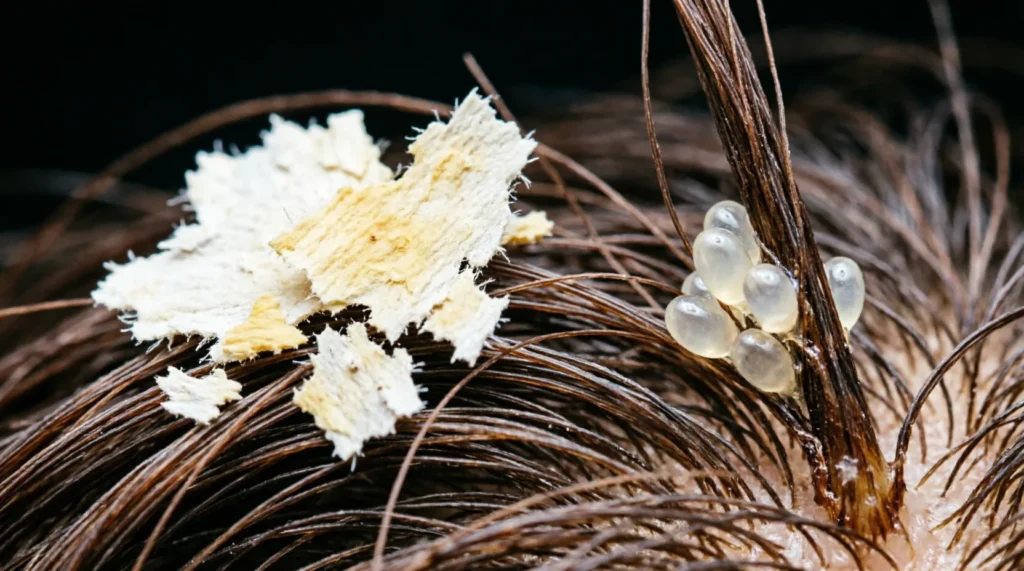
Quick answer: Dandruff consists of loose, irregular white flakes that brush off easily, while lice eggs (nits) are tiny, oval-shaped capsules firmly glued to individual hair shafts near the scalp. If it wipes away with a tissue, it is dandruff; if it stays stuck and requires fingernail pressure to slide off, it is a nit.
Confusing dandruff with lice eggs is one of the most common anxieties parents and individuals face when spotting white specks in their hair. The visual similarity is undeniable at a glance, but the biological reality could not be more different. One is a harmless skin condition involving dead skin cells, while the other is a parasitic infestation requiring immediate treatment. I have spent years editing health content and advising worried parents, and I can tell you that misidentifying these two leads to either unnecessary panic or delayed treatment. Understanding the distinct physical characteristics of each allows you to resolve the mystery in seconds without needing a microscope.
| Term | Meaning / When to use | Example sentence |
|---|---|---|
| Dandruff | Loose, white or yellowish flakes of dead skin that shed from the scalp; not attached to the hair shaft. | “She noticed white flakes on her black blazer, confirming she had a mild case of dandruff.” |
| Lice Eggs (Nits) | Tiny, oval, yellowish-white eggs firmly cemented to the base of individual hair strands by a glue-like substance. | “The school nurse identified several nits attached to the hair shafts behind the child’s ears.” |
When to Use Dandruff
Dandruff is a chronic skin condition characterized by the shedding of dead skin cells from the scalp. It is not contagious and does not involve any living organism invading your body. According to Wikipedia, dandruff can be caused by seborrheic dermatitis, dry skin, or an overgrowth of a yeast-like fungus called Malassezia. The key identifier here is mobility and texture. Dandruff flakes are irregular in shape, often larger than lice eggs, and they sit loosely on top of the hair or scalp.
You should identify a speck as dandruff when it exhibits the following behaviors:
- It falls off easily. If you run your fingers through your hair or shake your head, dandruff will drift down onto your shoulders or collar.
- It varies in size. Dandruff flakes are rarely uniform. You will see a mix of large, visible sheets and smaller, dust-like particles.
- It appears across the scalp. Dandruff is usually widespread, covering large areas of the head rather than clustering in specific spots.
- It responds to washing. Using a standard anti-dandruff shampoo containing zinc pyrithione or selenium sulfide will significantly reduce the flaking within a few washes.
Consider this real-world example from a corporate setting. An employee sends an email to HR concerned about hygiene complaints. Upon inspection, you see white specks on their dark suit jacket. You ask them to tilt their head forward and gently brush their hair with a clean hand. The white particles fall freely onto the desk. This is dandruff. The fix is simple: recommend a moisturizing scalp treatment or an over-the-counter medicated shampoo. There is no need for isolation or harsh chemical treatments.
Another common scenario involves resume reviews or professional headshots. I frequently edit profiles where candidates worry that visible scalp flakes look unprofessional. In these cases, the “specks” are clearly irregular and scattered. They do not cling to specific hairs. Identifying this correctly saves the candidate from the embarrassment of treating a non-existent lice problem with toxic pesticides.
When to Use Lice Eggs
Lice eggs, commonly known as nits, are the reproductive stage of the head louse (Pediculus humanus capitis). Unlike dandruff, nits are living organisms in development. They are laid by adult female lice and secured to the hair shaft with a powerful, waterproof adhesive. This glue is so effective that normal washing, brushing, or blowing air on the hair will not dislodge them. According to Wikipedia, head lice are obligate ectoparasites, meaning they must live on the human host to survive.
You should identify a speck as a lice egg when it exhibits these specific traits:
- It is firmly attached. A nit will not fall out when you shake your head. It requires significant effort, often using a fine-toothed comb or fingernails, to slide it down the hair shaft.
- It is uniform in shape. Nits are tiny, oval-shaped capsules, roughly the size of a knot in a thread. They look like teardrops or footballs.
- It is located close to the scalp. Female lice lay eggs within 6 millimeters of the scalp because the heat is necessary for incubation. As the hair grows, the nit moves further away, but viable eggs are always found near the root.
- It changes color. Fresh nits are often yellowish or brownish. Empty hatched shells appear white or clear but remain stuck to the hair.
Let’s look at a practical example from a elementary school context. A parent calls the school nurse because their child is scratching their head behind the ears. The nurse parts the hair and uses a bright light. She sees tiny, oval objects glued tightly to the hair strands, about half an inch from the scalp. When she tries to wipe them with a tissue, they do not move. She has to pinch them and slide them off. These are nits. The correct action is to notify the parents immediately and begin a lice treatment protocol, such as using permethrin lotion or wet-combing techniques.
A second example involves a teenager who recently attended a sleepover. They notice intense itching and small red bumps on their neck. Upon closer inspection with a mirror, they find small, grain-like objects attached to individual hairs near the nape of the neck. These objects are not flaky; they are solid and smooth. This is a classic presentation of a lice infestation. Misidentifying these as dandruff would lead to using anti-flake shampoo, which does nothing to kill the parasites or remove the glue, allowing the infestation to spread to siblings or classmates.
How to Remember the Difference
The confusion between dandruff and nits persists because both appear as white specks against dark hair. However, the memory trick is simple: Stick vs. Slide.
Dandruff Slides. It is loose debris. Think of snow falling from a roof. It is dead material that has already detached from its source. If you can blow it away or brush it off with zero resistance, it is dandruff.
Nits Stick. They are glued on. Think of barnacles on a ship or tape on a package. They are attached with biological cement. If you have to pinch, pull, or scrape to remove it, it is a nit.
I teach this to parents using the “Fingernail Test.” Take a single suspected speck. Place it between your thumbnail and index finger. Try to slide it along the hair strand. If it moves effortlessly up and down the hair like a bead on a string, it might be a nit that has already hatched or is loose, but if it is truly glued, it will resist movement until you apply pressure to crush or pop it. Dandruff, by contrast, will crumble into dust or fall off entirely before you even apply pressure. Another way to remember is location: Dandruff is everywhere; nits are strategic. Lice prefer warm areas, so check behind the ears and at the nape of the neck first. If the specks are only in those warm zones and are attached, suspect lice. If they are scattered all over the crown and sides, suspect dandruff.
Common Mistakes and Exceptions
Even with the rules above, edge cases exist. One common mistake is confusing hair casts or product buildup with nits. Hair casts are sleeve-like structures that surround the hair shaft and can slide freely, unlike nits. Product buildup from hairspray or gel can harden into white clumps that look like flakes but are sticky. To differentiate, wash the hair thoroughly. If the specks disappear, it was product. If they remain glued, they are nits. If they fall off during washing, they were likely dandruff or product.
Another exception is dry scalp vs. oily dandruff. Dry scalp produces small, white, non-oily flakes that fall easily. Seborrheic dermatitis produces larger, yellowish, oily flakes that may stick to the scalp but still do not attach to the hair shaft with glue. Both are forms of dandruff/skin shedding, not lice. People often mistake the oily, sticky nature of seborrheic flakes for nits because they don’t fall as easily as dry scalp flakes. However, they still lack the distinct oval shape and firm attachment to a single hair strand that defines a nit.
Geographical and cultural differences also play a role. In some regions, home remedies like olive oil or mayonnaise are used to treat both conditions. While oil can suffocate lice, it does not remove the glue holding the nits, leading to false negatives where parents think the treatment worked because the lice died, but the nits remain and hatch later. Conversely, using lice shampoo on dandruff can irritate the scalp further, worsening the flaking. Always diagnose before treating.
A frequent error in professional settings is assuming that cleanliness prevents lice. This is false. Lice prefer clean hair because it is easier for them to attach their eggs to the shaft. Dandruff, however, is often associated with hygiene issues or skin conditions. Therefore, having a clean scalp does not rule out lice, and having a flaky scalp does not confirm it. The physical attachment test remains the only reliable diagnostic tool.
Frequently Asked Questions
Can you get lice from sharing hats if you have dandruff? Yes, you can still get lice from sharing hats regardless of whether you have dandruff. Dandruff is a skin condition and offers no protection against parasitic infestations. Lice spread through direct head-to-head contact or shared personal items.
Do lice eggs look different on blonde hair versus dark hair? The shape and attachment method of lice eggs remain the same regardless of hair color. However, nits are much harder to spot on blonde or light-colored hair because they blend in, whereas they stand out starkly against dark hair. Dandruff is also less visible on light hair.
If I find one nit, do I have an infestation? Finding a single nit does not necessarily mean an active infestation, but it is a strong indicator. You should carefully check the rest of the scalp for live lice or additional nits. If you find only one empty shell far from the scalp, it may be an old residue. If you find multiple nits close to the scalp, treatment is required.
Can dandruff turn into lice? No, dandruff cannot turn into lice. They are completely unrelated biological phenomena. Dandruff is shed skin cells, while lice are insects. One does not evolve into or cause the other, though scratching due to dandruff itchiness can create scalp wounds that might theoretically make the scalp more susceptible to irritation from lice bites if an infestation occurs separately.

Kimberly Sanchez holds a Bachelor’s degree in Linguistics from UCLA and has spent over a decade working as a language consultant and educator. Her journey in the world of words began with a curiosity about how language shapes our perception of the world. With a keen eye for detail and a knack for making complex concepts accessible, Kimberly specializes in the nuances of English word comparisons and their real-world implications. She joined WordCompareHub to share her insights on frequently confused words and to promote a deeper understanding of language accuracy. Kimberly writes content that is both enlightening and practical, aimed at readers who seek to enhance their communication skills. Outside of her professional pursuits, she is an avid reader and enjoys exploring multilingual environments to observe linguistic diversity in action.