

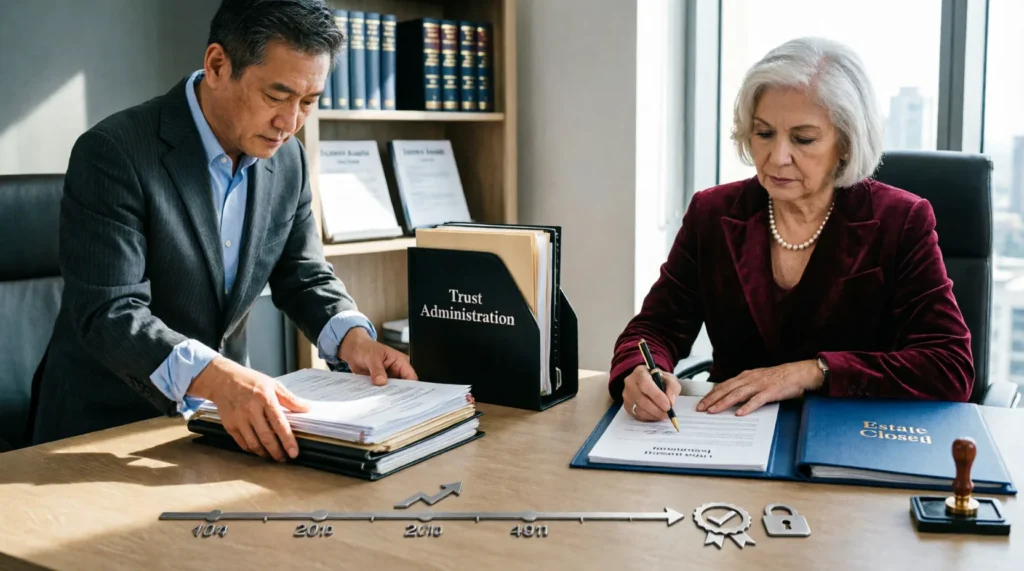
Quick answer: An executor manages a deceased person’s probate estate under court supervision, while a trustee manages assets held in a trust The executor’s authority ends when probate closes; the trustee’s duties continue as long as the trust exists.
People often confuse these two roles because both involve managing someone else’s money after death. However, the legal frameworks, timelines, and responsibilities differ significantly. Understanding the distinction is crucial for anyone drafting a will or establishing a trust, as choosing the wrong person—or failing to appoint either—can lead to costly delays and family disputes. I have reviewed countless estate documents where this confusion caused unnecessary complications, so let us clarify exactly what each role entails.
| Term | Meaning / When to use | Example sentence |
|---|---|---|
| Executor | A person named in a will to administer the probate estate, pay debts, and distribute assets under court oversight. | “The court appointed Sarah as the executor of her father’s will to handle the probate process.” |
| Trustee | A person or entity appointed to hold and manage assets placed in a trust for the benefit of beneficiaries. | “As the trustee of the family education fund, Mark ensures the money is used only for tuition costs.” |
When to Use Executor
An executor, sometimes called a personal representative, steps into action only after a person dies and their will is submitted to probate court. This role is strictly tied to the probate process, which is the legal procedure for validating a will and transferring ownership of assets that were solely in the deceased’s name. an executor is the person responsible for executing the instructions contained in a will Executor.
You need an executor when assets are not held in a trust, joint tenancy, or other non-probate vehicles. Their primary duty is to settle the estate efficiently and legally. This involves locating all assets, notifying creditors, paying valid debts and taxes, and finally distributing what remains to the heirs named in the will.
Here are common scenarios where an executor’s involvement is essential:
- Selling real estate owned solely by the deceased. If your mother owned her home in her name alone, the executor must obtain court authority to sell it and transfer the proceeds.
- Closing bank accounts. Banks will freeze individual accounts upon notice of death. The executor provides the death certificate and letters testamentary (court documents proving their authority) to release funds.
- Defending the will against challenges. If a disgruntled relative contests the validity of the will, the executor represents the estate in court to uphold the deceased’s wishes.
Consider this real-world example from a client’s email: “I thought I could just transfer Dad’s brokerage account to my name since I’m the oldest child, but the broker said I need letters testamentary from the executor first.” This illustrates the executor’s exclusive authority to access and move probate assets. Without this formal appointment, no individual has the legal right to touch those assets.
When to Use Trustee
A trustee operates under a completely different legal structure: the trust. A trust is a fiduciary arrangement created during the grantor’s lifetime (in the case of a revocable living trust) or at death (testamentary trust). The trustee holds legal title to the trust assets and manages them for the benefit of the beneficiaries, following the rules set out in the trust document. Unlike an executor, a trustee does not typically go through probate court, which allows for greater privacy and speed.
You rely on a trustee when you want to avoid probate, control how assets are distributed over time, or protect assets from creditors. The trustee’s powers begin immediately upon the grantor’s death (or incapacity, if specified) and do not require court approval to act. This makes the trustee’s role more continuous and less bureaucratic than that of an executor.
Common duties of a trustee include:
- Managing investments. If the trust holds stocks or rental properties, the trustee must manage these prudently, often following specific investment guidelines in the trust document.
- Making discretionary distributions. Many trusts allow the trustee to decide when and how much money to give beneficiaries based on needs like health, education, or support.
- Filing trust tax returns. Trusts are separate taxable entities, so the trustee must ensure annual income tax returns are filed correctly.
For instance, in a recent resume review, I saw a candidate list “Managed $2M family trust as successor trustee” under professional experience. This highlights the ongoing, active management nature of the role. Another example comes from a text message I received from a colleague: “Mom’s trust says the trustee can pay for my grad school directly to the university, so I don’t even see the cash.” This demonstrates the trustee’s ability to make direct payments without distributing lump sums to beneficiaries.
How to Remember the Difference
The easiest way to distinguish these roles is to focus on the venue of their authority. Think of the Executor as working with the Estate in Everyone’s view (probate court is public record). They are the court’s officer. In contrast, think of the Trustee as working with the Trust in Total privacy. They answer to the trust document and the beneficiaries, not a judge.
Another helpful mnemonic is the timeline. An executor’s job is finite: they open the estate, clean it up, and close it. It is a project with a clear end date. A trustee’s job is often ongoing: they may manage assets for decades, making distributions as conditions are met. If you imagine a relay race, the executor runs the first leg (getting assets out of probate), and then hands the baton to the trustee (who manages the assets long-term). However, note that one person can serve in both roles if the will pours assets into a trust upon death, but the hats they wear remain distinct.
Common Mistakes and Exceptions
One frequent error I encounter is assuming that being named an executor gives you power over trust assets. It does not. If a house is titled in the name of the “Smith Family Trust,” the executor of John Smith’s will has zero authority over it. Only the trustee can sell or manage that house. Mixing these boundaries leads to rejected deeds and frustrated buyers.
Another common mistake is failing to update successor trustees. People diligently update their wills and executors but forget that the trust document names its own trustees. If your original trustee dies or becomes incapacitated, and you did not name a successor in the trust agreement, the court may need to intervene, defeating the purpose of avoiding probate.
There are also jurisdictional differences. In some states, the term “personal representative” replaces “executor” in legal statutes, though the function remains the same. Additionally, while executors are almost always individuals, trustees can be corporate entities like banks or trust companies. This is rare for executors, as courts prefer accountable individuals for probate administration.
It is also worth noting that the concept of difference is fundamental in law, where precise definitions determine rights and obligations Difference. Confusing these two roles blurs the line between probate and non-probate assets, which can invalidate transactions. For example, if an executor tries to withdraw money from a trust-owned bank account, the bank will rightfully deny the request because the executor lacks standing over trust property.
Frequently Asked Questions
Can the same person be both the executor and the trustee? Yes, it is very common for a spouse or adult child to serve in both roles, especially if the will directs assets into a trust upon death. However, they must keep separate records for each role because the legal duties and standards of care differ.
Which role pays more for their services? Both executors and trustees are entitled to reasonable compensation, often defined by state law or the governing document. Trustees may earn more over time because their role can last for years, whereas an executor’s fee is a one-time payment for closing the estate.
Do I need a lawyer to act as an executor or trustee? No, you do not need to be a lawyer to serve in either role. However, the complexity of the estate or trust may make professional legal advice necessary. Many people choose corporate trustees for large or complex trusts to ensure impartiality and expertise.
What happens if an executor or trustee steals money? Both roles are fiduciaries, meaning they have a legal duty to act in the best interest of the beneficiaries. If they misappropriate funds, beneficiaries can sue them for breach of fiduciary duty, and criminal charges may apply. Courts take these violations seriously and can remove the individual and order restitution.

Nathan Williams is a seasoned editor and writer with a passion for the subtleties of the English language. With a degree in English from NYU and more than 12 years of editorial experience, he has honed his expertise in spelling accuracy and the comparison of often-misused words. Nathan’s foray into language analysis was sparked by his desire to help others communicate more effectively and avoid common pitfalls in writing. At WordCompareHub, he crafts comprehensive guides and articles that discuss word usage distinctions and provide effective spelling strategies. Nathan is driven by the belief that clarity in language is key to effective communication. In his leisure time, he enjoys crosswords and participates in local word games, continually expanding his lexicon and sharpening his linguistic skills.