

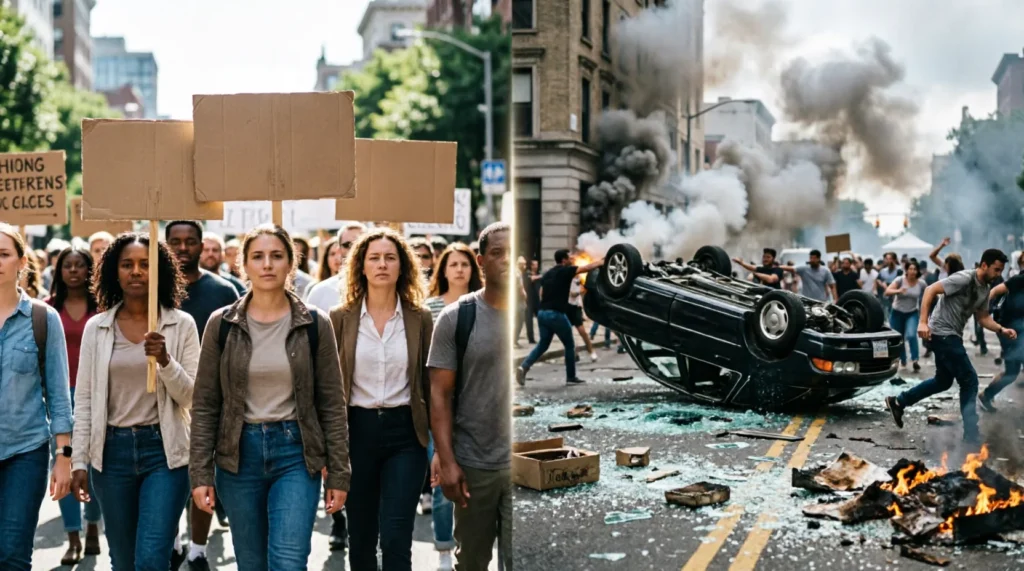
Quick answer: A protest is a lawful, organized expression of dissent protected by constitutional rights, while a riot is an illegal, violent public disturbance involving three or more people that creates immediate danger to persons or property. The critical difference lies in violence, legality, and intent# Difference Between Riot and Protest: Why the Distinction Matters
Quick answer: A protest is a lawful, organized expression of dissent protected by free speech rights, while a riot is an unlawful, violent disturbance involving destruction or threat to public safety. The core difference between riot and protest lies in legality, intent, and conduct—not just the size of the crowd.
People often use these terms interchangeably in heated political debates, but they describe fundamentally different events with distinct legal consequences. Understanding the difference between riot and protest is essential for accurate journalism, informed civic participation, and clear communication. Confusing the two can mischaracterize peaceful demonstrators as criminals or downplay genuine violence as legitimate dissent.
| Term | Meaning / When to use | Example sentence |
|---|---|---|
| Protest | A lawful, organized public demonstration expressing objection or support for a cause | Thousands gathered for a peaceful protest against the new zoning laws. |
| Riot | An unlawful, violent disturbance by a crowd involving destruction, looting, or threat to public safety | The police declared a riot after demonstrators began smashing storefront windows and setting cars on fire. |
When to use protest
Use “protest” when describing a planned, nonviolent gathering where people express disagreement with a policy, action, or social condition. Protests are protected forms of assembly in democratic societies and typically involve permits, designated routes, and coordination with local authorities. The key characteristics include organization, clear messaging, and adherence to legal boundaries.
Protests can take many forms: marches, sit-ins, vigils, picket lines, or rallies. What unites them is the intent to communicate a message through visible, collective presence rather than through force or destruction. As noted in discussions about social Difference, the distinction between acceptable and unacceptable collective action often hinges on whether participants remain within legal frameworks.
Here are realistic examples showing correct usage:
- Email to a colleague: “I’ll be late to the morning meeting because I’m attending the climate protest downtown. The organizers have a permit, and it’s expected to remain peaceful.”
- News headline: “Students stage silent protest outside university administration building demanding tuition freeze.”
- Social media post: “Proud to join 5,000 neighbors at today’s housing justice protest. Signs up, voices heard, no incidents reported.”
When you see crowds holding signs, chanting slogans, marching along approved routes, or sitting peacefully in a public space, you are witnessing a protest. Law enforcement may monitor these events, but their role is typically to facilitate safe passage and protect participants’ rights rather than to disperse the crowd.
When to use riot
Use “riot” when describing an unlawful assembly that has escalated into violence, property destruction, or serious threats to public order. Riots are criminal events, not protected speech. The transition from protest to riot occurs when participants engage in acts such as arson, looting, assault, or widespread vandalism that endanger people and damage property.
Legal definitions vary by jurisdiction, but most require evidence of violent conduct by three or more people acting with common purpose. The critical factor is not the protesters’ original grievance but their current behavior. A group can begin as lawful protesters and become rioters if they cross into criminal activity. Conversely, a spontaneous outbreak of violence without political messaging still qualifies as a riot.
According to analyses of civil unrest and the spatial dynamics of conflict Between lawful and unlawful assembly, the line is crossed when the primary activity shifts from expression to destruction.
Here are realistic examples showing correct usage:
- Police press release: “At approximately 9:45 PM, the peaceful demonstration devolved into a riot when individuals began breaking windows at retail stores on Main Street. Officers deployed tear gas to restore order.”
- Resume bullet (journalism experience): “Covered the 2020 civil unrest, distinguishing between daytime protests and nighttime riots in my reporting to ensure accurate terminology.”
- Text message to family: “Stay away from the downtown area tonight. What started as a protest turned into a riot hours ago, and there’s still active looting.”
Key indicators of a riot include: fires set intentionally, storefronts smashed and goods stolen, vehicles overturned or burned, physical attacks on individuals or officers, and a general breakdown of public order. Law enforcement responds to riots with crowd-control tactics aimed at stopping criminal activity, which may include curfews, mass arrests, and the use of non-lethal force.
How to remember the difference
The simplest mnemonic is: Protest = Peaceful; Riot = Ruin.
If the event involves protecting property and respecting law, it’s a protest. If it involves ruining property and breaking law, it’s a riot. This alliteration makes it easy to recall under pressure, such as when writing quickly during breaking news or drafting a statement.
Another editor-level insight: check the verbs associated with the event. Protests involve marching, chanting, holding, gathering, and speaking. Riots involve smashing, burning, looting, attacking, and destroying. If your sentence requires violent action verbs, you’re likely describing a riot, not a protest.
I’ve corrected this confusion countless times in newsroom copy. A junior reporter once wrote, “The riot drew 10,000 peaceful participants.” That sentence is self-contradictory. You cannot have a peaceful riot. The fix was simple: “The protest drew 10,000 peaceful participants before a small faction sparked a riot later that evening.” Precision matters because it assigns responsibility accurately and avoids stigmatizing entire movements for the actions of a few.
Common mistakes and exceptions
Mistake 1: Calling any large, loud crowd a riot. Size and volume do not define a riot. A protest with 50,000 people chanting loudly is still a protest if no violence occurs. Media outlets sometimes sensationalize by using “riot” loosely, but this is inaccurate and inflammatory.
Mistake 2: Assuming all protests remain peaceful. Some protests escalate. The correct phrasing acknowledges the transition: “What began as a protest descended into a riot when…” This preserves accuracy about both the initial intent and the subsequent criminal conduct.
Mistake 3: Using “riot” to describe minor scuffles. A fistfight between two individuals at a rally is assault, not a riot. Riots require broader disorder involving multiple participants and significant disruption. Isolated incidents of violence within a larger peaceful protest do not automatically convert the entire event into a riot.
US vs. UK differences: Both countries distinguish between lawful protest and unlawful riot, but legal thresholds vary. In the UK, the Public Order Act 1986 defines riot as 12 or more people present together using or threatening unlawful violence with common purpose. In the US, state laws differ, but most require three or more people engaging in violent conduct. Despite these numerical differences, the conceptual distinction remains consistent: legality and violence separate the two.
Exception: “Riot” as metaphor. In informal speech, people say “The party was a riot” to mean it was wildly fun. This idiomatic usage is unrelated to civil unrest and causes no confusion in context. However, avoid this metaphor when discussing actual civil disorder, as it trivializes serious criminal conduct.
Frequently Asked Questions
Can a protest turn into a riot? Yes. If participants in a lawful protest begin engaging in violence, destruction, or looting, the event transitions from protest to riot. The original purpose does not shield subsequent criminal acts from being classified as riotous conduct.
Is it ever correct to call a violent protest a “peaceful riot”? No. This is an oxymoron. By definition, a riot involves unlawful violence or destruction. If violence occurs, the event is no longer peaceful, regardless of the participants’ initial intentions. Use precise language: “a protest that escalated into a riot.”
Do journalists have to wait for police to declare a riot before using the word? Ideally, yes. Official declarations provide legal clarity and reduce liability for mischaracterization. However, if violent conduct is clearly visible and ongoing, reporters may describe the behavior factually (“demonstrators smashed windows and set fires”) even before an official riot declaration, avoiding the label until confirmed.
What should I write if I’m unsure whether an event was a protest or a riot? Describe the observable facts without labeling. Write: “Crowds gathered to demonstrate against the policy. Later, some individuals broke windows and clashed with police.” Let readers draw conclusions from specific actions rather than applying potentially loaded terms prematurely. Accuracy trumps speed.

Brian Garcia has always been fascinated by the intricacies of the English language. With a Master’s degree in English Literature from the University of Chicago and over 15 years of experience in the field, Brian has dedicated his career to unraveling the complexities of word usage, comparisons, and spelling. His expertise lies in breaking down commonly confused words, helping readers gain clarity and confidence in their language skills. What drew Brian to this field was his passion for storytelling and his love for the art of communication. As a content creator for WordCompareHub, he focuses on engaging readers with insightful articles that demystify tricky word pairs and offer practical spelling tips. In his free time, Brian enjoys delving into etymology and exploring the evolution of words through history.