

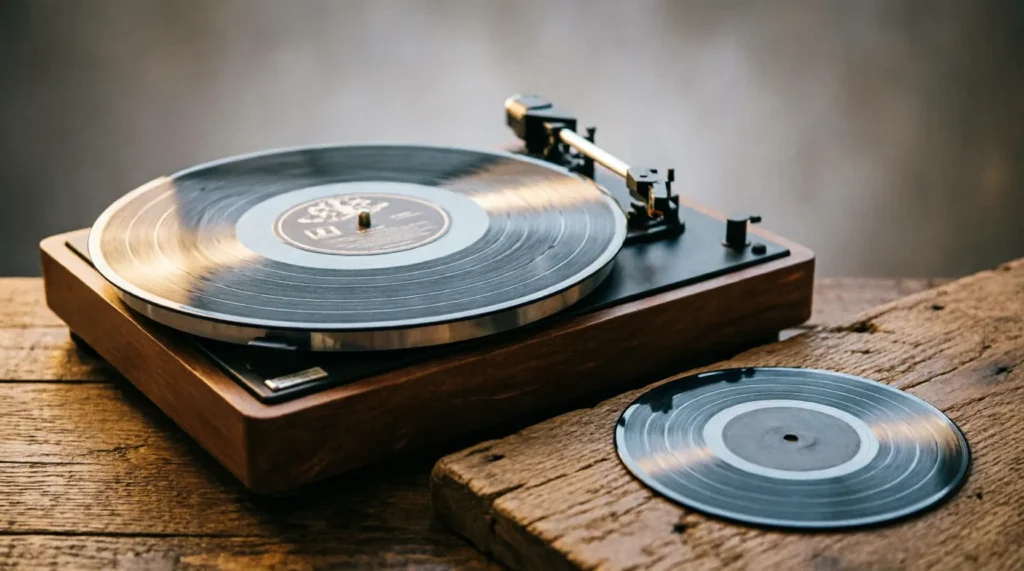
Quick answer: “Vinyl” refers to the physical plastic material (polyvinyl chloride) used to manufacture records, while “LP” stands for “Long Play” and describes a specific 12-inch format that plays at 33⅓ RPM. All LPs are vinyl records, but not all vinyl records are LPs; use “vinyl” when discussing the medium or collecting in general, and use “LP” only when specifying the full-length album format.
I see this confusion constantly in music journalism drafts, record store newsletters, and even catalog descriptions from major labels. Writers frequently use “LP” as a catch-all synonym for any black disc with grooves, which is technically incorrect and signals a lack of domain expertise to serious collectors. The terms are related but distinct: one describes what the object is made of, and the other describes how it functions within a standardized playback system. Understanding this distinction matters because using them interchangeably can make your writing feel imprecise to an audience that cares deeply about audio formats and pressing specifications.
| Term | Meaning / When to Use | Example Sentence |
|---|---|---|
| Vinyl | The PVC plastic material; the general medium for analog sound recordings | I prefer buying new releases on vinyl because the packaging is superior to streaming art. |
| LP | A specific 12-inch, 33⅓ RPM long-playing album format containing multiple tracks per side | The original 1959 mono LP has significantly better dynamic range than the stereo reissue. |
When to Use Vinyl
Use “vinyl” whenever you are referring to the physical substance, the collectible medium as a whole, or the cultural phenomenon of record collecting. This is the umbrella term that encompasses 7-inch singles, 10-inch EPs, 12-inch maxi-singles, flexi-discs, picture discs, and yes, LPs. In my years editing music copy, I have found that “vinyl” is almost always the safer, more accurate choice for general references because it avoids making assumptions about format that may be wrong. If you are writing a gift guide, discussing market trends, or describing the tactile experience of owning physical music, “vinyl” is correct.
Consider these real-world applications where “vinyl” is the only appropriate term:
- Retail and e-commerce category names: A website navigation menu should read “New Vinyl Arrivals,” not “New LP Arrivals,” because the category includes 7-inch singles and box sets that are not LPs. Using “LP” here would mislead customers looking for non-album formats and create filtering errors in inventory management systems.
- Condition grading and sales listings: On Discogs or eBay, sellers write “Vinyl condition: Near Mint (NM)” rather than “LP condition: NM” because the grade applies to the physical surface of the disc regardless of its diameter or speed. A 7-inch single graded VG+ is still being evaluated as vinyl, and calling it an “LP” in the condition field would confuse buyers and violate marketplace taxonomy standards.
- Cultural commentary and trend reporting: When a journalist writes “Vinyl sales surpassed CDs in 2023 for the first time since 1987,” they are citing aggregate industry data that includes all formats. Replacing “vinyl” with “LP” in this sentence would be factually wrong because the RIAA and BPI track revenue across all physical analog formats, not just full-length albums.
The key editorial test is simple: if swapping the word for “plastic disc” or “record” maintains the sentence’s truth value, “vinyl” is likely correct. According to Difference, distinguishing between a general class and a specific subclass requires precision in terminology to avoid logical fallacies in technical writing. Applying this principle to audio formats means reserving “LP” for its narrow definition and defaulting to “vinyl” for everything else.
When to Use LP
Use “LP” exclusively when you need to specify the 12-inch, 33⅓ RPM long-play album format introduced by Columbia Records in 1948. This term carries precise technical and historical weight: it denotes a playing time of approximately 20–25 minutes per side, microgroove technology, and a specific rotational speed that distinguishes it from 78 RPM shellac discs, 45 RPM singles, and 16⅔ RPM spoken-word records. In professional audio engineering, archival work, and serious collector discourse, “LP” is never a generic synonym; it is a specification. Misusing it erodes credibility instantly among knowledgeable readers.
Here are concrete scenarios where “LP” is mandatory and “vinyl” would be insufficient or misleading:
- Discography entries and database metadata: When cataloging Miles Davis’s Kind of Blue, the entry must specify “Format: LP, Mono, 1959 US Pressing” because there also exist 7-inch EP excerpts, CD reissues, and digital downloads of the same title. Omitting “LP” or substituting “vinyl” fails to distinguish this specific artifact from other manifestations of the same musical work, which defeats the purpose of bibliographic control.
- Technical reviews and audiophile comparisons: A review stating “The 2023 Mobile Fidelity One-Step LP uses a lower-noise compound than standard pressings” communicates exact product specifications that matter to buyers spending $125+. Writing “vinyl” instead would obscure the fact that this is a premium-format release with unique mastering characteristics tied specifically to the LP production chain, not just another record made of PVC.
- Historical narratives and format evolution: When explaining why the Beatles’ Sgt. Pepper was conceived as a cohesive artistic statement, writers must reference “the LP format” because the album’s structure exploited the extended playing time that defined LPs against the three-minute limitation of singles. Saying “vinyl” here collapses a crucial technological constraint into mere materiality and loses the explanatory power of format history.
Remember that “LP” originated as a trademarked Columbia designation before becoming genericized, much like “Kleenex” or “Band-Aid.” But unlike those consumer goods, “LP” retained strict technical parameters in specialist usage. According to Between, relational terms derive meaning from their position within a system of contrasts; “LP” only makes sense in opposition to “single,” “EP,” and “78,” so deploying it outside that comparative framework strips it of semantic content.
How to Remember the Difference
After correcting hundreds of manuscripts, I developed a mnemonic that sticks because it ties the acronym directly to its functional origin rather than relying on abstract association. Think “LP = Long Play, Not Just Plastic.” The letters L and P literally encode the format’s defining characteristic: extended duration enabled by slower rotation and finer grooves. Every time you consider writing “LP,” ask yourself whether the sentence hinges on playing time or album structure. If the answer is no—if you could replace the term with “record,” “disc,” or “pressing” without losing information—then you actually mean “vinyl.”
A secondary editor-level insight involves testing with substitution. Try replacing your chosen term with “7-inch single” in the same sentence. If the resulting statement becomes obviously false or absurd, you were probably correct to use “LP” because you were referencing a format-specific attribute. For example, “This 7-inch single contains forty minutes of uninterrupted ambient drone” is patently impossible, confirming that the original subject was indeed an LP. Conversely, “I bought three 7-inch singles at the flea market” remains perfectly coherent, proving that “vinyl” was the appropriate general term in the unmodified sentence. This substitution test takes two seconds and prevents virtually every misuse I encounter in freelance submissions.
Common Mistakes and Exceptions
The most persistent error I correct in cover letters and bio drafts is writers claiming they “collect LPs” when their social media photos clearly show 7-inch punk singles and 10-inch jazz EPs dominating their shelves. The fix is always “collect vinyl” or “collect records.” Precision matters here because collectors who specialize in actual LPs often exclude non-LP formats from their scope, and misrepresenting your collection suggests unfamiliarity with community norms. Similarly, press releases announcing “a new LP” for what is actually a four-song 10-inch EP waste promotional opportunities by signaling the wrong format to reviewers and retailers who filter coverage by release type.
Another frequent mistake occurs in resale listings where sellers describe damaged items as “cracked LP” when the item is visibly a 7-inch single. Beyond being inaccurate, this creates customer service disputes and negative feedback because buyers expecting a 12-inch album receive something entirely different. Always measure and verify before listing. Edge cases do exist: some 12-inch releases play at 45 RPM and are marketed as “12-inch singles” or “maxi-singles” despite sharing the LP’s physical dimensions. These are not LPs, even though they are vinyl. Likewise, certain avant-garde and spoken-word releases used 16⅔ RPM on 12-inch discs; these occupy a gray area but are typically cataloged separately from standard LPs due to incompatible playback requirements.
Regional variation rarely affects this particular distinction, unlike spelling differences such as “colour/color.” Both American and British English maintain identical definitions for “LP” and “vinyl” in audio contexts. However, UK writers sometimes use “gramophone record” as a formal alternative to “vinyl” in heritage or museum settings, whereas American writers almost never employ this phrase outside historical quotation. Neither dialect uses “LP” generically in edited prose; the confusion is purely a matter of informal speech bleeding into written content. My standing advice to junior editors: when in doubt, default to “vinyl” for general references and reserve “LP” for sentences where removing the term would erase essential technical information.
Frequently Asked Questions
Is every vinyl record an LP? No, because vinyl records include 7-inch singles, 10-inch EPs, 12-inch maxi-singles, and novelty formats like flexi-discs that do not meet the LP specification of 12 inches at 33⅓ RPM with extended playing time. Only full-length albums pressed in that specific format qualify as LPs.
Can I call a CD or digital album an LP? Technically no, since LP refers to a physical analog format, but the music industry has adopted “LP” metaphorically to denote any full-length album release regardless of medium. In casual conversation this is accepted, but in technical writing, retail categorization, or collector discourse, restrict “LP” to actual vinyl pressings to maintain precision.
Why do people say “buying LPs” when they mean vinyl records generally? This is a case of synecdoche where the most culturally prominent subtype stands in for the entire category, similar to saying “watching films” when including television series. While common in spoken language, professional writers should avoid this shorthand because it obscures meaningful distinctions between formats that affect pricing, playback equipment, and archival handling.
Does “vinyl” include colored or picture discs? Yes, absolutely, because “vinyl” describes the base material (PVC) regardless of visual modifications like colorants, embedded images, or shaped edges. Colored and picture discs are still vinyl records, and if they meet the 12-inch/33⅓ RPM/extended-play criteria, they are also LPs; the aesthetic treatment does not change the fundamental format classification.

Brian Garcia has always been fascinated by the intricacies of the English language. With a Master’s degree in English Literature from the University of Chicago and over 15 years of experience in the field, Brian has dedicated his career to unraveling the complexities of word usage, comparisons, and spelling. His expertise lies in breaking down commonly confused words, helping readers gain clarity and confidence in their language skills. What drew Brian to this field was his passion for storytelling and his love for the art of communication. As a content creator for WordCompareHub, he focuses on engaging readers with insightful articles that demystify tricky word pairs and offer practical spelling tips. In his free time, Brian enjoys delving into etymology and exploring the evolution of words through history.