

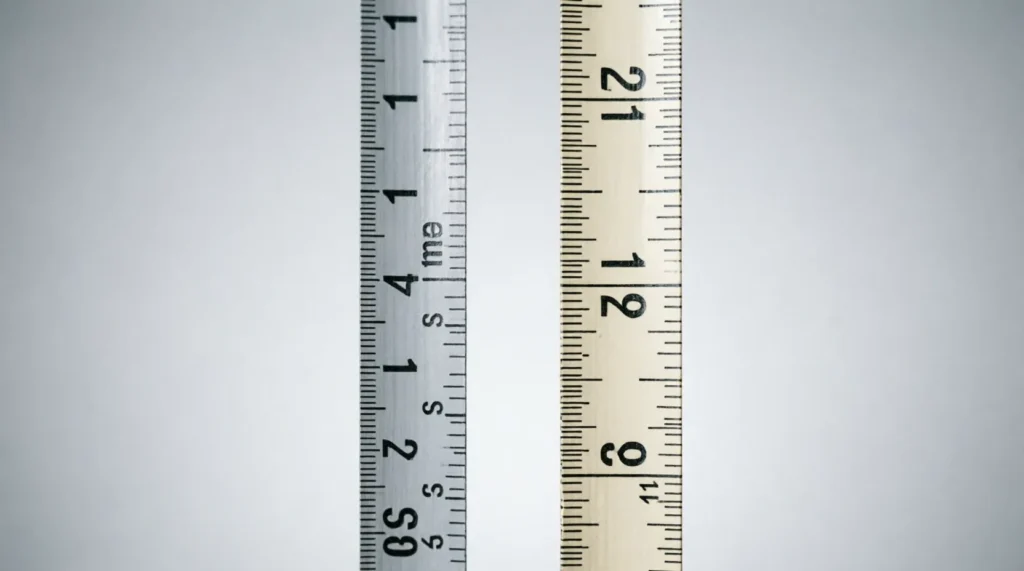
Quick answer: To convert meters to feet, multiply the meter value by 3.28084. To convert feet to meters, divide the foot value by 3.28084 (or multiply by 0.3048). One meter is exactly equal to 3.28084 feet.
The confusion between meters and feet isn’t just about spelling or grammar; it’s a fundamental clash between two measurement systems that governs how we describe height, distance, and depth in the modern world. While most of the globe has adopted the metric system, the United States, Liberia, and Myanmar still rely heavily on imperial units like feet. This creates frequent friction in international travel, engineering, sports, and even casual conversation. Knowing the precise conversion factor allows you to navigate these contexts without error, ensuring your data is accurate whether you are reading a European hiking trail map or specifying dimensions for a US-based construction project.
| Term | Meaning / When to use | Example sentence |
|---|---|---|
| Meter | The base unit of length in the International System of Units (SI), used globally for scientific, commercial, and everyday measurements. | “The swimming pool is 50 meters long, which is the standard Olympic distance.” |
| Foot | A unit of length in the imperial and US customary systems, equal to 12 inches or exactly 0.3048 meters, primarily used in the United States. | “The ceiling height in this apartment is 9 feet, which feels spacious.” |
When to use Meters
You should use meters when operating within any context that adheres to the International System of Units (SI). This includes nearly every country outside of the United States, as well as all international scientific, medical, and athletic standards. The meter was originally defined in the late 18th century as one ten-millionth of the distance from the equator to the North Pole, but today it is defined by the distance light travels in a vacuum in 1/299,792,458 of a second Source: Metre. This definition ensures extreme precision and reproducibility across borders.
In professional settings, using meters is non-negotiable if you are collaborating with international teams. For example, if you are an architect sending blueprints to a manufacturer in Germany, all dimensions must be in millimeters or meters. Using feet here would cause catastrophic manufacturing errors. Similarly, in track and field, races are measured in meters (100m, 400m, 5000m). Referring to a “100-yard dash” in an Olympic context shows a lack of familiarity with the sport’s global standards.
Here are three concrete examples of when meters are the correct choice:
- Scientific Research: “The sample was heated to a temperature gradient of 5 meters per second wind speed simulation.” (Note: While wind is often m/s, distance in physics experiments is strictly metric).
- International Travel: “The hiking trail to the summit is 4.2 meters kilometers long.” (Hikers in Europe will always see km and m, never miles or feet).
- Global Commerce: “The shipping container dimensions are 6.1 meters in length.” (Logistics worldwide uses metric tons and meters for cargo).
When to use Feet
You should use feet when communicating within the United States or in specific industries that have retained imperial standards despite global metrication. The foot is historically based on the length of a human foot, though it has been standardized over centuries. Today, one foot is legally defined as exactly 0.3048 meters Source: Conversion. This exact definition allows for precise conversion back and forth, but the cultural inertia of the foot remains strong in the US.
In the US, real estate, aviation, and construction predominantly use feet. If you are describing the height of a person in the US, you say “6 feet tall,” not “1.83 meters tall.” Doing the latter would mark you as an outsider or someone overly technical in a casual setting. In aviation, altitude is universally measured in feet, even in countries that otherwise use the metric system. This is a critical safety standard to prevent mid-air confusion during international flights.
Here are three concrete examples of when feet are the correct choice:
- US Real Estate Listing: “This charming bungalow features 10-foot ceilings and a 20-foot by 15-foot living room.”
- Aviation Communication: “Climb and maintain flight level three five zero (35,000 feet).”
- Casual US Conversation: “I’m trying to grow my tomatoes, but the fence is only 4 feet high, so the deer keep jumping over it.”
How to remember the difference
The easiest way to remember the conversion is to anchor yourself to a single, memorable number: 3.28.
One meter is roughly 3.28 feet. You can think of it this way: a meter is significantly longer than a yard (which is 3 feet). Since a yard is 3 feet, and a meter is a bit longer than a yard, it makes sense that a meter is a bit more than 3 feet. Specifically, it is 3 feet and roughly 3.37 inches.
For a quick mental estimate without a calculator:
- Multiply the meters by 3.
- Add 10% of that result.
For example, if you have 10 meters:
- 10 x 3 = 30
- 10% of 30 is 3
- 30 + 3 = 33 feet.
The actual answer is 32.8084 feet, so this estimate is incredibly close and sufficient for most casual purposes. Conversely, to go from feet to meters, divide by 3.3. If you are 6 feet tall, 6 divided by 3.3 is approximately 1.81 meters (actual is 1.8288).
Another mnemonic involves the word “Meter.” It has 6 letters. “Feet” has 4. This doesn’t help with math, but it helps with spelling. However, for conversion, remember: Meters are Major (larger), so you need more Feet to equal one Meter. Hence, the multiplier is greater than 1 (3.28).
Common mistakes and exceptions
One of the most common mistakes is confusing the conversion factor for square meters and square feet. Linear conversion does not apply to area. If 1 meter = 3.28 feet, then 1 square meter = 3.28 x 3.28 square feet, which is approximately 10.76 square feet. Many people erroneously multiply square meters by 3.28, leading to significant underestimation of area. This is critical in flooring or painting projects where material costs are involved.
Another frequent error occurs in mixed-unit environments, such as in the UK. While the UK officially uses the metric system, road signs are in miles and yards, and many older generations still refer to height in feet and inches. A tourist might see a sign indicating a clearance height of 4.5 meters and mistakenly think it is 4.5 feet, leading to a collision if driving a tall vehicle. Always check the unit symbol: ‘m’ for meters, ‘ft’ or ’ for feet.
In sports, confusion arises between track events. The US high school system often runs the 100-yard dash, while the rest of the world runs the 100-meter dash. These are different distances (91.44 meters vs 100 meters). Converting times between them requires adjusting for the 8.56-meter difference, not just a simple unit swap.
Additionally, be wary of “survey feet” in the United States. Prior to 1959, the US used a slightly different definition of the foot for land surveying. While the international foot (0.3048 m) is now standard, some old legal documents and maps may reference the US survey foot (0.3048006096 m). The difference is tiny (2 parts per million), but over long distances like state boundaries, it matters. For general purposes, ignore this, but be aware if you are doing precise land legal work.
Frequently Asked Questions
Is 1 meter exactly 3 feet? No, 1 meter is approximately 3.28084 feet. Using 3 feet as a conversion will result in an error of about 8.5%, which is significant for construction or scientific tasks.
How do I convert my height from feet to meters? Divide your height in feet by 3.28084. For example, if you are 5.5 feet tall, 5.5 / 3.28084 equals approximately 1.676 meters.
Which countries still use feet instead of meters? The United States, Liberia, and Myanmar are the only countries that have not fully adopted the metric system as their primary official system of measurement, though even in these nations, metric is used in science and medicine.
Why is the conversion factor 3.28084? This number comes from the exact definition established in 1959, where the international foot was defined as exactly 0.3048 meters. Therefore, 1 / 0.3048 equals 3.280839895…, which is rounded to 3.28084 for practical use.

Brian Garcia has always been fascinated by the intricacies of the English language. With a Master’s degree in English Literature from the University of Chicago and over 15 years of experience in the field, Brian has dedicated his career to unraveling the complexities of word usage, comparisons, and spelling. His expertise lies in breaking down commonly confused words, helping readers gain clarity and confidence in their language skills. What drew Brian to this field was his passion for storytelling and his love for the art of communication. As a content creator for WordCompareHub, he focuses on engaging readers with insightful articles that demystify tricky word pairs and offer practical spelling tips. In his free time, Brian enjoys delving into etymology and exploring the evolution of words through history.