

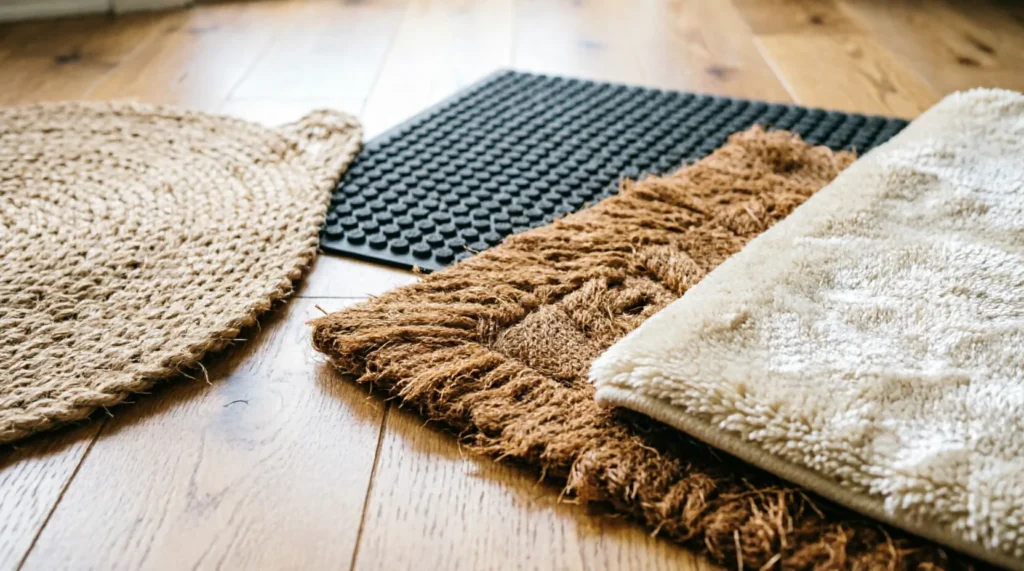
Quick answer: Use mats when referring to multiple individual floor coverings, protective pads, or picture frame borders. Use matting when describing the material itself, the collective bulk of such items, or the specific craft of inserting a border in a picture frame. In most general contexts involving countable objects, “mats” is the correct choice.
It is surprisingly common to see these two terms swapped in product descriptions, interior design blogs, and even professional framing invoices. The confusion stems from the fact that both words share the same root and refer to overlapping concepts. However, grammatical number and context dictate which one you should use. Getting this right matters for clarity in purchasing, inventory management, and professional communication. As an editor who has reviewed countless home improvement guides and art supply catalogs, I can tell you that mixing these up makes your writing look unpolished and imprecise.
| Term | Meaning / When to use | Example sentence |
|---|---|---|
| Mats | Plural noun; refers to distinct, countable individual items used for flooring, protection, or framing. | Please place the rubber mats at the entrance to catch the mud. |
| Matting | Mass noun or gerund; refers to the material substance, the process of creating mats, or the collective bulk of the item. | The framer recommended using acid-free matting to preserve the watercolor. |
When to use mats
Use mats when you are talking about more than one specific, discrete object. This is the standard plural form of the noun “mat.” If you can count them (one mat, two mats, three mats), you must use “mats” when referring to multiple units. This applies across various industries, from gym equipment to automotive accessories and art framing.
In the context of flooring and safety, mats are distinct items placed on the ground. mats are generally flat pieces of material placed on the floor or other surfaces for a variety of purposes, including cleaning footwear, providing comfort, or ensuring safety. When you buy a pack of doorstops or yoga pads, you are buying mats.
Here are three concrete examples where “mats” is the only correct choice:
- Email to a facilities manager: “Hi Sarah, the entrance mats in the lobby are worn out and need replacement before the client visit next Tuesday.” (Not “entrance matting are worn out.”)
- Resume bullet point: “Coordinated the installation of anti-fatigue mats for the assembly line, reducing worker complaints by 40%.” (Not “anti-fatigue matting for the assembly line.”)
- Text message to a spouse: “Can you pick up two new bath mats on your way home? The blue ones are moldy.” (Not “two new bath matting.”)
The key indicator here is quantification. If you are using a number (two, five, several) or a quantifier that implies distinct units (each, every), you are almost certainly referring to “mats.”
When to use matting
Use matting when you are referring to the material as a substance, the process of creating mats, or a collective mass that is not easily counted as individual units. It functions as a mass noun (like “sand” or “water”) or a gerund (a verb form ending in -ing that acts as a noun).
This distinction is critical in the art and framing world. When an artist talks about “matting,” they are often referring to the technique or the continuous roll of board material used to create the border around a piece of artwork. While the final product inside the frame might be called a “mat,” the raw material or the general category of the supply is “matting.” Wikipedia notes that matting can also refer to a dull finish or a tangled mass, but in the context of home and art, it primarily denotes the material composition.
Consider these scenarios where “matting” is the required term:
- Invoice from a framing shop: “Charge for 2 meters of cream-colored acid-free matting and labor for cutting.” (You are paying for the length of the material, not necessarily pre-cut individual units yet.)
- Product description for a craft store: “Our premium cotton matting is ideal for DIY projects and provides superior moisture absorption.” (Referring to the fabric/material type.)
- Interior design specification: “The hallway features natural coir matting installed wall-to-wall, rather than individual rugs.” (Here, it acts as a flooring material similar to carpeting, not discrete rugs.)
A helpful rule of thumb: if you can replace the word with “carpeting” or “flooring” and the sentence still makes sense structurally, “matting” is likely the correct choice. You would say “wall-to-wall carpeting,” not “wall-to-wall carpets.” Similarly, you say “coir matting,” not “coir mats” when it is installed as a continuous surface.
How to remember the difference
The easiest way to keep these straight is to focus on the suffix -ing. In English, words ending in “-ing” often describe a material, a substance, or an ongoing process (e.g., “cladding,” “flooring,” “painting”). Words without this suffix are typically the finished, countable objects (e.g., “clad,” “floor,” “paint” as a noun is tricky, but think “brick” vs “bricking”).
Think of it like hair vs hairs:
- Matting is like “hair” (the collective mass on your head). You brush your hair.
- Mats is like “hairs” (individual strands you might find on your shirt). You found three hairs on your collar.
Another powerful mnemonic is the Countability Test:
- Ask yourself: “Can I put a number directly in front of this word?”
- If yes (“three ___”), use mats.
- If no (“three ___” sounds wrong), use matting. You wouldn’t say “three matting,” but you would say “three mats.”
I have seen this error persist in inventory spreadsheets where warehouse managers list “50 units of matting.” This is incorrect. It should be “50 units of mats” or “50 square feet of matting.” Using the countability test prevents this logical error in business documentation.
Common mistakes and exceptions
One of the most frequent mistakes I encounter is in the realm of art framing. People often write, “I need to buy some mats for my photos,” when they are actually buying a large sheet of matboard to cut themselves. In this case, if they are buying the raw sheets, they are buying “matting” or “matboard.” If they are buying pre-cut borders ready to insert, they are buying “mats.” Precision here avoids confusion with suppliers.
Another common error occurs in landscaping and gardening. Gardeners often refer to “weed matting.” This is correct because it is usually sold in rolls and laid out as a continuous barrier. However, if they cut that roll into small squares to place under individual potted plants, those become “pots mats” or simply “mats.” The transition from mass noun to count noun happens at the point of division into discrete units.
There is also a regional nuance in industrial contexts. In some manufacturing sectors, “matting” might refer to a specific type of textured surface treatment applied to metal or glass to make it non-reflective (a matte finish). In this technical sense, “matting” is a process or a state, not an object. You would never say “apply some mats to the glass” to mean making it non-glossy. You would say “apply a matting finish.”
Finally, beware of the verb form. “To mat” means to become tangled or matted together. “The dog’s fur is matting” describes the process. “The dog has mats in its fur” describes the resulting clumps. Confusing the progressive verb (“is matting”) with the plural noun (“has mats”) is a grammatical slip that changes the meaning from an action to an object.
Frequently Asked Questions
Is “matting” ever used as a plural for “mat”? No, “matting” is not a plural noun. It is a mass noun or a gerund. The plural of “mat” is always “mats.” Using “matting” to mean multiple individual mats is grammatically incorrect.
Can I use “matting” to describe a single rug? Generally, no. A single, distinct rug or floor covering is a “mat.” You would only use “matting” if you are referring to the material it is made from (e.g., “a piece of rubber matting”) or if it is part of a continuous installed surface (e.g., “hallway matting”).
Which term should I use in an SEO product title for Amazon? If you are selling individual, pre-cut items, use “Mats” (e.g., “Yoga Mats for Home Gym”). If you are selling rolls of material or bulk supplies for crafting, use “Matting” (e.g., “Acid-Free Photo Matting Roll”). Matching the user’s intent—countable items vs. bulk material—is crucial for conversion.
Is there a difference between “mat board” and “matting”? In the framing industry, they are often used interchangeably, but “mat board” specifically refers to the rigid cardboard-like material. “Matting” is a broader term that can include the material, the process, or the finished border. For precision in technical specifications, “mat board” is preferred for the substrate, while “matting” is acceptable for the general category.

Nathan Williams is a seasoned editor and writer with a passion for the subtleties of the English language. With a degree in English from NYU and more than 12 years of editorial experience, he has honed his expertise in spelling accuracy and the comparison of often-misused words. Nathan’s foray into language analysis was sparked by his desire to help others communicate more effectively and avoid common pitfalls in writing. At WordCompareHub, he crafts comprehensive guides and articles that discuss word usage distinctions and provide effective spelling strategies. Nathan is driven by the belief that clarity in language is key to effective communication. In his leisure time, he enjoys crosswords and participates in local word games, continually expanding his lexicon and sharpening his linguistic skills.