

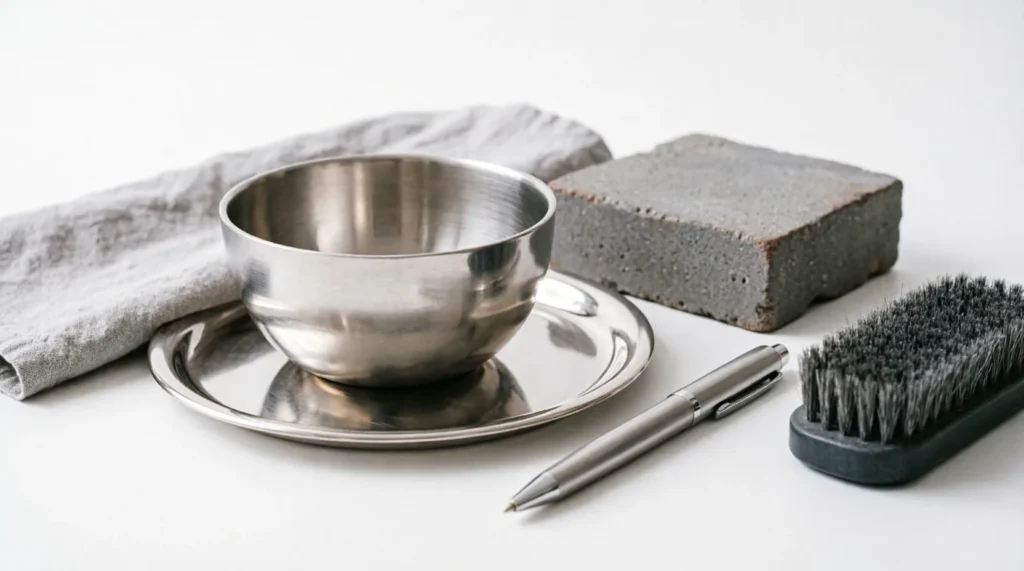
Quick answer: “Grey” is a neutral achromatic color between black and white, while “silver” is a metallic shade that mimics the luster of the element silver. In terms of spelling, “grey” is the standard British English form, whereas “gray” is preferred in American English; “silver” remains spelled the same globally.
The confusion between grey and silver often stems from their visual similarity in digital design and fashion, but they represent fundamentally different concepts in color theory and linguistics. While grey describes a lack of saturation and lightness, silver implies a specific reflective quality and metallic sheen. Understanding this distinction is crucial for designers, writers, and anyone aiming for precision in description, especially when navigating the nuances of British versus American English spelling conventions for the non-metallic term.
| Term | Meaning / When to use | Example sentence |
|---|---|---|
| Grey (UK) / Gray (US) | A neutral color with no hue, created by mixing black and white. Use for matte, flat, or non-reflective surfaces. | The storm clouds turned a dark grey before the rain began. |
| Silver | A metallic color that mimics the polished surface of the chemical element silver. Use for shiny, reflective, or luxurious contexts. | She wore a stunning silver gown that caught the light with every step. |
When to use Grey
Grey is an achromatic color, meaning it has no hue. It exists strictly on the spectrum between black and white. According to the Wikipedia article on Colour, color perception is derived from the spectral composition of light, and grey represents a balanced reduction in light intensity without shifting toward red, blue, or yellow. You should use “grey” when describing objects that are dull, matte, or lacking in luster.
In the context of spelling, it is vital to note regional differences. “Grey” is the standard spelling in British English, Canadian English, Australian English, and most other Commonwealth countries. If you are writing for a UK-based audience, always default to “grey.”
Here are three concrete examples of how I correct this in professional editing:
- Email Context: A client once wrote, “The office walls are painted a bright silver.” I corrected this to “The office walls are painted a light grey,” because paint is typically matte and lacks the reflective properties of metal.
- Resume Line: A job applicant listed, “Managed a team in a high-pressure, silver environment.” This was nonsensical. I changed it to “high-pressure, grey-area environment,” referring to ambiguity rather than a metallic color.
- Product Description: An e-commerce site described a cotton t-shirt as “silver.” Since cotton does not shine like metal, I revised it to “heather grey,” which accurately describes the textured, non-reflective fabric blend.
Use grey when:
- Describing weather, such as fog, clouds, or overcast skies.
- Referring to hair color that has lost its pigment.
- Discussing moral ambiguity (e.g., “a grey area”).
- Describing matte finishes in interior design or automotive paints.
When to use Silver
Silver is distinct because it is not just a color; it is a simulation of a physical material. It refers to the appearance of the chemical element silver (Ag), which is known for its high reflectivity and metallic luster. As noted in the Wikipedia entry on Silver, the metal has been prized since antiquity for its brilliance and conductivity. In color terms, “silver” implies a light grey base with added highlights that mimic reflection.
Unlike grey/gray, the spelling of “silver” does not change based on region. It is “silver” in the US, UK, Canada, and everywhere else. You should use “silver” when the object being described is metallic, shiny, or intended to convey luxury and modernity.
Consider these real-world corrections I have made in copyediting:
- Wedding Invitation: A couple wrote, “Please join us for a grey-themed wedding.” While technically possible, they meant metallic accents. I suggested “silver-accented wedding” to convey the sparkle and elegance they wanted.
- Tech Review: A blogger described a laptop casing as “dark grey plastic.” However, the device had a brushed aluminum finish. I updated it to “brushed silver aluminum,” which accurately communicates the premium, reflective texture.
- Jewelry Listing: A seller listed a stainless steel watch as “grey metal.” This undersold the product. I changed it to “silver-tone stainless steel,” which aligns with consumer expectations for jewelry descriptions.
Use silver when:
- Describing jewelry, coins, or cutlery.
- Referring to metallic car paints that contain flakes for reflection.
- Describing digital interfaces with glossy, glass-like aesthetics.
- Evoking themes of wealth, futurism, or high technology.
How to remember the difference
The easiest way to distinguish between these two terms is to focus on the light source. Grey absorbs and diffuses light evenly, resulting in a flat appearance. Silver reflects light directionally, creating highlights and shadows that shift as you move.
Here is a simple mnemonic I teach to junior designers: “Grey is day, Silver is shimmer.”
- Grey rhymes with “day.” Think of an overcast day—flat, uniform, and without sparkle.
- Silver contains the word “shiver” if you rearrange the letters slightly, but more importantly, think of “shimmer.” If it shimmers, it’s silver.
Another editor-level trick is to look at the material. If you can scratch it and it looks the same underneath, it’s likely grey (paint, fabric, stone). If you polish it and it gets brighter, it’s silver (metal, foil, chrome). This physical test translates directly to language: use “grey” for static, unchanging tones and “silver” for dynamic, reflective surfaces.
Common mistakes and exceptions
One of the most frequent errors I encounter is the interchangeable use of “gray” and “grey” in international business communications. While both are correct, consistency is key. If your company style guide follows American English, use “gray.” If it follows British English, use “grey.” Mixing them in the same document signals a lack of attention to detail.
However, “silver” has no such variant. A common mistake is using “silver” to describe anything that is merely light grey. For example, calling a pigeon “silver” is incorrect unless you are poetically referring to its iridescent neck feathers. Pigeons are typically grey. Similarly, calling a concrete sidewalk “silver” is inaccurate; concrete is grey.
There are also fixed phrases where the choice is non-negotiable:
- “Grey matter”: Refers to brain tissue. Never “silver matter.”
- “Silver screen”: Refers to cinema. Never “grey screen.”
- “Grey hair”: Refers to aging. While “silver fox” is a complimentary term for an attractive older man, general hair loss of pigment is “grey hair.”
- “Silver lining”: Refers to hope in difficulty. Never “grey lining.”
In digital design, a common exception is the CSS color name. In web development, silver is a predefined HTML/CSS color name that is actually a light shade of grey (#C0C0C0). It does not have true metallic reflectivity unless simulated with gradients and shadows. Designers must understand that naming a color “silver” in code does not automatically make it look metallic; it just makes it a specific hex value of grey. To achieve a true silver look, one must use complex CSS gradients or images.
Frequently Asked Questions
Is “grey” or “gray” correct? Both are correct, but they are regional. “Grey” is standard in British English, while “gray” is standard in American English. Choose based on your target audience.
Can silver be considered a shade of grey? Technically, yes. Silver is often described as a metallic shade of grey. However, in common usage, “grey” implies a matte finish, while “silver” implies a reflective, metallic finish, so they are treated as distinct categories in design and fashion.
Why is the element spelled “silver” everywhere? Unlike “grey/gray,” which has etymological roots leading to different spellings in Old English and later dialects, “silver” has maintained a consistent spelling across major English variants due to its direct derivation from the Proto-Germanic silubra.
How do I describe a car that is light grey but shiny? If the car has a metallic flake in the paint that reflects light, use “silver.” If it is a solid, non-metallic light grey paint, use “light grey” or “pearl grey” if it has a slight sheen but no metallic flakes.

Kimberly Sanchez holds a Bachelor’s degree in Linguistics from UCLA and has spent over a decade working as a language consultant and educator. Her journey in the world of words began with a curiosity about how language shapes our perception of the world. With a keen eye for detail and a knack for making complex concepts accessible, Kimberly specializes in the nuances of English word comparisons and their real-world implications. She joined WordCompareHub to share her insights on frequently confused words and to promote a deeper understanding of language accuracy. Kimberly writes content that is both enlightening and practical, aimed at readers who seek to enhance their communication skills. Outside of her professional pursuits, she is an avid reader and enjoys exploring multilingual environments to observe linguistic diversity in action.