

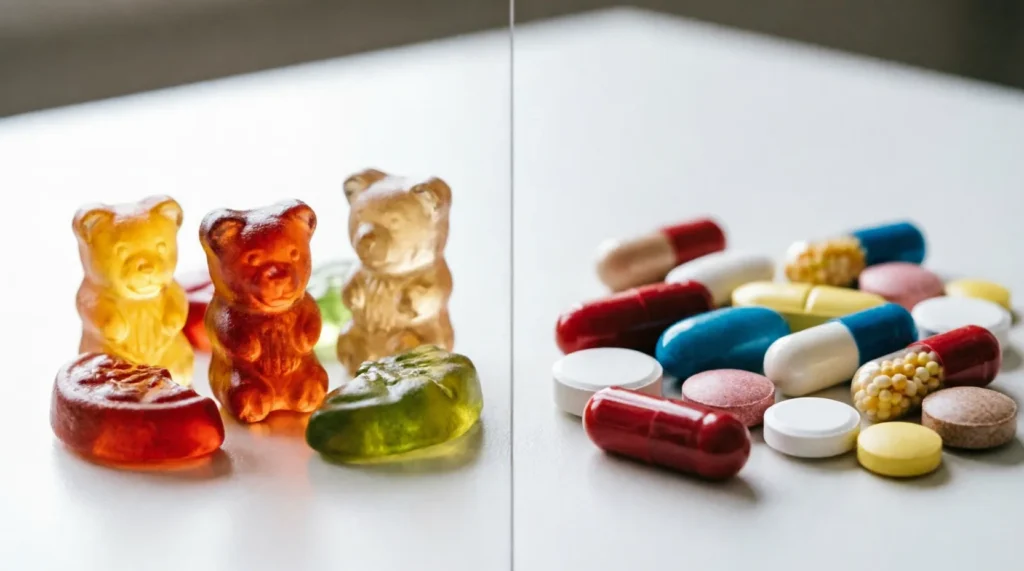
Quick answer: Pills generally offer superior potency, stability, and cost-effectiveness, while gummies provide better compliance for those who struggle with swallowing tablets. However, gummies often contain added sugars and may have lower nutrient bioavailability due to manufacturing heat processes.
The debate between chewable treats and traditional tablets is one of the most common dilemmas in the supplement aisle. Many consumers assume that because gummies taste like candy, they are less effective, while others believe pills are outdated and hard to digest. The reality lies in the chemical stability of the nutrients and the behavioral psychology of habit formation. Understanding the mechanical and nutritional differences helps you choose the right delivery system for your specific health goals.
| Term | Meaning / When to use | Example sentence |
|---|---|---|
| Pill Vitamins | Compressed powder or capsule forms; best for high-dose nutrients, stability, and sugar-free requirements. | “I switched to pill vitamins because I needed a higher dose of Vitamin D without the extra glucose.” |
| Gummy Vitamins | Gelatin or pectin-based chewables; best for children, adults with dysphagia, or those prioritizing taste over potency. | “She prefers gummy vitamins because the orange flavor makes her morning routine enjoyable.” |
When to Use Pill Vitamins
Pill vitamins, which include both hard tablets and softgel capsules, remain the gold standard for clinical efficacy. As noted in the comprehensive overview on Vitamin chemistry, many micronutrients are sensitive to heat and moisture. The manufacturing process for gummies involves high-heat cooking to melt sugars and gelatin, which can degrade heat-sensitive nutrients like Vitamin C and certain B vitamins before they even reach the bottle.
I have reviewed countless supplement labels in my years as a health editor, and the data consistently favors pills for purity. If you are treating a diagnosed deficiency, such as iron-deficiency anemia or severe Vitamin D insufficiency, pills are the only reliable option. They allow for precise dosing without the need for binders, sweeteners, or artificial colors that bulk up gummy formulations.
Consider these real-world scenarios where pills are the superior choice:
- Correcting a Medical Deficiency: A patient with clinically low ferritin levels needs 65mg of elemental iron. A gummy cannot safely hold this amount without becoming unpalatably large or metallic-tasting, whereas a coated tablet delivers it efficiently.
- Managing Blood Sugar: A diabetic individual requires a multivitamin but must avoid the 2–4 grams of added sugar found in just two gummy bears. A pill provides zero glycemic impact.
- Cost-Effective Long-Term Use: For a family of four taking daily supplements, pills can cost 50% less per serving than gummies, making them the logical choice for budget-conscious health maintenance.
When to Use Gummy Vitamins
Gummy vitamins are not merely a marketing gimmick; they solve a genuine physiological barrier: dysphagia, or difficulty swallowing. For many adults and most children, the act of swallowing a large capsule triggers a gag reflex or anxiety that leads to skipped doses. In this context, the “best” vitamin is the one you actually take.
The texture and flavor profile of gummies leverage positive reinforcement. According to general food science principles outlined in the Gummy confectionery entry, the chewy texture and sweet taste create a sensory experience that contrasts sharply with the medicinal association of pills. This psychological shift can be critical for establishing long-term habits.
Here are specific instances where gummies are the recommended format:
- Pediatric Supplementation: Children often refuse bitter-tasting liquids or fear choking on pills. A cherry-flavored gummy ensures they receive essential nutrients like Vitamin D and Zinc without a nightly struggle.
- Adults with Esophageal Sensitivity: Individuals who experience pain or discomfort when swallowing solid objects benefit from the pre-digested nature of chewables, which begin breaking down in the mouth.
- Travel and Convenience: Gummies do not require water to ingest. For frequent travelers or hikers, popping a vitamin without needing to find a water source is a practical advantage.
However, users must remain vigilant about dosage. Because gummies resemble candy, there is a risk of overconsumption, particularly in households with young children. Always store them out of reach and treat them with the same respect as medication.
How to Remember the Difference
To decide between these two forms, use the “Stability vs. Simplicity” mnemonic.
- Pills = Stability: Think of the hard shell of a pill as a protective vault. It locks in potent, heat-sensitive nutrients and keeps them stable until they reach your stomach. Choose pills when you need maximum power and precision.
- Gummies = Simplicity: Think of the soft, simple act of chewing. It removes the friction of swallowing and the need for water. Choose gummies when the biggest hurdle to your health is simply remembering to take the supplement.
Another editor’s trick I use is the “Sugar Check.” If you look at the label and see “sucrose,” “glucose syrup,” or “pectin” as the first three ingredients, you are looking at a food product first and a supplement second. If the first ingredient is the vitamin itself or a minimal filler like cellulose, you are looking at a pharmaceutical-grade delivery system. This quick visual scan instantly tells you which category you are holding.
Common Mistakes and Exceptions
One of the most frequent errors I see in client consultations is the assumption that “natural” gummies are nutritionally equivalent to pills. Many consumers switch to gummies believing they are getting a “whole food” experience, but most gummies are highly processed confections with synthetic vitamins added back in. The heating process required to create the gummy matrix often destroys the very natural enzymes or probiotics that users seek.
Another common mistake is ignoring the bioavailability of fat-soluble vitamins. Vitamins A, D, E, and K require fat for absorption. Softgel pills often come suspended in oil, aiding absorption. Gummies, being water-based or sugar-based, may not provide this lipid carrier unless specifically formulated with added oils, which can affect their texture and shelf life.
There are also exceptions regarding specific nutrients. For example, fiber supplements are almost exclusively available in powder or gummy form because compressing high-fiber content into a small pill is physically difficult. Conversely, magnesium pills are often preferred over gummies because achieving a therapeutic dose of magnesium (200–400mg) in a gummy would require eating an impractical number of pieces, leading to excessive sugar intake.
US vs. UK differences also play a role in labeling. In the US, gummies are regulated as dietary supplements, allowing for broader claims. In the UK and EU, regulations are stricter regarding sugar content and health claims, often resulting in gummies with lower potency or different sweetener profiles like xylitol or stevia. Always check the local regulatory standards if you are importing supplements.
Frequently Asked Questions
Do gummy vitamins expire faster than pills? Yes, gummies typically have a shorter shelf life because their moisture content and sugar base make them susceptible to melting, sticking together, or growing mold if exposed to heat, whereas dry pills remain stable for years.
Are gummy vitamins suitable for vegans? Not all gummies are vegan; traditional gummies use gelatin derived from animal collagen, but many brands now offer pectin-based gummies which are plant-derived, so you must check the label for “gelatin-free” or “pectin” explicitly.
Can I cut pill vitamins in half to save money? You should never cut enteric-coated or time-release pills, as this disrupts the controlled release mechanism and can cause stomach irritation or ineffective dosing, though standard compressed tablets can often be split if they are not coated.
Do gummy vitamins cause tooth decay? Yes, because gummies are sticky and contain sugar, they adhere to teeth longer than pills, increasing the risk of cavities, so it is advisable to rinse your mouth with water or brush your teeth after taking them.

Kimberly Sanchez holds a Bachelor’s degree in Linguistics from UCLA and has spent over a decade working as a language consultant and educator. Her journey in the world of words began with a curiosity about how language shapes our perception of the world. With a keen eye for detail and a knack for making complex concepts accessible, Kimberly specializes in the nuances of English word comparisons and their real-world implications. She joined WordCompareHub to share her insights on frequently confused words and to promote a deeper understanding of language accuracy. Kimberly writes content that is both enlightening and practical, aimed at readers who seek to enhance their communication skills. Outside of her professional pursuits, she is an avid reader and enjoys exploring multilingual environments to observe linguistic diversity in action.