

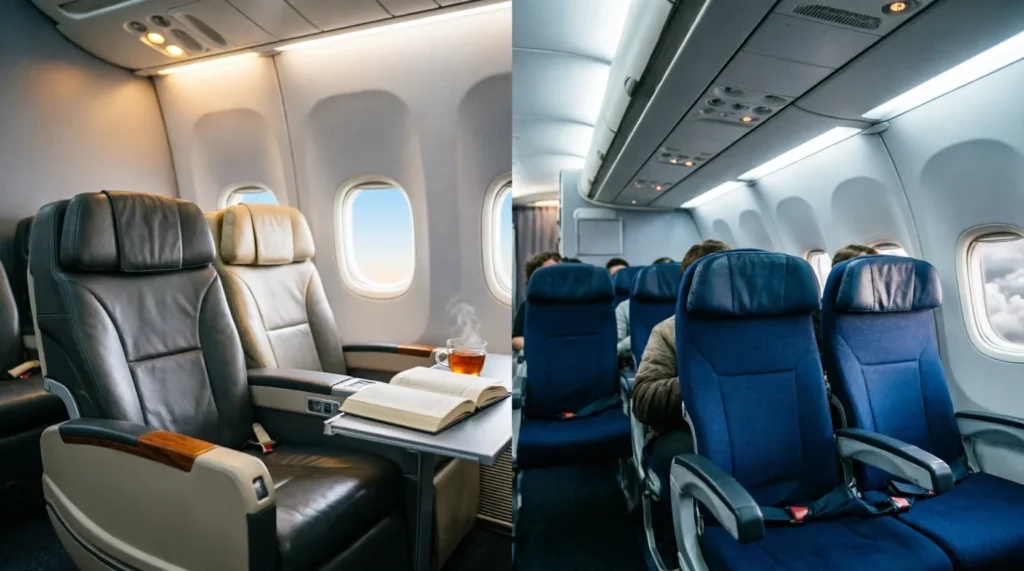
Quick answer: In commercial aviation, “coach class” and “economy class” refer to the exact same seating tier. There is no difference in service, legroom, or price between the two; they are simply regional synonyms for the standard, lowest-fare cabin.
If you have ever booked a flight and wondered if you should select “economy” or “coach” to get a better seat, you are not alone. This confusion stems from decades of marketing shifts and regional language differences. Many travelers assume “coach” implies a slightly more premium experience than “economy,” or vice versa. The reality is far simpler: airlines use these terms interchangeably depending on their brand heritage and geographic market. Understanding this equivalence can save you time during booking and help you focus on what actually matters—fare rules and seat selection fees—rather than getting distracted by semantic labels that offer no tangible benefit.
| Term | Meaning / When to use | Example sentence |
|---|---|---|
| Economy Class | The standard, lowest-fare cabin on most international and modern domestic flights. Use this term when booking outside North America or on global carriers. | “I booked my ticket in economy class to save money for the hotel.” |
| Coach Class | A synonym for economy class, primarily used in the United States and by legacy American carriers. Use this term when speaking with US-based agents or reading older US airline literature. | “My grandmother always refers to her window seat as coach class.” |
When to use Economy Class
“Economy class” is the globally recognized standard term for the basic tier of air travel. If you are flying on any major international carrier—such as Lufthansa, Emirates, or Singapore Airlines—you will almost exclusively see this terminology. It is the default designation used by the International Air Transport Association (IATA) and most global booking engines.
The term “economy” reflects the primary value proposition of this cabin: cost-effectiveness. It signals to the traveler that they are purchasing the most affordable option available, stripped of the frills associated with business or first class. the concept of an Economy in travel is rooted in providing essential transportation services at a price point accessible to the mass market, rather than offering luxury amenities.
Here are three real-world scenarios where “economy class” is the correct and expected term:
- International Booking: When you are on the British Airways website selecting your fare bundle, the options will be labeled “Basic,” “Standard,” and “Flexible,” but all fall under the umbrella of Economy Class. You would say, “I need to upgrade from economy class to premium economy.”
- Corporate Travel Policy: Most multinational corporations define their travel policies using global standards. A policy might state, “All employees must book economy class for flights under six hours.” Using the term “coach” here might cause confusion for HR departments based in London or Tokyo.
- Frequent Flyer Status: When earning miles, the accrual rate is often tied to the fare class within economy. You might check your statement and see, “You earned 50% miles on your economy class fare.”
When to use Coach Class
“Coach class” is a term deeply entrenched in American English and the history of US aviation. It originated in the early days of commercial flight when airlines sought to distinguish between the luxurious “first class” and the more utilitarian seating behind it. The term “coach” evokes the idea of a stagecoach or a bus—functional, communal, and straightforward.
While its usage has declined in favor of “economy” on many modern US carrier websites, it remains prevalent in spoken language among American travelers and in the branding of certain legacy carriers. For instance, American Airlines has historically used “Main Cabin” but often refers to the experience colloquially as coach. The term persists because it feels less stark than “economy.” To some ears, “economy” sounds cheap, while “coach” sounds standard.
Here are three concrete examples where “coach class” is the natural choice:
- US Domestic Conversation: If you are talking to a friend in New York about a trip to Chicago, you are more likely to say, “I’m flying coach,” rather than “I’m flying economy.” It is the cultural default in the US. As noted in historical contexts regarding transport, the term Coach has long been associated with passenger vehicles designed for comfort over long distances, a legacy that carried over into aviation nomenclature.
- Legacy Airline Marketing: Some US-based airlines still use “Coach” in their internal coding or older customer service scripts. If you call a US airline’s support line, the agent might ask, “Are you looking to upgrade from coach?” even if the website says “Economy.”
- Travel Insurance Claims: When filing a claim for a delayed flight in the US, the forms may ask for your “class of service.” While “Economy” is accepted, “Coach” is frequently listed as a dropdown option or understood synonym in American insurance databases.
How to remember the difference
The best way to remember that these terms are identical is to use the “Global vs. Local” mnemonic.
Think of Economy as Everywhere. It is the global standard. If you are anywhere outside the United States, or dealing with an international entity, use Economy.
Think of Coach as Continental US. It is the local, American preference. If you are in the States, speaking to Americans, or dealing with a distinctly American brand heritage, Coach is the familiar term.
Another helpful trick is to look at the word length. “Economy” is longer and more formal, fitting for international contracts and global standards. “Coach” is shorter and punchier, fitting for casual American conversation. However, never let this trick fool you into thinking one is “better.” They are the same product. I have seen clients waste hours trying to find a hidden “coach” section on a European airline’s website, only to realize they were already looking at economy. Stop looking for a difference that does not exist.
Common mistakes and exceptions
The most common mistake travelers make is assuming that “Premium Economy” is just a nicer version of “Coach.” It is not. Premium Economy is a distinct cabin class with wider seats, more legroom, and enhanced meal service. It sits between Economy/Coach and Business Class. Do not confuse the standard “coach” seat with “premium economy.”
Another frequent error occurs in resume writing or professional bios. I often see phrases like, “Managed travel budgets for coach class employees.” This sounds informal and slightly dated. In a professional context, always use “economy class.” It is the industry-standard term recognized by global finance and HR departments. Using “coach” can make your documentation appear insular or unaware of international norms.
There is also a regional exception in Australia and New Zealand, where the term “Economy” is universal, but “Coach” is rarely used in aviation at all. Instead, “Coach” in those regions might refer to long-distance bus travel. If you are booking a flight in Sydney and ask for “coach,” the agent might look at you confusedly before directing you to the economy counter.
Finally, beware of “Basic Economy.” This is a sub-tier within economy class introduced by many US carriers in the last decade. It is still “economy” or “coach,” but with severe restrictions: no carry-on bags, no seat selection, and no changes. Some travelers mistakenly believe “Basic Economy” is a different class entirely. It is not. It is simply the most restrictive fare within the economy/coach cabin.
Frequently Asked Questions
Is coach class cheaper than economy class? No, they are the same price because they are the same thing. Any price difference you see is due to fare bundles (like Basic vs. Standard), not the name of the cabin.
Do I get more legroom in coach or economy? You get the exact same legroom. Seat pitch and width are determined by the aircraft and the specific fare bundle, not by whether the airline calls it coach or economy.
Why do some airlines still use the term coach? Legacy US carriers retain the term for brand consistency and because it resonates with older American travelers who grew up with the terminology. It is a marketing choice, not a service distinction.
Should I put “coach” or “economy” on my expense report? Use “economy class.” It is the formal, globally recognized term that will not raise questions from auditors or accounting software, regardless of where your company is based.

Kimberly Sanchez holds a Bachelor’s degree in Linguistics from UCLA and has spent over a decade working as a language consultant and educator. Her journey in the world of words began with a curiosity about how language shapes our perception of the world. With a keen eye for detail and a knack for making complex concepts accessible, Kimberly specializes in the nuances of English word comparisons and their real-world implications. She joined WordCompareHub to share her insights on frequently confused words and to promote a deeper understanding of language accuracy. Kimberly writes content that is both enlightening and practical, aimed at readers who seek to enhance their communication skills. Outside of her professional pursuits, she is an avid reader and enjoys exploring multilingual environments to observe linguistic diversity in action.