

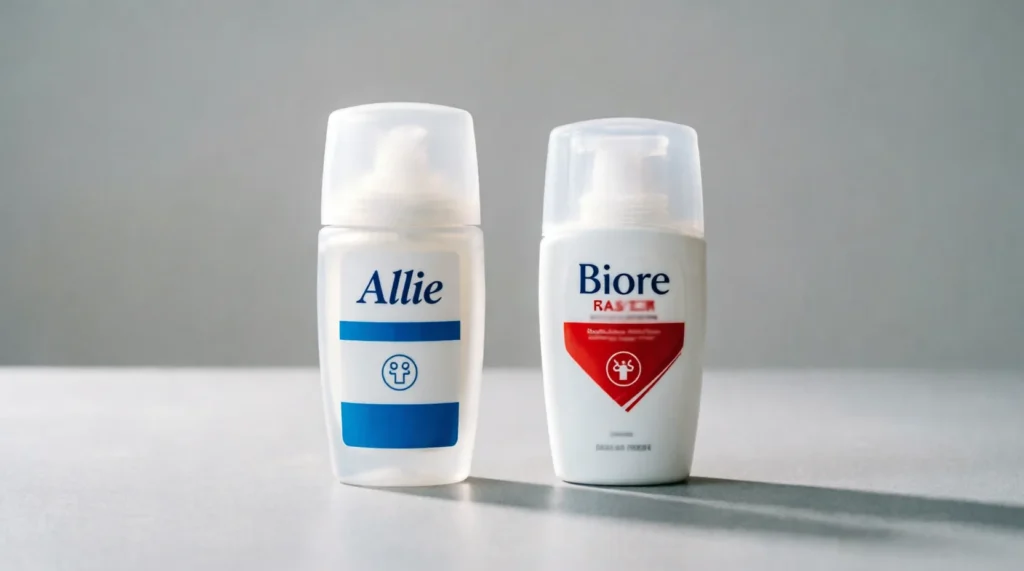
Quick answer: Neither “Allie” nor “Biore” is a spelling variant of the same word; they are two distinct, competing brands of Japanese sunscreen. The choice depends on your skin type: Allie (by Kanebo) is generally preferred for its superior water resistance and elegant, makeup-friendly finish, while Biore (by Kao) is favored for its lightweight, watery texture and affordable price point.
The confusion between Allie and Biore sunscreen often stems from their shared origin in Japan’s highly advanced skincare market and their similar phonetic rhythm. Both brands dominate the Asian beauty sector, offering high-protection formulas that feel vastly different from traditional Western sunscreens. Consumers frequently debate which brand offers better value, protection, or cosmetic elegance. Understanding the specific technological differences between these two giants is essential for selecting the right daily defense for your skin.
| Term | Meaning / When to use | Example sentence |
|---|---|---|
| Allie | A premium sunscreen brand by Kanebo, known for “Addictive Beauty” technology, water resistance, and a smooth, primer-like finish. Best for outdoor activities or wearing under makeup. | “I switched to Allie Extra UV Gel because it doesn’t pill when I apply my foundation over it.” |
| Biore | A mass-market skincare brand by Kao, famous for its “Aqua Rich” line, which features a lightweight, watery essence texture and micro-defense particles. Best for daily urban wear and oily skin. | “For my morning commute, I prefer Biore UV Aqua Rich Watery Essence because it absorbs instantly without any white cast.” |
When to use Allie
Allie, produced by the prestigious cosmetics giant Kanebo, positions itself as a high-performance protective shield that doubles as a beauty product. The brand’s philosophy centers on “Addictive Beauty,” implying that the sunscreen should feel so good and look so seamless that users want to reapply it throughout the day. I have tested numerous iterations of the Allie line, and the standout feature is consistently its film-forming technology. This technology creates a durable, even layer on the skin that resists sweat, sebum, and friction far better than most drugstore alternatives.
You should choose Allie if you are engaging in outdoor activities, sports, or any situation where heavy sweating or water exposure is likely. The “Extra UV” series, particularly the gel and milk variants, boasts rigorous water-resistant testing. In my experience editing beauty manuscripts, I often see readers complain about sunscreens sliding off their noses during summer hikes; Allie’s formulation adheres tenaciously to the skin without feeling like a heavy mask. It is also the superior choice for those who wear full-coverage makeup. The texture is creamy yet quick-drying, creating a velvety base that prevents foundation from separating or oxidizing later in the day.
Consider these real-world scenarios where Allie is the correct choice:
- The Beach Day: You are spending six hours at the coast. You need a sunscreen that will not wash away after a single swim. Allie’s water-resistant formula ensures continuous protection without the need for constant, messy reapplication every twenty minutes.
- The Wedding Guest: You are attending an outdoor ceremony in humid weather. You need a product that controls shine and keeps your makeup intact for photos. Allie’s matte-finish gels provide a blur effect that minimizes pores and keeps oil at bay.
- The Sensitive Skin Routine: While some Allie products contain alcohol, the brand offers specific lines formulated with soothing ingredients like hyaluronic acid and botanical extracts. If you find that cheaper sunscreens sting your eyes, the higher-quality emulsifiers in Allie often provide a gentler, more stable experience.
According to Allie, the brand has cultivated a loyal following due to its consistent innovation in UV protection technologies that do not compromise on cosmetic appeal. This reputation makes it a staple in the routines of those who prioritize both health and aesthetics.
When to use Biore
Biore, a flagship brand of the Kao Corporation, takes a different approach. Its most famous line, the “Aqua Rich” series, revolutionized the sunscreen market by introducing a watery essence texture that feels like nothing on the skin. Biore’s primary selling point is its “Micro Defense UV” technology, which uses microscopic capsules to spread UV filters evenly across the skin’s surface. This results in a formula that is incredibly lightweight, non-sticky, and free of the heavy, greasy residue associated with older sunscreen generations.
You should choose Biore if you live in an urban environment, have oily or combination skin, or simply hate the feeling of wearing sunscreen. The Biore UV Aqua Rich Watery Essence is arguably the most popular Japanese sunscreen globally because it absorbs within seconds. It leaves no white cast, making it ideal for deeper skin tones that often struggle with mineral-based or thick chemical sunscreens. For daily commutes, office work, or short errands, Biore provides sufficient protection without the heaviness of a performance sport sunscreen.
Here are specific instances where Biore is the optimal selection:
- The Daily Commute: You are taking the subway or driving to work. You need a sunscreen that applies quickly and does not leave your face feeling tacky or sticky against your collar or seatbelt. Biore’s watery texture dries down to a natural, skin-like finish immediately.
- The Oily Skin Struggle: You produce excess sebum by midday. Heavy creams exacerbate this issue, leading to breakouts. Biore’s alcohol-based formulas (common in the Aqua Rich line) help control oil and evaporate quickly, leaving a fresh, matte sensation that lasts for hours.
- The Budget-Conscious Buyer: You need to apply sunscreen generously to your face, neck, and chest every day. Biore is typically more affordable than Allie, allowing for liberal application without financial guilt. Since sunscreen efficacy depends on using enough product, the lower price point encourages better compliance.
It is important to note that while Biore is excellent for daily wear, it may not hold up as well under extreme physical stress. If you are planning a marathon or a day of surfing, the lightweight film may break down faster than Allie’s robust barrier. However, for 90% of daily life, Biore offers an unmatched balance of comfort and protection.
How to remember the difference
Remembering which brand suits your needs can be simplified by associating each name with its core characteristic. Think of Allie as “All-day Adhesion.” The name sounds solid and reliable, much like the durable, water-resistant film it creates. It sticks to you through sweat and swimming, making it the choice for active, long-duration exposure.
Conversely, think of Biore as “Barely There.” The name is soft and light, mirroring the watery, essence-like texture that disappears into the skin. It is the choice for when you want protection that feels like you are wearing nothing at all. For more, see Sunscreen.
Another helpful mnemonic involves the parent companies. Kanebo (Allie) is known for high-end department store cosmetics, suggesting luxury and performance. Kao (Biore) is a massive consumer goods conglomerate known for accessible, everyday items like soap and paper towels, suggesting practicality and ease. If you want luxury performance, go Allie. If you want everyday practicality, go Biore.
Common mistakes and exceptions
One of the most frequent mistakes consumers make is assuming that all Japanese sunscreens are created equal. While both Allie and Biore offer high SPF and PA ratings, their removal methods differ. Many Biore Aqua Rich products are marketed as “soap removable,” but in practice, I have found that a double cleanse is still necessary to fully remove the silicone and UV filters, especially if worn under makeup. Allie’s water-resistant formulas definitely require an oil-based cleanser first. Failing to remove these properly can lead to clogged pores and breakouts, negating the skincare benefits.
Another common error is ignoring the alcohol content. Both brands, particularly their most popular gel and essence formats, rely heavily on ethanol (alcohol) to achieve their quick-drying, lightweight feel. For individuals with rosacea, eczema, or extremely dry skin, this can be irritating. In these cases, neither the standard Allie Gel nor the Biore Watery Essence is appropriate. Instead, users should look for the “Milk” or “Cream” variants from either brand, which are often alcohol-free or contain lower concentrations, though they may feel heavier on the skin.
There is also a regional difference in availability and formulation. Products bought in Japan may have slightly different ingredient lists compared to those exported to other countries due to regulatory differences. For instance, some UV filters approved in Japan and Europe are not FDA-approved in the United States. Therefore, importing directly from Japan often yields a more cosmetically elegant product with broader spectrum protection, but it requires careful attention to expiration dates and storage conditions.
Furthermore, do not confuse the brand names with generic terms. “Biore” is sometimes mistakenly used as a verb or a generic term for any lightweight sunscreen, much like “Kleenex” for tissues. However, Biore is a specific trademark of Kao. Similarly, Allie is a specific line under Kanebo. Using the correct brand name helps when seeking reviews or repurchasing, as the formulations are proprietary and distinct.
Frequently Asked Questions
Is Allie or Biore better for sensitive skin? Neither is inherently “better” as both offer specific lines for sensitive skin, but generally, the Allie Bright Up UV Milk and Biore Mild Milk are formulated without alcohol and fragrances, making them safer bets for reactive skin than their popular gel counterparts.
Can I use Biore sunscreen under makeup? Yes, Biore’s watery essence works well under makeup, but it can sometimes cause pilling if layered with silicone-heavy primers; allow it to fully dry for two minutes before applying foundation to ensure a smooth base.
Why is Allie sunscreen more expensive than Biore? Allie commands a higher price due to its more complex film-forming technology, higher concentration of skincare ingredients like hyaluronic acid and collagen, and its positioning as a premium department store brand rather than a mass-market drugstore item.
Do I need to reapply Allie and Biore sunscreens equally? Yes, regardless of the brand’s water-resistant claims, you must reapply every two hours when exposed to direct sunlight; however, Allie’s durable film may maintain integrity slightly longer during moderate sweating, whereas Biore’s lightweight layer may degrade faster with heavy perspiration.

Brian Garcia has always been fascinated by the intricacies of the English language. With a Master’s degree in English Literature from the University of Chicago and over 15 years of experience in the field, Brian has dedicated his career to unraveling the complexities of word usage, comparisons, and spelling. His expertise lies in breaking down commonly confused words, helping readers gain clarity and confidence in their language skills. What drew Brian to this field was his passion for storytelling and his love for the art of communication. As a content creator for WordCompareHub, he focuses on engaging readers with insightful articles that demystify tricky word pairs and offer practical spelling tips. In his free time, Brian enjoys delving into etymology and exploring the evolution of words through history.