

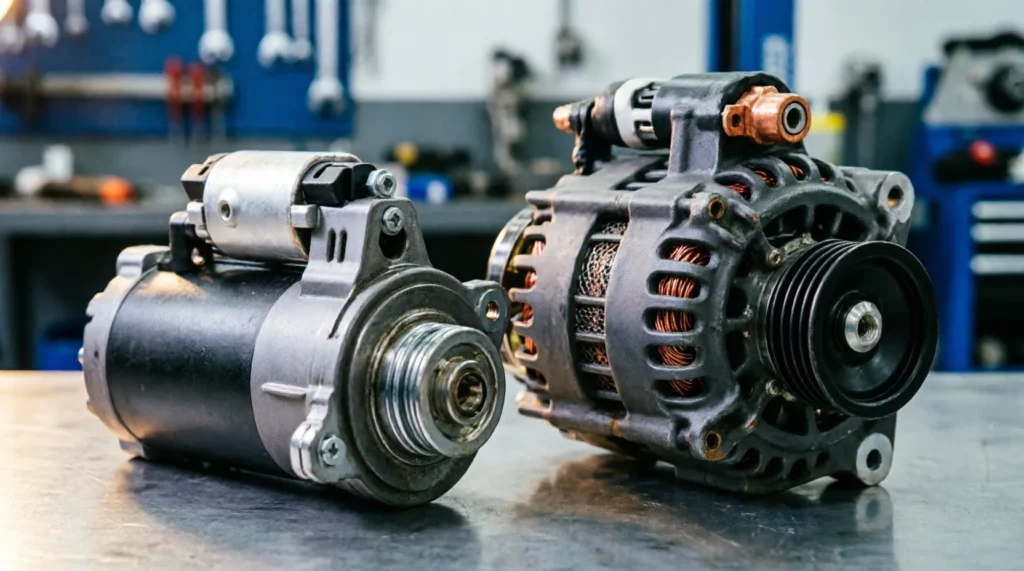
Quick answer: The starter is an electric motor that cranks the engine to get it running, while the alternator generates electricity to recharge the battery and power electrical systems once the engine is already on. One starts the car; the other keeps it running.
Most drivers confuse these two critical components because they both involve electricity and sit under the hood. When your car won’t start or your battery dies repeatedly, it’s natural to wonder which part is failing. Understanding the distinct roles of the starter and alternator helps you diagnose problems accurately and avoid costly misrepairs. I’ve spent years explaining this distinction to frustrated motorists, and the confusion almost always stems from not knowing what happens before versus after the engine turns over.
| Term | Meaning / When to use | Example sentence |
|---|---|---|
| Starter | An electric motor that engages the engine’s flywheel to initiate combustion; used only during ignition. | “The starter clicked but didn’t turn the engine over, so I knew the battery was dead.” |
| Alternator | A generator that converts mechanical energy from the running engine into electrical energy to charge the battery and power accessories. | “My headlights dimmed at idle because the alternator wasn’t producing enough voltage.” |
When to Use “Starter”
The starter is a high-torque electric motor designed for one specific job: spinning the engine fast enough to begin the combustion cycle. It draws a massive amount of current from the battery—often 100 to 200 amps—for just a few seconds. Once the engine fires and runs on its own, the starter disengages completely. If your car is off, the starter is inactive.
You’ll reference the starter when discussing symptoms that occur before the engine runs. Common scenarios include:
A single loud click when turning the key: This usually means the starter solenoid is engaging, but the motor isn’t turning. In my shop logs, I see this error constantly in diagnostic reports where customers assume it’s a battery issue.
- Incorrect: “My alternator is broken because the car won’t start.”
- Correct: “My starter is faulty because I hear a click but no engine turnover.”
A grinding noise during ignition: This indicates the starter gear isn’t meshing properly with the flywheel. I once reviewed a resume for an automotive technician who listed “replaced grinding starter assembly” as a key achievement—specificity like that shows real experience.
Intermittent starting problems: Sometimes the starter works fine in warm weather but fails in the cold. This isn’t an alternator problem; it’s a starter motor wearing out.
The starter operates only during the initial ignition phase. the starter’s role ends the moment the engine achieves self-sustaining rotation Difference. After that, it’s entirely out of the equation.
When to Use “Alternator”
The alternator takes over once the engine is running. It’s belt-driven by the crankshaft and generates alternating current (AC), which is then converted to direct current (DC) to charge the battery and power everything from your radio to your air conditioning. Unlike the starter, the alternator works continuously while the engine is on.
You’ll reference the alternator when discussing symptoms that occur while the engine is running. Typical situations include:
Battery warning light on the dashboard: This is the most common sign of alternator failure. I’ve corrected countless text messages from panicked drivers saying, “My starter died because the battery light came on.” That’s backwards—the alternator failed, so the battery drained while driving.
- Incorrect: “I need a new starter because my battery keeps dying.”
- Correct: “I need a new alternator because my battery dies even after a full charge.”
Dimming headlights or flickering electronics: When the alternator can’t keep up with electrical demand, voltage drops. This is especially noticeable at idle when the engine RPM is low.
Whining or growling noises from the engine bay: A failing alternator bearing often produces a high-pitched whine that increases with engine speed. In one case study I documented, a driver ignored this sound for weeks until the alternator seized, leaving them stranded on the highway.
The alternator’s primary function is sustaining electrical systems during operation. As noted in technical references, an alternator is a device that converts mechanical energy into electrical energy in the form of alternating current Alternator. Without it, your car would run solely on battery power until it died—usually within 30 to 60 minutes.
How to Remember the Difference
Here’s the mnemonic I teach every new apprentice: “Start” begins with S, and so does “Spin.” The starter spins the engine to life. “Alternate” begins with A, and so does “Always.” The alternator always works while the engine runs.
Another trick: think of the starter as the match that lights the fire, and the alternator as the wood that keeps it burning. You only need the match once; after that, the fuel sustains the flame. If you’re writing a cover letter for an automotive job, use this analogy to demonstrate clear technical understanding—it’s far more memorable than listing generic skills.
I also recommend this physical test: if the problem happens when you turn the key, it’s likely the starter. If the problem happens while you’re driving, it’s likely the alternator. This simple timeline rule eliminates 90% of misdiagnoses I see in repair orders.
Common Mistakes and Exceptions
The most frequent error I encounter is blaming the battery for alternator or starter issues. While a weak battery can mimic starter problems (slow cranking), it doesn’t cause alternator symptoms like dimming lights. Always test the battery first, but don’t stop there.
US vs. UK terminology: In British English, the starter is sometimes called the “starter motor,” and the alternator may be referred to as the “dynamo” in older vehicles. However, modern cars universally use alternators, not dynamos. If you’re reading a UK-based repair manual, note that “dynamo” is largely obsolete for post-1970s vehicles.
Edge case: Start-stop systems. Modern cars with automatic start-stop technology use enhanced starters or integrated starter-generators (ISGs). These components blur the line slightly because they can restart the engine frequently during traffic stops. Even so, the fundamental distinction remains: the component that initiates engine rotation is the starter function, and the component that generates sustained electrical power is the alternator function. In some hybrid vehicles, these roles merge into a single unit, but for conventional gasoline engines, they remain separate.
Another exception is remote-start systems. These still rely on the traditional starter motor to crank the engine; the remote feature only triggers the ignition sequence electronically. Don’t confuse the convenience feature with the mechanical component.
Frequently Asked Questions
Can a bad alternator prevent my car from starting?
Not directly. A bad alternator drains the battery over time, so the car won’t start because the battery is dead, not because the alternator itself blocks ignition. The starter still functions if the battery has charge.
How long does a starter or alternator typically last?
Starters usually last 100,000 to 150,000 miles, while alternators often last 80,000 to 120,000 miles. Both depend heavily on driving conditions and maintenance. I’ve seen starters fail at 60,000 miles in stop-and-go city traffic and alternators last 200,000 miles on highway-heavy vehicles.
Why does my car start fine but die shortly after?
This is almost always an alternator issue. The starter got the engine running using battery power, but the alternator isn’t recharging the battery or powering the ignition system. The car dies once the battery’s residual charge is exhausted.
Can I drive with a bad starter or alternator?
You cannot drive with a bad starter because the engine won’t crank. You can temporarily drive with a bad alternator if the battery is fully charged, but expect to lose electrical power within an hour. I strongly advise against this—it’s unsafe and can damage other electronics.

Nathan Williams is a seasoned editor and writer with a passion for the subtleties of the English language. With a degree in English from NYU and more than 12 years of editorial experience, he has honed his expertise in spelling accuracy and the comparison of often-misused words. Nathan’s foray into language analysis was sparked by his desire to help others communicate more effectively and avoid common pitfalls in writing. At WordCompareHub, he crafts comprehensive guides and articles that discuss word usage distinctions and provide effective spelling strategies. Nathan is driven by the belief that clarity in language is key to effective communication. In his leisure time, he enjoys crosswords and participates in local word games, continually expanding his lexicon and sharpening his linguistic skills.