

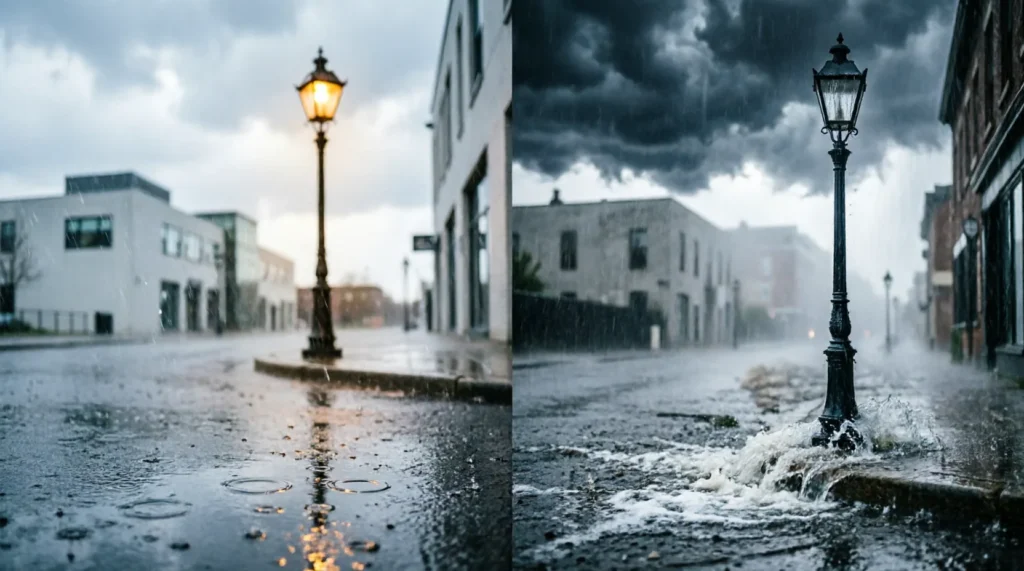
Quick answer: The primary difference between showers and rain lies in intensity, duration, and coverage. Rain is steady, widespread, and lasts for hours, while showers are intermittent, localized, and start or stop abruptly.
Many people use the terms “rain” and “showers” interchangeably when checking the weather forecast, but meteorologists distinguish them based on specific atmospheric behaviors. Understanding this distinction helps you plan your day more effectively, as a morning of steady rain requires different preparation than an afternoon of scattered showers. While both involve liquid precipitation falling from clouds, their underlying mechanics and practical impacts on your schedule are vastly different.
| Term | Meaning / When to use | Example sentence |
|---|---|---|
| Rain | Steady, continuous precipitation that covers a wide area and lasts for an extended period. | “The steady rain lasted all afternoon, so we canceled the picnic.” |
| Showers | Intermittent, localized precipitation that starts and stops suddenly, often with varying intensity. | “We got caught in a brief shower, but it cleared up before we reached the car.” |
When to Use Rain
You should use the term “rain” when describing precipitation that is consistent, widespread, and predictable in its duration. This type of weather event is typically associated with stratiform clouds, which form in stable atmospheric conditions. These clouds spread out like a blanket across the sky, producing a uniform layer of moisture that falls steadily over a large geographic region.
When I edit travel guides or outdoor event planning documents, I always advise clients to treat “rain” as a long-term commitment from the atmosphere. It is not going anywhere quickly. If the forecast calls for rain, you can expect the ground to become thoroughly saturated, visibility to decrease consistently, and the sound of precipitation to remain a constant background noise.
Here are common scenarios where “rain” is the correct terminology:
- All-day events: “The wedding reception was moved indoors due to the heavy rain predicted from noon until midnight.”
- Agricultural contexts: “The farmers welcomed the slow, soaking rain that replenished the groundwater without causing erosion.”
- Commute planning: “Allow extra time for your commute because the steady rain will reduce traction and visibility on the highways.”
In these examples, the key factor is continuity. The precipitation does not take breaks. It is a sustained event that affects everyone in the region equally. the concept of Difference is crucial here because it highlights how distinct atmospheric processes lead to visibly different outcomes, even though the end result—wet ground—is the same.
When to Use Showers
Use the term “showers” when describing precipitation that is sporadic, localized, and often intense. Showers are typically produced by cumuliform clouds, such as cumulus or cumulonimbus clouds. These clouds develop vertically in unstable air, leading to pockets of heavy precipitation that fall from specific parts of the cloud rather than the entire base.
The defining characteristic of a shower is its unpredictability in terms of exact timing and location. One street may be dry while the next block is experiencing a downpour. Showers often start abruptly, reach peak intensity quickly, and then cease just as suddenly. This “on-again, off-again” nature is what separates them from steady rain.
I frequently see this confusion in casual conversation, where someone might say, “It’s raining,” when they actually mean, “It’s showering.” Here is how to correctly apply the term in real-world contexts:
- Short outdoor activities: “We can still play golf if we watch the radar; these are just scattered showers that pass through quickly.”
- Variable intensity: “The shower started as a drizzle, turned into a torrential downpour for ten minutes, and then stopped completely.”
- Localized impact: “My office building is dry, but my colleague three blocks away got soaked in a sudden shower.”
In these cases, the precipitation is not a blanket covering the entire sky. It is isolated. You might see sunlight breaking through the clouds while it is still wet outside. This patchy behavior is the hallmark of showers. The spatial Between distinct weather cells means that your immediate microclimate can differ significantly from areas just a few miles away.
How to Remember the Difference
Remembering the distinction between rain and showers can be simple if you focus on the behavior of the water rather than the amount. Think of “rain” as a faucet left running steadily. It is consistent, predictable, and covers everything evenly. Think of “showers” as a bucket of water being dumped intermittently. It is sudden, heavy, and stops when the bucket is empty.
Here is a mnemonic device I teach to junior editors and weather enthusiasts alike:
R.A.I.N. = Regular And Integrated Nowcast.
- Regular: It happens at a steady pace.
- Integrated: It covers the whole area.
S.H.O.W.E.R. = Sudden Halts, Often Wet Everywhere Randomly.
- Sudden Halts: It stops abruptly.
- Randomly: It hits some spots and misses others.
Another helpful visual is to look at the clouds. If the sky looks like a flat, gray sheet (stratus clouds), expect rain. If the sky looks like puffy cotton balls or towering anvils (cumulus clouds), expect showers. The shape of the cloud dictates the style of the precipitation.
Common Mistakes and Exceptions
Even native English speakers and seasoned weather watchers make mistakes when distinguishing between these two terms. One common error is assuming that intensity determines the label. People often think that light precipitation is “rain” and heavy precipitation is “showers.” This is incorrect. You can have a heavy, steady rain that lasts for six hours, and you can have a light, intermittent shower that lasts for five minutes. The key is duration and continuity, not just volume.
Another frequent mistake involves regional dialects. In some parts of the world, particularly in tropical climates, the term “rain” is used for any liquid precipitation regardless of its behavior. However, in standard meteorological reporting and formal writing, maintaining the distinction is important for accuracy.
US vs. UK Usage
While the meteorological definitions remain consistent globally, colloquial usage can vary. In the United Kingdom, where weather changes rapidly, residents are very accustomed to showers. They might refer to a “bright spell followed by a shower” as a typical day. In the United States, particularly in the Midwest or Pacific Northwest, prolonged periods of steady rain are more common, so the term “rain” is used more frequently in daily conversation. However, professional meteorologists in both countries adhere to the same technical standards.
Edge Cases: Sun Showers
A “sun shower” is a phenomenon where rain falls while the sun is shining. This is almost always a shower, not steady rain, because it indicates that the precipitation is coming from a isolated cloud cell while the rest of the sky remains clear. If you experience precipitation while seeing direct sunlight, you are almost certainly in a shower. Steady rain requires overcast skies that block the sun entirely.
Resume and Professional Writing Errors
In professional writing, precision matters. I once reviewed a logistics coordinator’s resume that stated, “Managed supply chain disruptions during severe rain events.” Given that their region was known for flash floods caused by intense, short-duration storms, the correct term should have been “severe shower events” or “thunderstorms.” Using “rain” implied a slow, manageable soak, whereas the reality was abrupt, high-volume water accumulation that required different emergency protocols. Precision in language reflects precision in thought.
Frequently Asked Questions
Can showers turn into rain? Yes, if the atmospheric conditions stabilize and the cloud cover expands to become a uniform layer, intermittent showers can merge and transition into steady, widespread rain. This often happens as a weather front moves through an area.
Is drizzle considered rain or a shower? Drizzle is technically a form of rain because it is steady and continuous, even though the droplets are smaller. It is not considered a shower because it lacks the intermittent, start-stop nature and the intense variability of showers.
Why do showers feel heavier than rain? Showers often feel heavier because they come from cumuliform clouds that can hold more moisture and release it in concentrated bursts. Rain from stratiform clouds falls more gently and evenly, so the perceived intensity is lower even if the total accumulation over time is similar.
How do I know if I should carry an umbrella for showers versus rain? For steady rain, you will need your umbrella for the entire duration of your trip. For showers, you might only need it for short intervals, and you may be able to wait out the precipitation under cover. Checking a radar map is more useful for showers, as it shows the specific location of storm cells, whereas rain forecasts are generally area-wide.

Nathan Williams is a seasoned editor and writer with a passion for the subtleties of the English language. With a degree in English from NYU and more than 12 years of editorial experience, he has honed his expertise in spelling accuracy and the comparison of often-misused words. Nathan’s foray into language analysis was sparked by his desire to help others communicate more effectively and avoid common pitfalls in writing. At WordCompareHub, he crafts comprehensive guides and articles that discuss word usage distinctions and provide effective spelling strategies. Nathan is driven by the belief that clarity in language is key to effective communication. In his leisure time, he enjoys crosswords and participates in local word games, continually expanding his lexicon and sharpening his linguistic skills.