

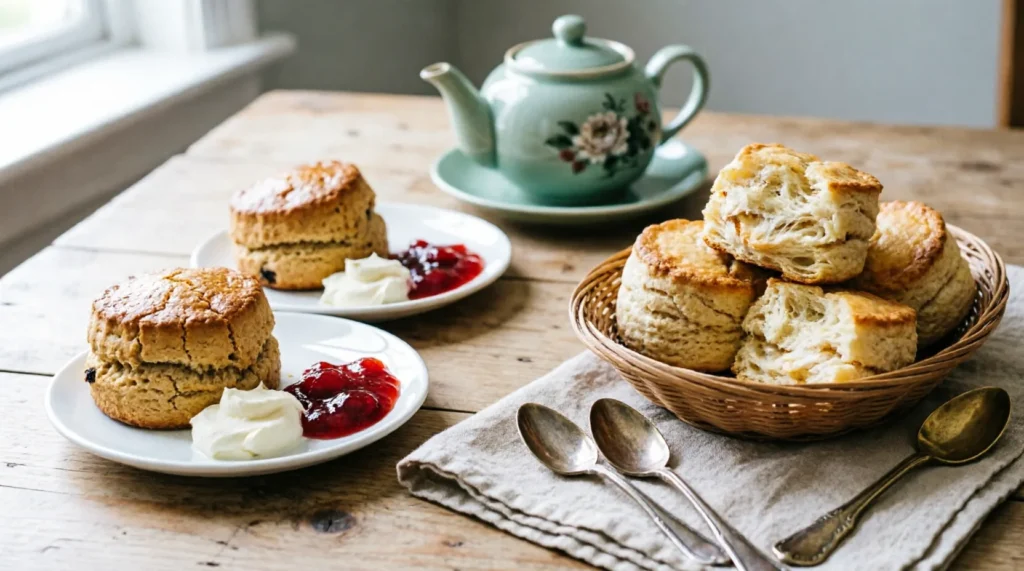
Quick answer: A scone is a slightly sweet, dense British baked good made with eggs and often dried fruit, while a biscuit is a savory, flaky American quick bread leavened with baking powder and buttermilk. The primary difference lies in their texture, sweetness, and cultural origin.
If you have ever stood in a bakery aisle staring at two seemingly identical rounds of dough, wondering which one belongs on your breakfast plate and which belongs with your afternoon tea, you are not alone. The confusion between scones and biscuits is widespread, largely because they share a common ancestor and similar preparation methods. However, treating them as interchangeable ingredients will ruin both your recipe and your palate experience. Understanding the distinction is crucial for any home baker or food enthusiast who wants to master the nuances of English-speaking culinary traditions.
Comparison at a Glance
To understand the core distinctions quickly, refer to the table below. This breakdown highlights the fundamental differences in composition, flavor profile, and traditional serving methods.
| Term | Meaning / When to use | Example sentence |
|---|---|---|
| Scone | A dense, slightly sweet British baked good made with eggs, butter, and milk/cream; often includes dried fruit. | “I ordered a cranberry scone with my Earl Grey tea at the café.” |
| Biscuit | A soft, flaky, savory American quick bread made with buttermilk and baking powder; contains no eggs. | “She served hot buttery biscuits alongside the fried chicken and gravy.” |
When to Use Scone
The scone is a staple of British cuisine, specifically associated with “cream tea” or “afternoon tea.” It is essential to recognize that a scone is not merely a hard cookie or a dry cake; it is a specific type of quick bread that relies on a delicate balance of fat and liquid to achieve its characteristic crumb.
The Rule of Thumb
Use the term “scone” when referring to a baked item that is denser than a cake but lighter than a cookie, typically containing eggs and sugar. The texture should be tender yet substantial enough to hold its shape without crumbling into dust. the concept of Difference in culinary terminology often stems from regional adaptations of basic recipes, and the scone is a prime example of how British bakers adapted simple doughs into a refined tea-time treat.
Key Characteristics
- Ingredients: Flour, sugar, baking powder, butter, milk or cream, and almost always eggs.
- Texture: Dense, crumbly, and slightly dry if eaten plain, which is why it is traditionally paired with moist accompaniments.
- Flavor: Mildly sweet. Common variations include currant, raisin, cranberry, or lemon zest. Cheese scones exist but are less common than their sweet counterparts.
Real-World Examples
- Email Context: “Hi Sarah, thanks for hosting the book club. I’ll bring the clotted cream and jam if you can pick up some fresh strawberry scones from the bakery on Main Street.”
- Recipe Instruction: “Cut the cold butter into the flour mixture until it resembles coarse crumbs, then stir in the beaten egg and milk to form a stiff dough for the scones.”
- Travel Blog: “Our first stop in Edinburgh was a historic tearoom where we enjoyed warm plain scones split open and layered with thick cream and raspberry preserve.”
When to Use Biscuit
In the United States, the word “biscuit” refers to a completely different culinary entity than it does in the UK or other Commonwealth countries. In America, a biscuit is a savory, fluffy quick bread that serves as a side dish rather than a dessert or tea-time snack. It is a cornerstone of Southern cuisine and comfort food across the nation.
The Rule of Thumb
Use the term “biscuit” when referring to a soft, flaky, savory bread product that is leavened with baking powder or soda and typically made with buttermilk. Crucially, American biscuits do not contain eggs. The layering effect, known as lamination, is achieved by folding the dough multiple times, creating steam pockets during baking that result in a light, airy interior. The spatial relationship Between the layers of fat and dough is what defines the structural integrity of a proper biscuit.
Key Characteristics
- Ingredients: Flour, baking powder, salt, cold butter or shortening, and buttermilk (or whole milk). No sugar, no eggs.
- Texture: Flaky, tender, and moist. The exterior should be golden brown and slightly crisp, while the interior should pull apart in distinct layers.
- Flavor: Savory, buttery, and tangy (if buttermilk is used). It acts as a vehicle for gravies, jams, or butter.
Real-World Examples
- Resume/Cover Letter: “Managed inventory for a high-volume breakfast diner, ensuring daily preparation of 200+ made-from-scratch buttermilk biscuits for morning service.”
- Text Message: “Running late! Can you put the frozen biscuits in the oven? I’ll pick up the sausage gravy on my way home.”
- Restaurant Review: “The chicken and waffles were good, but the real star was the basket of warm, flaky biscuits served with honey butter before the meal even arrived.”
How to Remember the Difference
Memorizing the distinction between these two baked goods can be challenging, especially if you travel frequently or consume international media. Here is a simple mnemonic device that focuses on the key ingredient difference:
“Scones have Eggs; Biscuits are Basic.”
- Scones have Eggs: If the recipe calls for an egg, it is likely a scone. The egg provides structure and richness, contributing to the denser, cake-like crumb.
- Biscuits are Basic: American biscuits rely on a “basic” combination of flour, fat, and liquid (buttermilk) without the complexity of eggs or significant sugar. They are the basic, savory backbone of a Southern meal.
Another helpful tip is to think about the occasion. If you are sitting down with a teacup and a small plate in the afternoon, you are likely eating a scone. If you are sitting down with a fork and knife for a hearty breakfast or dinner with gravy, you are likely eating a biscuit.
Common Mistakes and Exceptions
Even experienced cooks can stumble when navigating the global usage of these terms. Here are the most frequent errors and important exceptions to keep in mind.
The UK/US Language Trap
The biggest source of confusion is geographical. In the United Kingdom, Australia, and New Zealand, the word “biscuit” refers to what Americans call a “cookie.” Therefore, if a British friend offers you a “chocolate chip biscuit,” they are handing you a cookie, not a fluffy bread roll. Conversely, if an American invites you over for “biscuits and gravy,” do not expect cookies covered in sauce; expect savory quick bread smothered in white peppered gravy.
The “American Scone” Variation
In recent years, American cafes have popularized a version of the scone that is larger, sweeter, and often topped with glazes or icing. These “American scones” sometimes blur the line by becoming quite cake-like. However, they still retain the egg and higher sugar content that distinguishes them from biscuits. A common mistake is calling these glazed, massive triangles “biscuits” because they are soft. Remember: if it’s sweet and has eggs, it’s a scone, regardless of its size.
Cheese Biscuits vs. Cheese Scones
Both cultures enjoy savory versions. A cheddar chive biscuit is common in the US South, while a cheese scone is popular in the UK. The differentiation rule still applies: check for eggs and sugar. If the savory bake has a hint of sweetness and contains egg, it is technically a scone. If it is purely savory, flaky, and egg-free, it is a biscuit.
Frozen Dough Confusion
Supermarkets sell frozen dough rounds labeled variously. Read the ingredient list. If you see “egg solids” or “sugar” in the top five ingredients, you are buying scones. If the list reads “flour, buttermilk, baking powder,” you are buying biscuits. Using the wrong type in a recipe will lead to disappointment; scones will not rise properly in a gravy-heavy dish, and biscuits will taste bland and strange when paired with clotted cream.
Frequently Asked Questions
Can I use biscuit mix to make scones? Yes, but you must add eggs and sugar. Standard biscuit mix lacks the richness and sweetness required for a true scone. Add one egg and two tablespoons of sugar per cup of mix, and reduce the liquid slightly to compensate for the egg.
Why are my scones hard and my biscuits dense? Hard scones usually result from overmixing the dough, which develops gluten. Dense biscuits often occur when the butter melts before baking or when the dough is handled too much. Keep ingredients cold and handle the dough as little as possible for both.
Is a scone considered a bread or a cake? A scone is technically a quick bread, but its higher sugar and egg content place it closer to cake in terms of richness. It occupies a middle ground, which is why it pairs well with both sweet jams and savory clotted cream.
Do authentic British scones have raisins in them? Not always. Plain scones are very common. However, fruit scones (usually with currants or raisins) are a traditional variety. Adding chocolate chips or blueberries is a modern adaptation more common in American-style scones.

Brian Garcia has always been fascinated by the intricacies of the English language. With a Master’s degree in English Literature from the University of Chicago and over 15 years of experience in the field, Brian has dedicated his career to unraveling the complexities of word usage, comparisons, and spelling. His expertise lies in breaking down commonly confused words, helping readers gain clarity and confidence in their language skills. What drew Brian to this field was his passion for storytelling and his love for the art of communication. As a content creator for WordCompareHub, he focuses on engaging readers with insightful articles that demystify tricky word pairs and offer practical spelling tips. In his free time, Brian enjoys delving into etymology and exploring the evolution of words through history.