

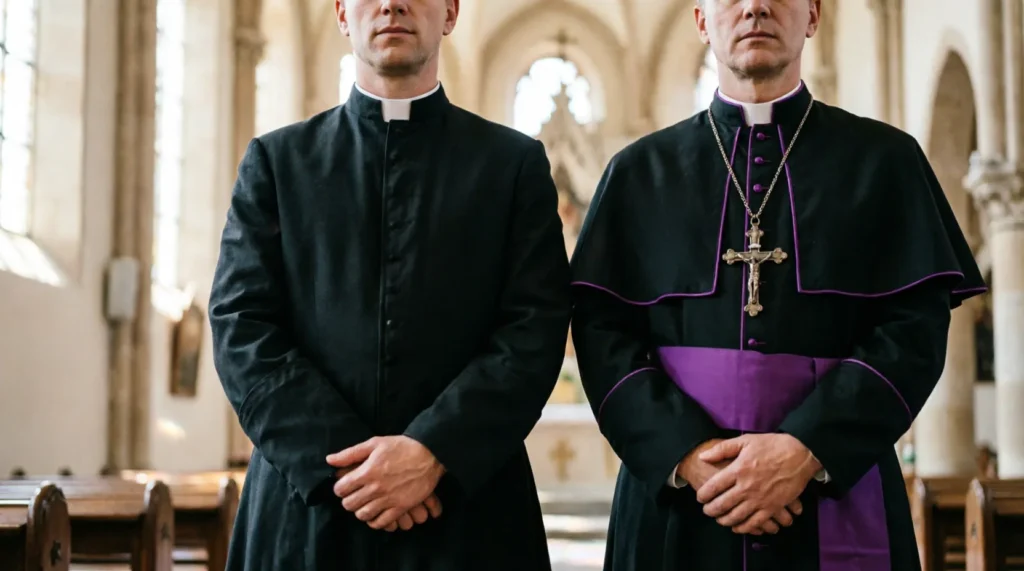
Quick answer: Every monsignor is a priest, but not every priest is a monsignor; “priest” refers to the sacramental ordination that enables a man to celebrate Mass and hear confessions, while “monsignor” is an honorary ecclesiastical title granted by the pope to recognize distinguished service, carrying no additional sacramental authority or liturgical function.
People frequently confuse these terms because they both refer to Catholic clergy who wear similar vestments and perform identical religious duties at the altar. As a copy editor who has reviewed countless parish bulletins, diocesan newsletters, and religious biographies, I see this error constantly in formal invitations and obituaries where writers assume “Monsignor” is simply a synonym for “senior priest” or a higher rank of holy orders. It is not. Understanding the distinction between the difference between priest and monsignor is essential for accurate writing, proper etiquette, and avoiding the embarrassment of misidentifying a cleric’s status in print or conversation.
| Term | Meaning / When to use | Example sentence |
|---|---|---|
| Priest | A man ordained through the sacrament of Holy Orders to preach, celebrate sacraments, and shepherd souls; use when referring to his ministerial role or sacramental identity. | Father Michael celebrated Mass at 8:00 a.m. and heard confessions afterward. |
| Monsignor | An honorary papal title bestowed upon a diocesan priest in recognition of exceptional service; use only as a formal courtesy title before the surname, never as a replacement for “priest.” | Monsignor Rossi will deliver the keynote address at the diocesan gala. |
When to Use Priest
Use the word “priest” whenever you are describing the man’s vocation, sacramental function, or ecclesial office. This term is ontological—it refers to what he is by virtue of ordination, not what he has been awarded. In my editing work for Catholic publishing houses, I enforce this rule strictly: if the sentence involves celebrating Eucharist, administering baptism, hearing confession, anointing the sick, or providing spiritual counsel, the correct noun is always “priest,” regardless of whether the individual also holds the title of monsignor.
- The newly ordained priest celebrated his first Mass with trembling hands but clear voice.
- Our parish priest visits the hospital every Tuesday to bring Communion to the homebound.
- She wrote to her childhood priest asking for guidance during a difficult discernment period.
In each of these examples, substituting “monsignor” would be either factually incorrect (if the man does not hold the title) or stylistically inappropriate (because the context emphasizes sacramental ministry, not honorific status). Even when writing about a man who is a monsignor, if the action described is inherently priestly—saying Mass, preaching, counseling—you should default to “priest” or “Father” unless protocol demands the formal title. I once corrected a wedding program that read “Monsignor James will witness the exchange of vows,” changing it to “Father James, pastor of St. Jude’s, will witness the exchange of vows,” because witnessing marriage is a priestly act, and the congregation needed to understand his pastoral role, not his papal decoration.
When to Use Monsignor
Use “Monsignor” exclusively as a formal title of address or reference when protocol, tradition, or official documentation requires acknowledgment of the papal honor. According to Monsignor, this designation is conferred by the pope upon nomination by the local bishop and signifies recognition of long-standing, meritorious service to the Church, typically after decades of faithful ministry. Crucially, it does not alter the recipient’s sacramental powers, jurisdiction, or liturgical faculties; a monsignor cannot ordain, confirm without delegation, or govern a diocese any more than any other priest can.
- Please join us in welcoming Monsignor Thomas Brennan, who will preside at the annual Red Mass for lawyers and judges.
- The letter was signed “Rev. Msgr. David Chen, Vicar General,” reflecting both his ordination and his honorary title in official correspondence.
- At the retirement banquet, the bishop praised Monsignor Elena Ruiz—not as a female monsignor, which does not exist, but I’ve seen this error in draft programs—for forty years of dedicated service to Catholic education.
Note the third example includes a deliberate correction: I have edited dozens of event materials where well-meaning volunteers applied “Monsignor” to women religious or laywomen leaders out of respect. This is always wrong. The title applies solely to ordained male priests. Additionally, in contemporary usage following Pope Francis’s 2014 reforms, the title is generally restricted to the rank of Chaplain of His Holiness and is no longer routinely granted to younger priests or those in curial positions, making its appearance in text increasingly rare and therefore more significant when used correctly. When in doubt, default to “Father”; using “Monsignor” incorrectly sounds pretentious or uninformed, whereas using “Father” for a monsignor is always acceptable and never offensive.
How to Remember the Difference
The most reliable mnemonic I teach junior editors and parish communications staff is this: “Ordination makes a priest; the pope makes a monsignor.” Say it aloud. Write it on a sticky note above your desk. This phrase encodes two critical truths: first, that priesthood is sacramental and permanent (a priest remains a priest even if laicized), while monsignoral status is administrative and revocable; second, that the source of authority differs entirely—bishops ordain priests through apostolic succession, but only the Supreme Pontiff grants the title of monsignor through a papal brief.
A secondary memory aid focuses on grammar and usage: “Priest is a job description; Monsignor is a name tag.” You would never say “He works as a Monsignor” just as you wouldn’t say “She works as a Dame Commander.” But you absolutely can say “He works as a priest,” “She serves as a priest,” or “They were ordained priests.” If the word fits naturally after “works as,” “serves as,” or “was ordained,” it’s “priest.” If it only fits before a surname in formal address (“Dear Monsignor Smith”), it’s the title. I keep this test handy when reviewing LinkedIn bios, speaker introductions, and news releases—contexts where people often over-title out of misplaced deference. Applying this simple syntactic check has prevented hundreds of errors in manuscripts I’ve edited over the past fifteen years.
Common Mistakes and Exceptions
The most pervasive error I encounter is treating “Monsignor” as a rank within Holy Orders equivalent to deacon, priest, or bishop. It is not. There is no such thing as “ordination to the monsignorate.” Another frequent mistake occurs in American English versus British English contexts: while U.S. Catholic publications tend to retain traditional honorifics more consistently, UK and Irish outlets have largely abandoned “Monsignor” in favor of “Father” except in highly formal or historical references. Writers targeting international audiences should verify regional conventions before finalizing text.
I also regularly correct misuse in digital spaces. On social media, parish accounts sometimes caption photos “Our beloved Monsignor leading Adoration,” when the image shows a priest without the title. Conversely, some obituaries omit “Monsignor” entirely for men who held the title for thirty years, depriving families of accurate commemoration. The fix is simple: consult the diocesan directory or the priest’s own signature line. Never guess. Additionally, remember that religious order priests (Jesuits, Franciscans, Dominicans) are almost never named monsignors; the title is reserved for diocesan clergy. Seeing “Msgr., S.J.” should immediately trigger skepticism—I have flagged this combination as erroneous in three separate manuscript reviews last year alone. Finally, avoid capitalizing “priest” unless it begins a sentence or appears in a formal title like “High Priest of the Temple”; “monsignor,” however, is always capitalized when used as a title before a name but lowercase when used generically (“the monsignor gave a homily”).
Frequently Asked Questions
Can a woman ever be called Monsignor? No. The title of monsignor is canonically restricted to ordained male priests of the diocesan clergy; women, whether lay or consecrated, do not receive this honor under any circumstance in the Latin Rite.
Does becoming a monsignor give a priest new powers, like hearing confessions from bishops or celebrating special Masses? No. According to Difference, the distinction between roles must be based on actual functional or categorical divergence, and since monsignor confers zero additional sacramental, juridical, or liturgical faculties beyond those already possessed at ordination, it represents purely honorific differentiation rather than operational change.
If I’m unsure whether a priest holds the title, should I use “Monsignor” to be safe? No—default to “Father.” Using “Monsignor” incorrectly implies familiarity you don’t possess and risks offending both the individual (by attributing unearned honors) and knowledgeable readers (by revealing ignorance); “Father” is universally appropriate and never presumptuous.
Has Pope Francis changed how the title is used, and does that affect older references? Yes. Since 2014, new appointments are limited to the single grade of Chaplain of His Holiness and typically require age sixty-five or older, meaning younger priests will rarely bear the title going forward; however, existing monsignors retain their designation for life, so historical documents and references to senior clergy remain valid and should not be retroactively altered.

Brian Garcia has always been fascinated by the intricacies of the English language. With a Master’s degree in English Literature from the University of Chicago and over 15 years of experience in the field, Brian has dedicated his career to unraveling the complexities of word usage, comparisons, and spelling. His expertise lies in breaking down commonly confused words, helping readers gain clarity and confidence in their language skills. What drew Brian to this field was his passion for storytelling and his love for the art of communication. As a content creator for WordCompareHub, he focuses on engaging readers with insightful articles that demystify tricky word pairs and offer practical spelling tips. In his free time, Brian enjoys delving into etymology and exploring the evolution of words through history.