

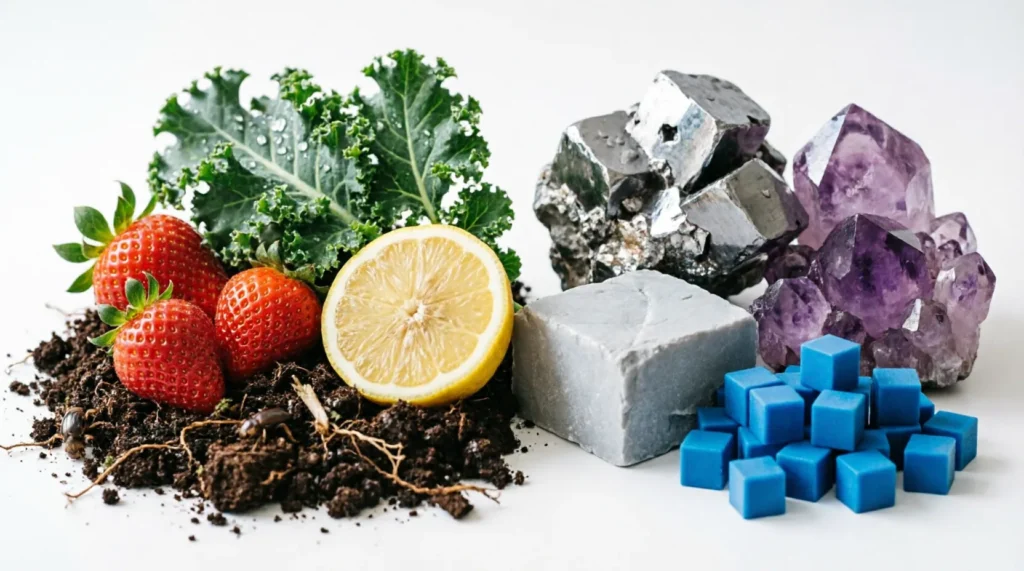
Quick answer: The difference between organic and inorganic is that organic compounds always contain carbon-hydrogen bonds and are typically associated with living systems, while inorganic compounds generally lack these bonds and include minerals, metals, and salts.
Writers frequently confuse these terms because they assume “organic” simply means natural or healthy, and “inorganic” means synthetic or artificial. This conflation leads to embarrassing errors in scientific writing, marketing copy, and academic papers where precision matters far more than colloquial associations. As a copy editor who has reviewed hundreds of technical manuscripts and product descriptions, I can confirm that using these words interchangeably is not just a stylistic choice; it is a factual error that undermines credibility.
| Term | Meaning / When to use | Example sentence |
|---|---|---|
| Organic | Use for compounds containing carbon-hydrogen bonds, or products certified by agricultural standards. | The lab analysis confirmed the presence of organic solvents in the water sample. |
| Inorganic | Use for compounds lacking carbon-hydrogen bonds, including minerals, metals, and most salts. | Calcium carbonate is an inorganic compound commonly found in limestone and antacids. |
When to use organic
Use organic when you are describing chemical compounds that contain at least one carbon-hydrogen (C-H) bond. In chemistry, this is the non-negotiable definition. It does not matter if the substance was created in a laboratory or harvested from a forest; if it has C-H bonds, it is organic. Methane (CH₄), glucose (C₆H₁₂O₆), and DNA are all organic because their molecular structures rely on carbon backbones bonded to hydrogen. According to Difference, the distinction fundamentally rests on this specific atomic arrangement rather than the source or method of production.
In agriculture and food marketing, organic refers to a regulated certification standard regarding farming practices, pesticide use, and processing methods. This usage is entirely separate from the chemical definition. A banana is chemically organic regardless of how it was grown, but it can only be labeled “organic” for retail sale if it meets specific government criteria. When editing food packaging or wellness content, I always verify whether the writer intends the chemical meaning or the regulatory meaning, as conflating them invites legal scrutiny and consumer mistrust.
Here are three realistic examples showing correct usage in professional contexts:
- Resume/CV bullet point: “Synthesized novel organic semiconductors that improved solar cell efficiency by 12%.” (Correct: Refers to carbon-based electronic materials.)
- Product description email: “Our face cream uses certified organic jojoba oil sourced from sustainable farms.” (Correct: Refers to agricultural certification.)
- Lab report conclusion: “The residue tested positive for organic contaminants, specifically benzene derivatives.” (Correct: Refers to carbon-hydrogen chemistry.)
A common mistake I see in cover letters and LinkedIn bios is the phrase “organic growth strategy.” While this is accepted business jargon meaning internal or natural expansion, it is metaphorical. If you are writing for a biotech firm or environmental agency, ensure your audience understands you are speaking figuratively. In strict scientific editing, I would flag this unless the context clearly establishes the metaphorical frame. Precision demands that we reserve the primary definition for chemistry and clearly signal when we are borrowing the term.
When to use inorganic
Use inorganic for compounds that do not contain carbon-hydrogen bonds. This category encompasses the vast majority of substances on Earth, including water (H₂O), table salt (NaCl), ammonia (NH₃), and all metallic elements. As detailed in the entry on Inorganic, this classification includes not only naturally occurring minerals but also synthetically produced industrial chemicals like sulfuric acid and silicon wafers. The absence of C-H bonds is the defining feature, not whether the substance is man-made or mined from the ground.
In broader non-scientific contexts, inorganic describes processes or structures that develop without biological intervention or conscious design. An “inorganic organizational structure” in management theory refers to one imposed top-down rather than evolving naturally from team dynamics. However, this usage is rare outside specialized academic or consulting literature. In general editing, I advise writers to avoid this sense unless they are certain their readership shares the same disciplinary vocabulary. Stick to the chemical definition for clarity.
Consider these corrected examples from real-world editing scenarios:
- Text message to colleague (incorrect): “This fertilizer is inorganic so it’s bad for the garden.” → Fix: “This fertilizer contains inorganic nitrogen salts, which release nutrients faster than composted options.” (The original confused chemical class with moral judgment; the fix specifies the actual compound type.)
- Grant proposal abstract: “We study inorganic catalysts for carbon capture.” (Correct: Catalysts are typically metal complexes or mineral surfaces without C-H bonds.)
- Nutrition blog draft (incorrect): “Bananas are inorganic because they’re grown in soil.” → Fix: “Bananas are organic compounds composed of carbohydrates, proteins, and lipids.” (Soil origin does not determine chemical classification.)
I frequently encounter the misconception that “inorganic” equals “toxic” or “unnatural.” This is false. Water is inorganic and essential for life. Oxygen gas is inorganic. Conversely, many organic compounds like cyanide and methanol are lethally toxic. When editing health or environmental content, I insist on replacing value-laden language with precise chemical terminology. Your readers deserve accurate information, not emotional shorthand disguised as science.
How to remember the difference
The most reliable mnemonic I teach junior editors is “CH = Organic.” If you can identify a carbon atom directly bonded to a hydrogen atom in the molecular formula or structure, the compound is organic. No C-H bond? It is inorganic. This rule works for 99% of cases encountered in professional writing. Memorize this visual pattern, and you will never second-guess yourself when reviewing technical documents.
For the agricultural sense, remember “Certified = Organic.” If the word appears on a food label or farm sign, it refers to regulatory compliance, not chemistry. Ask yourself: Is this document discussing molecular structure or farming practices? The answer determines which definition applies. This mental checkpoint prevents the catastrophic error of claiming that conventionally grown apples are “inorganic,” which is chemically absurd and professionally damaging.
Another editor-level insight: When in doubt during proofreading, search the document for the word “carbon.” If the surrounding text discusses carbon chains, hydrocarbons, or biomolecules, “organic” is likely correct. If the text discusses crystal lattices, ionic bonds, or elemental metals, “inorganic” is probably intended. Contextual keywords serve as reliable signals even when you lack deep chemistry expertise. Trust the textual evidence over your gut feeling.
Common mistakes and exceptions
The most pervasive error is treating “organic” as synonymous with “natural” and “inorganic” as synonymous with “synthetic.” I have rejected manuscript submissions where authors described petroleum-derived plastics as “inorganic” because they were manufactured, despite polyethylene being unequivocally organic due to its C-H bonds. Petroleum itself is organic. Manufacturing process is irrelevant to chemical classification. Always defer to molecular structure.
Carbon-containing compounds that lack hydrogen bonds are the critical exception. Carbon dioxide (CO₂), carbon monoxide (CO), carbonates (CO₃²⁻), and cyanides (CN⁻) contain carbon but are classified as inorganic because they have no C-H bonds. This trips up students and professionals alike. If you are editing environmental science or industrial chemistry content, verify every carbon compound individually. Do not assume carbon presence automatically confers organic status.
Regional spelling differences do not apply here—both American and British English use identical spellings for both terms. However, usage frequency varies by discipline. British pharmaceutical literature sometimes uses “organic” more broadly to describe any carbon-containing medicinal compound, even those borderline cases. American chemical nomenclature tends toward stricter adherence to the C-H rule. When editing international collaborations, clarify which convention the target journal or publisher follows before finalizing terminology.
Another frequent mistake occurs in nutrition and wellness writing, where authors claim that “inorganic minerals” in supplements are less bioavailable than “organic minerals.” This is misleading. Minerals are inherently inorganic by definition. What writers often mean is “minerals chelated to organic molecules” versus “free ionic minerals.” Chelation improves absorption, but calling the mineral itself “organic” is chemically incorrect. Precise phrasing would be “organically bound minerals” or “amino acid chelates.” Sloppy terminology here misleads consumers and exposes brands to regulatory action.
Frequently Asked Questions
Is water organic or inorganic? Water (H₂O) is inorganic because it contains no carbon atoms whatsoever, let alone carbon-hydrogen bonds. Despite being essential for all known organic life, water itself falls squarely in the inorganic category.
Can something be both organic and inorganic? No single compound can be both simultaneously under standard chemical nomenclature. However, complex materials like organometallic compounds contain both organic ligands and inorganic metal centers, requiring careful contextual description rather than dual classification.
Why are some carbon compounds considered inorganic? Compounds like CO₂ and calcium carbonate lack carbon-hydrogen bonds, which is the structural criterion for organic classification. Historical convention also plays a role; these simple carbon compounds were studied alongside minerals long before modern organic chemistry emerged as a distinct field.
Does “organic” on food labels mean the same thing as in chemistry? No. Food labeling “organic” refers to agricultural production standards regulated by government agencies, while chemical “organic” refers exclusively to molecular structure containing C-H bonds. A conventionally grown apple is still chemically organic; it simply lacks the regulatory certification.

Nathan Williams is a seasoned editor and writer with a passion for the subtleties of the English language. With a degree in English from NYU and more than 12 years of editorial experience, he has honed his expertise in spelling accuracy and the comparison of often-misused words. Nathan’s foray into language analysis was sparked by his desire to help others communicate more effectively and avoid common pitfalls in writing. At WordCompareHub, he crafts comprehensive guides and articles that discuss word usage distinctions and provide effective spelling strategies. Nathan is driven by the belief that clarity in language is key to effective communication. In his leisure time, he enjoys crosswords and participates in local word games, continually expanding his lexicon and sharpening his linguistic skills.