

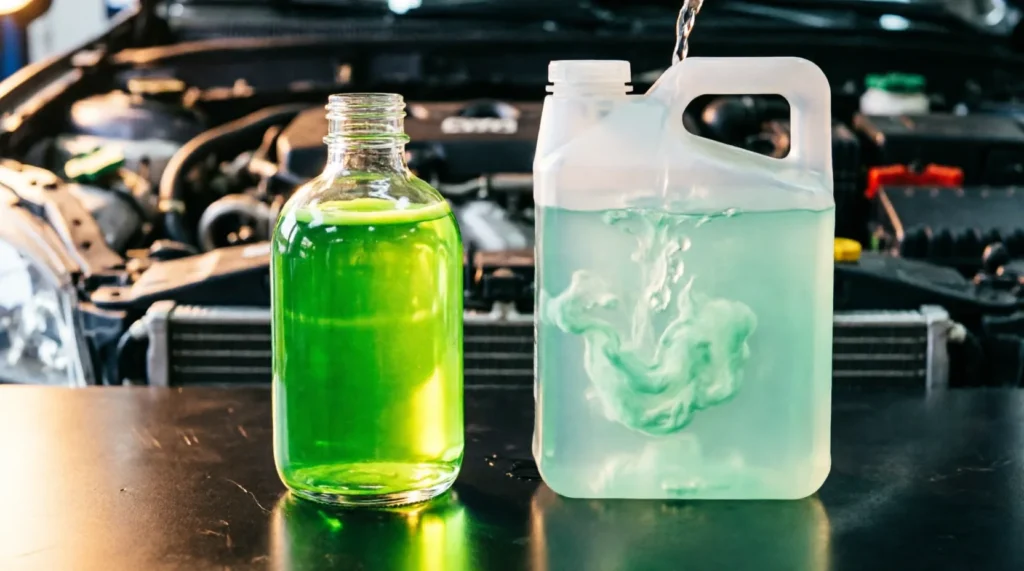
Quick answer: Antifreeze is the concentrated glycol-based fluid, while coolant is the mixture of antifreeze and water (typically 50/50) that actually goes into your radiator. Antifreeze is an ingredient; coolant is the final product.
If you’ve ever stood in the automotive aisle staring at jugs labeled “antifreeze” and “coolant,” wondering if you need one or both, you’re not alone. These terms are often used interchangeably, creating confusion for car owners trying to maintain their engines properly. Understanding the distinction isn’t just semantics—it’s critical for keeping your vehicle running smoothly in both freezing winters and scorching summers.
Antifreeze vs Coolant: At a Glance
| Term | Meaning / When to use | Example sentence |
|---|---|---|
| Antifreeze | The concentrated glycol-based chemical (usually ethylene glycol or propylene glycol) that you mix with water before adding to your cooling system. | “I bought a gallon of orange antifreeze concentrate to mix with distilled water.” |
| Coolant | The ready-to-use mixture of antifreeze and water (typically 50/50 ratio) that circulates through your engine to regulate temperature. | “My mechanic checked the coolant level and found it was low, so we topped it off with pre-mixed solution.” |
What Is Antifreeze?
Antifreeze is a concentrated chemical additive, typically made from ethylene glycol or propylene glycol, designed to lower the freezing point and raise the boiling point of water. According to Wikipedia’s Antifreeze article, antifreeze is “a chemical additive which lowers the freezing point of a water-based liquid” and is essential for engine protection in extreme temperatures.
You’ll find antifreeze sold as a full-strength concentrate that requires dilution before use. The pure concentrate contains corrosion inhibitors, lubricants for the water pump, and dyes (green, orange, pink, or blue) that help identify the type and detect leaks.
Real-World Examples
Example 1 – The Mistake: Email to a friend: “Hey, my car’s overheating. Should I just pour straight antifreeze into the radiator?”
The Fix: Never use undiluted antifreeze. Pure concentrate doesn’t transfer heat as efficiently as a proper mixture and can actually cause overheating. Always mix it with water first.
Example 2 – The Mistake: Auto shop invoice note: “Customer added antifreeze directly to reservoir without diluting.”
The Fix: The technician needs to drain and flush the system, then refill with properly mixed 50/50 coolant to restore optimal heat transfer properties.
Example 3 – The Mistake: Text message: “Running low on antifreeze. Can I just top off with water?”
The Fix: In an emergency, yes, add water to prevent overheating. But you must restore the proper antifreeze-to-water ratio as soon as possible, or risk freezing in winter or corrosion year-round.
What Is Coolant?
Coolant is the ready-to-use fluid that actually circulates through your engine’s cooling system. It’s the mixture—typically 50% antifreeze concentrate and 50% distilled water—that provides freeze protection, boil-over protection, and corrosion prevention.
When you buy “pre-mixed coolant” at the auto parts store, you’re getting a product that’s already been diluted to the proper ratio and is ready to pour directly into your radiator or coolant reservoir. This is what your engine actually uses during operation.
The coolant absorbs heat from the engine block, carries it to the radiator, where it’s dissipated into the air, then cycles back to repeat the process. This continuous loop keeps your engine operating at its optimal temperature range (typically 195-220°F or 90-105°C).
Real-World Examples
Example 1 – The Mistake: Maintenance log: “Added coolant to system. Used tap water to dilute concentrate.”
The Fix: Always use distilled or deionized water, never tap water. Tap water contains minerals that create deposits and accelerate corrosion inside your cooling system.
Example 2 – The Mistake: Cover letter for mechanic position: “Experienced in checking antifreeze levels and topping off when low.”
The Fix: While understandable, the technically accurate phrasing is “checking coolant levels.” You’re measuring the mixture in the system, not the concentrate itself.
Example 3 – The Mistake: Forum post: “My coolant is brown and rusty. I’ll just add more coolant to dilute it.”
The Fix: Discolored coolant indicates contamination or degraded inhibitors. You need a complete flush and refill, not just a top-off. Adding fresh coolant to old, contaminated fluid won’t solve the underlying problem. For more, see Difference.
When to Use Antifreeze
Use antifreeze concentrate when:
- You’re mixing your own coolant from scratch and want control over the ratio (useful in extreme climates where you might need 60/40 or 70/30 ratios)
- You’re performing a complete cooling system flush and refill, starting with an empty system
- You need to adjust the concentration of existing coolant (for example, testing reveals your mixture is only 30% antifreeze when it should be 50%)
- You’re topping off and know the exact current ratio in your system, allowing you to add concentrate and water separately to maintain the correct balance
Example sentences:
- “I bought antifreeze concentrate because I live in Minnesota and want to mix a 60/40 solution for extra freeze protection.”
- “After flushing the radiator, I mixed fresh antifreeze with distilled water before filling the system.”
- “The coolant tester showed my mixture was weak, so I drained some and added straight antifreeze to strengthen it.”
When to Use Coolant
Use pre-mixed coolant when:
- You’re topping off a low system and don’t know the current concentration ratio
- You want convenience and don’t want to measure and mix yourself
- You’re doing routine maintenance and simply need to maintain the existing level
- You’re not sure what type of antifreeze is currently in your system (pre-mixed coolant of the correct type is safer than guessing the ratio)
Example sentences:
- “I keep a jug of pre-mixed coolant in my garage for quick top-offs between oil changes.”
- “The dealership uses pre-mixed coolant for all their routine service appointments.”
- “After checking the reservoir, I added coolant to bring it back to the ‘full cold’ line.”
How to Remember the Difference
Here’s the memory trick I use with every new car owner I help: Antifreeze is the ingredient; coolant is the recipe.
Think of it like making orange juice from concentrate. The antifreeze is the frozen concentrate in the can. The coolant is the mixed drink in your glass. You can’t drink the concentrate straight—it’s too strong. You need to add water to make it usable.
Another way to remember: Coolant does the cooling. The fluid actually circulating through your engine, absorbing heat, and keeping temperatures stable is the coolant mixture. Antifreeze is just one component of that mixture.
Editor’s insight: I’ve corrected this confusion in hundreds of owner’s manuals and service guides. Here’s a pro tip: If the bottle says “concentrate” or requires mixing, it’s antifreeze. If it says “pre-mixed,” “ready-to-use,” or “50/50,” it’s coolant. When in doubt, check the label’s mixing instructions—or lack thereof.
Common Mistakes and Exceptions
Mistake #1: Using the Terms Interchangeably in Technical Contexts
While casual conversation might treat these words as synonyms, precision matters when you’re ordering parts, reading service manuals, or discussing issues with a mechanic. Saying “I need antifreeze” when you actually need “coolant” could result in buying the wrong product.
Mistake #2: Mixing Different Types
Not all antifreeze/coolant formulations are compatible. The old green ethylene glycol formula doesn’t mix well with newer orange (Dex-Cool), pink, or blue formulations. Mixing incompatible types can cause gel formation, clogging, and cooling system failure. Always check your owner’s manual for the specified type.
Mistake #3: Ignoring the Water Quality
Using tap water instead of distilled water introduces minerals (calcium, magnesium) that create scale deposits and accelerate corrosion. I’ve seen radiators clogged with white mineral buildup from years of tap water use. Always use distilled or deionized water.
Exception: Emergency Situations
If you’re stranded with an overheating engine and only have water available, add it. Running with plain water temporarily is better than destroying your engine from overheating. Just remember to flush and refill with proper coolant mixture as soon as you reach safety.
Exception: Extreme Climate Adjustments
In extremely cold climates (below -30°F/-34°C), you might need a 60/40 or even 70/30 antifreeze-to-water ratio for adequate freeze protection. Conversely, in very hot climates with minimal freeze risk, some manufacturers allow slightly lower antifreeze concentrations for maximum heat transfer. Always consult your owner’s manual before deviating from the standard 50/50 recommendation.
US vs. UK Terminology
While the technical distinction between antifreeze and coolant remains the same, British English speakers sometimes use “antifreeze” more broadly to refer to the mixture itself, whereas American technical literature maintains stricter separation between the concentrate and the mixture. However, modern automotive documentation in both regions increasingly uses “engine coolant” as the umbrella term.
Frequently Asked Questions
Can I use antifreeze without water? No. Pure antifreeze concentrate actually has poorer heat transfer properties than a proper mixture and can cause your engine to overheat. It also lacks the balanced corrosion protection that comes from proper dilution. Always mix with distilled water unless the product specifically states it’s pre-mixed.
Is it okay to mix different colors of coolant? Generally no. The color indicates the chemical formulation, and mixing incompatible types can cause gel formation, clogging, and cooling system damage. If you must mix in an emergency, use distilled water to top off, then schedule a complete flush and refill with the correct type as soon as possible.
How often should I replace my coolant? Most modern vehicles with extended-life coolant need replacement every 5 years or 150,000 miles, whichever comes first. Older green formulas typically require changing every 2-3 years or 30,000 miles. Check your owner’s manual for the specific interval for your vehicle, and test the coolant annually to check its condition.
What happens if I use the wrong type of coolant? Using the wrong formulation can cause corrosion, deposit formation, water pump seal failure, and in severe cases, complete cooling system blockage. The different chemical packages (inorganic additive technology vs. organic acid technology) aren’t compatible. Always use the type specified by your vehicle manufacturer.

Brian Garcia has always been fascinated by the intricacies of the English language. With a Master’s degree in English Literature from the University of Chicago and over 15 years of experience in the field, Brian has dedicated his career to unraveling the complexities of word usage, comparisons, and spelling. His expertise lies in breaking down commonly confused words, helping readers gain clarity and confidence in their language skills. What drew Brian to this field was his passion for storytelling and his love for the art of communication. As a content creator for WordCompareHub, he focuses on engaging readers with insightful articles that demystify tricky word pairs and offer practical spelling tips. In his free time, Brian enjoys delving into etymology and exploring the evolution of words through history.