

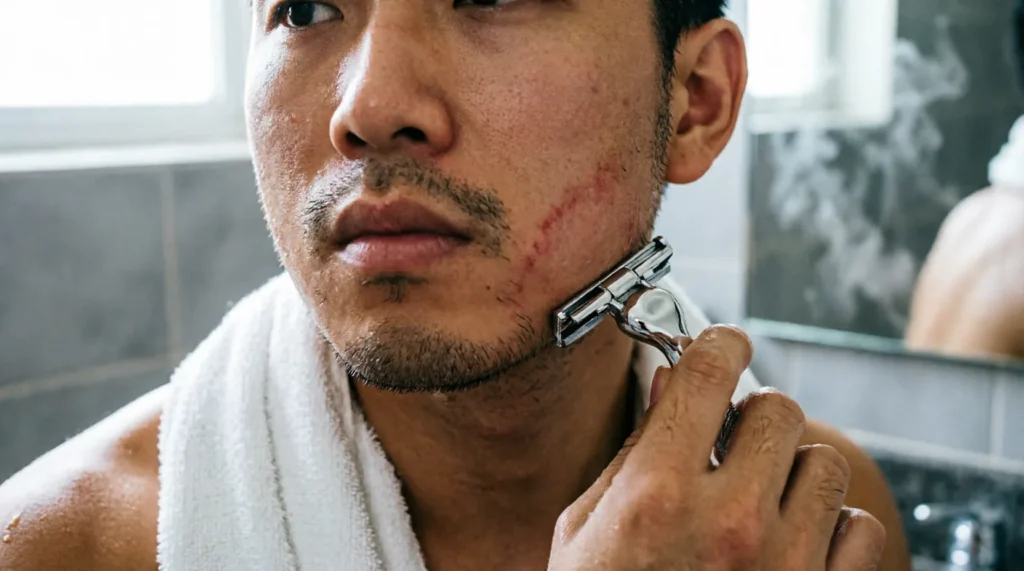
Quick answer: Shave with the grain (in the direction your hair grows) for less irritation and fewer ingrown hairs; shave against the grain (opposite the growth direction) only if you need an ultra-close shave and your skin can handle it. For most people, with-the-grain shaving is the safer, smarter choice.
If you’ve ever wondered why your skin burns after shaving or why you get those painful red bumps, the direction you shave matters more than your razor or cream. The debate between against or with the grain shaving isn’t just grooming folklore—it’s backed by dermatology and determines whether you walk away with baby-smooth skin or an irritated mess. Understanding your hair growth pattern and choosing the right shaving direction can eliminate razor burn, prevent ingrown hairs, and still give you the closeness you want.
With the Grain vs Against the Grain: The Breakdown
| Term | Meaning / When to use | Example sentence |
|---|---|---|
| With the grain | Shaving in the same direction your hair grows; use this for daily shaving, sensitive skin, or if you get razor burn | “I always shave with the grain on my neck because that’s where I get the worst irritation.” |
| Against the grain | Shaving opposite to your hair’s growth direction; use this only for special occasions when you need the closest possible shave and your skin tolerates it well | “He shaves against the grain before his wedding photos, but never does it during the work week.” |
When to Use With the Grain Shaving
Shaving with the grain means your razor moves in the same direction your facial hair grows. This is the gold standard for daily shaving and should be your default technique unless you have a specific reason to do otherwise.
According to Wikipedia’s entry on Shaving, proper shaving technique involves understanding hair growth patterns to minimize skin trauma. When you shave with the grain, the razor cuts the hair without tugging or pulling it below the skin surface, which dramatically reduces the risk of ingrown hairs and irritation.
Use with-the-grain shaving when:
- You have sensitive skin that turns red easily
- You shave daily or every other day
- You’re prone to razor bumps or ingrown hairs
- You’re shaving your neck (where hair grows in multiple directions)
- You want a quick, low-maintenance routine
Real-world examples:
Wrong: “I shaved against the grain on my neck this morning and now I can’t wear a collared shirt because it’s so red and bumpy.”
✓ Right: “I shaved with the grain on my neck and did a second pass across the grain on my cheeks—smooth enough for the office with zero irritation.”
✗ Wrong: “My resume says I’m ‘detail-oriented,’ but I can’t even figure out which way my facial hair grows to avoid razor burn every Monday morning.”
✓ Right: “I mapped my grain pattern last week: downward on the cheeks, sideways on the neck. Now I shave with the grain in each zone and my skin actually looks professional.”
Wrong (text to a friend): “Dude, my face is on fire. Tried that against-the-grain hack from YouTube and now I look like I have chicken skin.”
✓ Right (text to a friend): “Finally figured out my neck hair grows horizontally, not down. Shaving with that grain instead of against it = game over for razor bumps.”
When to Use Against the Grain Shaving
Shaving against the grain means moving your razor opposite to the direction your hair grows. This technique cuts the hair closer to (or slightly below) the skin surface, giving you that baby-bottom-smooth feel—but it comes with significant risks.
The concept of “against” in this context literally means opposing the natural direction, and your skin pays the price for that opposition. When you shave against the grain, the razor can push hair back into the follicle or cut it below skin level, creating the perfect conditions for ingrown hairs, razor burn, and bacterial infection.
Reserve against-the-grain shaving for:
- Special occasions when you need maximum smoothness (weddings, dates, important presentations)
- Areas of your face that don’t get irritated easily (often the cheeks, never the neck)
- When you’ve already done a with-the-grain pass and your skin is well-lubricated
- Only if you’ve confirmed your skin can tolerate it without breaking out
Real-world scenarios:
✗ Wrong: “I always shave against the grain every morning because that’s what my dad taught me, even though my neck is constantly red.”
✓ Right: “I do one pass with the grain every morning, then on Friday before date night, I’ll do a careful second pass against the grain on my cheeks only.”
Wrong (cover letter): “I’m a ‘go-getter’ who shaves against the grain and pushes boundaries!” (Please don’t actually write this, but you get the idea—against the grain isn’t always admirable in real life either.)
✓ Right (actual grooming routine): “Monday through Thursday: with the grain only. Friday morning: with the grain, then across, then carefully against on the cheeks if there’s no irritation.”
How to Determine Your Grain Direction
Before you can decide between against or with the grain shaving, you need to know which way your hair actually grows. Here’s the thing: it’s not the same everywhere on your face, and assuming it is is the fastest route to razor burn.
The three-day test:
Don’t shave for three days. On day four, run your fingers across different areas of your face. The direction that feels smoothest (least prickly) is with the grain. The direction that feels roughest is against the grain.
Map your zones:
- Cheeks: Usually grow downward (with the grain = top to bottom)
- Neck: This is where most guys mess up. Neck hair often grows sideways, upward, or in swirling patterns—not downward like cheek hair
- Jawline: Can be diagonal or horizontal
- Under the chin: Often grows in multiple directions
Pro tip from years of editing grooming content: Take a photo of your three-day stubble in good light. The hair direction is much easier to see in a photo than in the mirror when you’re rushing through your morning routine.
Common Mistakes and Exceptions
Even when you know the rules, certain mistakes creep into shaving routines. Here are the most common errors I see, plus the exceptions that actually matter.
Mistake #1: Assuming your whole face grows hair the same direction
Your neck is not your cheeks. Treating them identically guarantees irritation. Always map each zone separately.
Mistake #2: Going against the grain on dry or poorly prepped skin
If you’re going to shave against the grain, you need:
- A hot shower first (or hot towel for 2-3 minutes)
- Quality shaving cream or gel (not foam from a can)
- A sharp, clean blade
- Multiple passes, not one aggressive swipe
Mistake #3: Using the same technique for coarse vs. fine hair
Coarse, curly hair is far more prone to ingrown hairs when shaved against the grain. If you have thick, curly facial hair, stick with the grain religiously or consider an electric trimmer instead.
Mistake #4: Shaving against the grain daily
This isn’t sustainable for 99% of men. Your skin needs recovery time. Daily against-the-grain shaving will eventually cause chronic irritation, hyperpigmentation, or folliculitis.
The exception: Professional wet shavers
Some men who’ve spent years perfecting their technique, using premium products, and maintaining their skin can shave against the grain regularly without issues. But they’re the exception, not the rule. Don’t compare your five-minute morning rush to someone’s 20-minute ritual with pre-shave oil, badger brush, and post-shave alum block.
US vs. UK terminology note:
The concept is identical, but you might see “grain” referred to as “hair growth pattern” more frequently in UK grooming guides. The technique remains the same regardless of which English variant you’re reading.
Frequently Asked Questions
Can I train my skin to handle against-the-grain shaving?
Not really. While your skin can become somewhat more tolerant with proper prep and technique, the fundamental risk of cutting hair below skin level doesn’t go away. You can minimize irritation, but you can’t eliminate the biological reality that against-the-grain shaving causes more trauma.
What if I need a super-close shave for my wedding but have sensitive skin?
Do a test run two weeks before the event. Shave with the grain first, then carefully against on small sections. If you get irritation, stick with with-the-grain plus an across-the-grain pass. On the wedding day, don’t try anything new. A 95% close shave with zero redness photographs better than a 100% close shave with visible irritation.
Does electric shaving follow the same with/against grain rules?
Yes, but less critically. Electric razors don’t cut as close as blades, so they’re less likely to cause ingrown hairs even when going against the grain. However, you’ll still get less irritation going with the grain, especially with rotary shavers.
Is “with the grain” shaving good enough for professional settings?
Absolutely. A proper with-the-grain shave using a sharp blade and good technique leaves you clean-shaven and professional-looking. The difference between with and against the grain is measured in micrometers—your boss and clients won’t notice, but they will notice if your neck is red and bumpy.

Brian Garcia has always been fascinated by the intricacies of the English language. With a Master’s degree in English Literature from the University of Chicago and over 15 years of experience in the field, Brian has dedicated his career to unraveling the complexities of word usage, comparisons, and spelling. His expertise lies in breaking down commonly confused words, helping readers gain clarity and confidence in their language skills. What drew Brian to this field was his passion for storytelling and his love for the art of communication. As a content creator for WordCompareHub, he focuses on engaging readers with insightful articles that demystify tricky word pairs and offer practical spelling tips. In his free time, Brian enjoys delving into etymology and exploring the evolution of words through history.